An official website of the United States government. Here's how you know.


 Countdown to





This World War I Battlefield Tour includes Google Maps links at each stop. Travel along virtually or map the full route and take a drive along this historic battlefield route in France.
America’s first divisional attack of WWI
In spring 1918, the German Army began a series of Western Front offensives. Russia leaving the war freed many German troops for service in the west. The Germans employed new tactics, specially trained assault troops and artillery breached Allied defenses for additional troops to follow through. Their intent was to force Allied negotiation before American forces joined the war. Under the stress, the Allies urgently asked for American troops in training to be committed to battle.
The American infantry division was a combined-arms force of almost 19,000 soldiers. There were nearly 11,000 infantry in two brigades, and over 4,500 artillerymen. Divisional staff and engineers, along with signal, transport, supply, and medical troops made up the rest of the division. By comparison German and Allied divisions had half the number of men, but a proportionally larger amount of artillery.
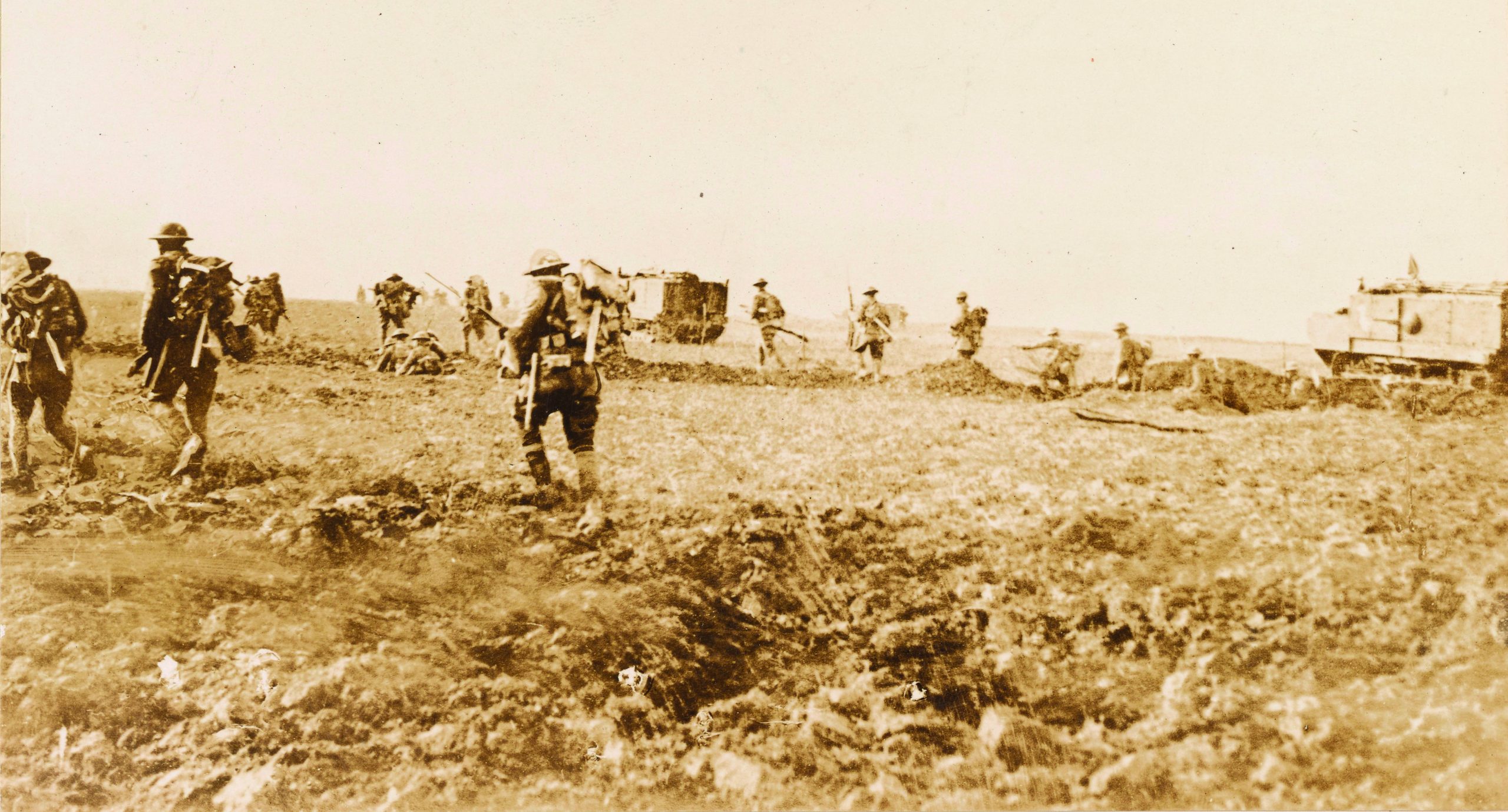
The first American divisional attack of the war took place at Cantigny, a village 5 km northwest of Montdidier in the Somme region. It had fallen to the German Eighteenth Army during the first spring offensive in March.
The 1st Division, including campaign-tested regiments from the Mexican border operations, had been the earliest American combat troops in France in May 1917. Their training included individual regiments fighting separately in French or British divisions. Nearly a year after their arrival, the 1st was sent to the front line opposite the heavily fortified village of Cantigny.
The Germans spent most of May 1918 bombarding the division with high–explosive artillery and gas. After enduring this prolonged shelling, the 1st was ordered to take Cantigny. The town was captured on the first day of the assault, May 28, with the division’s 28th Infantry Regiment in the lead. After taking over 200 prisoners, the Americans withstood a series of strong counterattacks over the next two days.
The 1st suffered 1,603 casualties, including 199 killed, taking Cantigny. Although a local operation, it boosted Allied morale to see the American Expeditionary Forces taking the offensive. With this small victory, and the deployment of the 2nd and 3rd Divisions to defend Chateau-Thierry, the German high command realized that the long feared American infusion of manpower was now a reality.
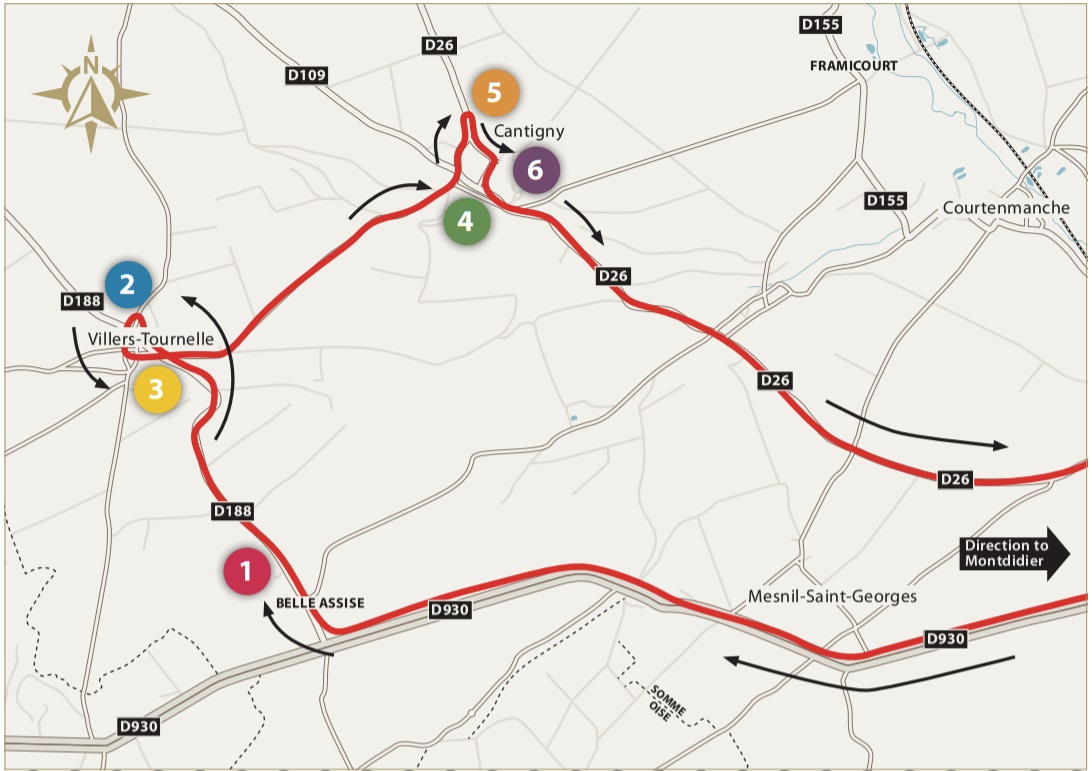
Stop 1 – Observation & Orientation
Just over 2.4 km to the northeast is the town of Cantigny. From this knoll you can see how Cantigny has a commanding view of the surrounding countryside, and how it hides the valley behind it from view. The many small forests were used to conceal movement of troops from observers on the ground and in the air. Just over 1.5 km away is Villers-Tournelle, an important American forward post in this area.
Stop 2 – The Villers-Tournelle Cemetery
Look east from here. Again you see Cantigny on the hill across the valley 2 km away. The little wood to your left was called the Bois Texas on American maps. From where you are standing a trench line ran to your right across the east side of the town. The two frontline trenches ran about a 1.5 km east of here. Casualties could only be brought out of the front-line aide stations to Villers- Tournelle in darkness.
To the east you can see the southern end of a broken line of woods that run north. Further to your right you can see roofs of farm buildings directly east. The line of advance toward Cantigny ran from the far side of those woods to a point east of the farm buildings.
Stop 3 – Villers-Tournelle
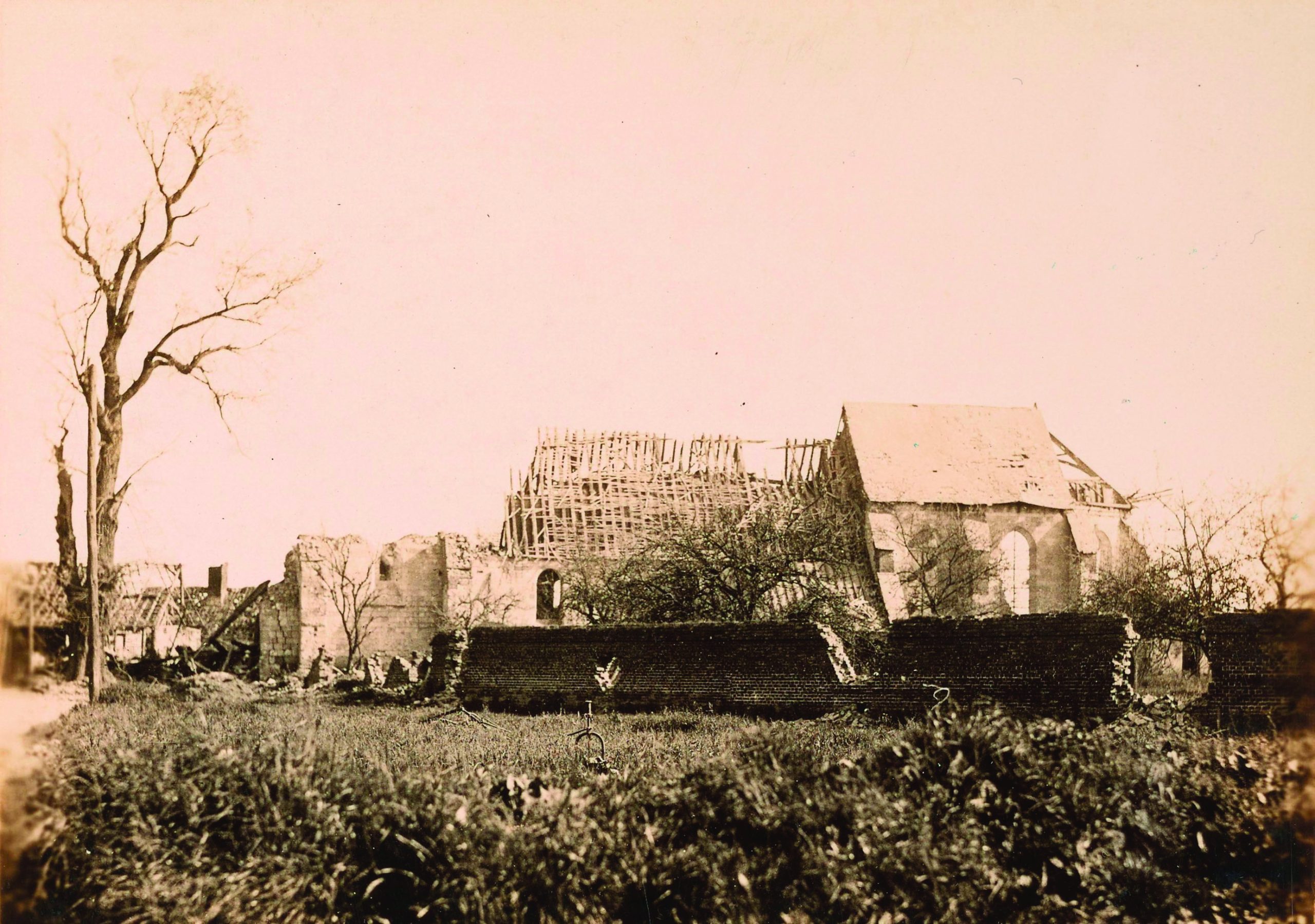
This town, which was heavily damaged in the war, was under frequent artillery fire, including poison gas, and air attacks. After the war, the church was rebuilt and the masonry of the tower in the field across the street still shows scars of battle. A regimental medical station with two Ford ambulances was concealed here, and aide stations were further forward in the trenches. Ambulance drivers sometimes braved the artillery fire, speeding west on roads to bring out the desperately wounded.
From Villers-Tournelle the American and French staff could communicate by telephone to Rocquencourt 1.5 km to the west. There, the massed artillery of the 1st Division and that of the French X Corps, over 200 guns, waited to support the attack.
Stop 4 – Cantigny American Monument
The America Battle Monuments Commission Cantigny American Monument commemorates the attack on Cantigny, on May 28, 1918, by the 1st Division, led by the 28th Infantry Regiment. The attack rolled quickly through the town to the eastern field where the 1st Engineers improved the defenses. Many German defenders were captured.
There are two other monuments in the park in Cantigny. One is to the 28th Infantry Regiment, the other is to the 1st Battalion, 5th Artillery Regiment that supported the attack.
The road between Villers-Tournelle and Cantigny was on the south side of the attack. The leading companies of the 28th moved forward in the dark to occupy the woods and trenches 600 yards in front of Cantigny. An hour later a rolling barrage began and the reinforced 28th went forward with French tanks and flamethrower teams. The center battalions moved swiftly through the town while the flanking battalions pushed around its edges, seizing German trenches and taking many prisoners. Support troops installed telephone wire to American and French observation posts taking advantage of the new position. Engineers followed the assault troops to improve defenses east of the town, ambulances now came forward to the western slope of Cantigny to evacuate casualties unobserved by the enemy.
Stop 5 – Cantigny Cemetery
From in front of the cemetery you can look west beyond the water tower to see the woods where the north flank of the American attack started on May 28. After the attack the American position straddled the road about 300 yards north of here. From there it ran 400 yards into the fields east of Cantigny. There the 1st Engineers and the 28th Regiment reworked German trenches to ward off seven strong counterattacks in the following days. The cemetery was made into a defensive strongpoint.
The Germans attacked the American position from those woods, the Bois de Framicourt, multiple times on the evening of May 28. The final German attack was from the Laval Wood northeast across the fields at 5:30 a.m. on May 30. American infantry stopped the attack with artillery support. Beyond the Framicourt and Laval woods the ground falls away to the valley of the Rivier des Trois Doms.
Stop 6 – 1st Division Cantigny Monument
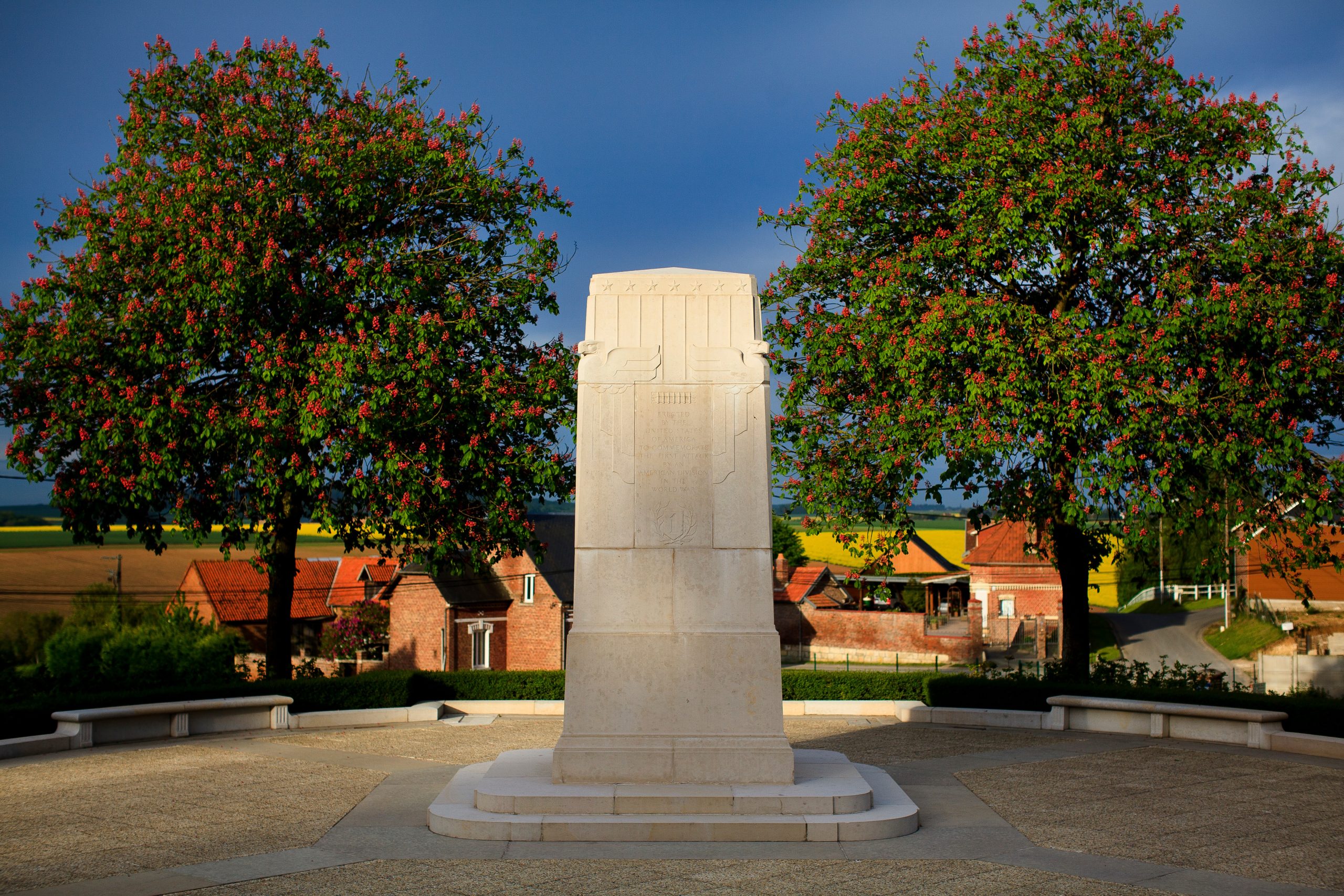
The 1st Division Cantigny Monument is a square pillar with an eagle perched atop. The eagle’s drooped wings shield an artillery shell bearing the 1st Division insignia inside a laurel wreath. The sides of the pillar bear bronze panels with the names of 1,138 members of the 1st Division lost during their 73 days in the front line.
Map this route: https://maps.app.goo.gl/VdxrYAv1WZeS14ky8
Download a PDF of ABMC’s full World War I Battlefield Companion.