


WWI Battlefield Tours: Meuse-Argonne Offensive, Part I
This World War I Battlefield Tour includes Google Maps links at each stop. Click the headings to travel along virtually or map the full route and take a drive along this historic battlefield route in France.
H-Hour to Montfaucon
The Meuse-Argonne Offensive was the greatest American battle to date in numbers of combatants and casualties. The First and Second Armies of the American Expeditionary Forces, with a force of 1.2 million men, suffered more than 120,000 casualties in sustained fighting from Sept. 26, 1918, up until the Armistice on Nov. 11, 1918. The greatest share of the fighting fell to the First Army, advancing between the Meuse River and the Argonne Forest.
The Supreme Allied Commander, French Marshal Ferdinand Foch, convened a conference of Allied commanders in late July. Foch foresaw that an orderly withdrawal of German forces in the face of increasing Allied strength could help Germany prolong the war.
The German High Command, recognizing the same reality, were also faced with a dilemma. A slow withdrawal would increase their combat losses, while a swift withdrawal would mean the loss of irreplaceable supplies near the front. The Germans chose the swift withdrawal option, in early September at St. Mihiel, prompting the comment from Foch, “The man could still escape if he did not mind leaving his luggage behind him.”
Based on the information available, the Allied command chose the area of the front between the Meuse River and the Argonne Forest for the American Expeditionary Forces’ great offensive because it was the sector Germany could least afford to lose. The Germans were heavily dependent on two rail lines with junctions in the vicinity of Sedan, 56 kilometers behind the frontline. Losing either of these rail junctions would greatly complicate withdrawal or resupply of German forces in Belgium and Northern France. Foch intended to drive toward both. This would break direct communication between German forces east and west of the Meuse River and make it difficult to shift reserves and supplies to meet Allied attacks. The Meuse-Argonne Offensive was intended to drive through the Hindenburg Line defenses toward Sedan, cross the Meuse there, and capture the rail junctions. To blunt the German reaction to the offensive the French and British would commit to simultaneous attacks elsewhere on the Western Front to draw off or delay the arrival of German reserves to counter the American attack.
The success of the American Expeditionary Forces in the earlier St. Mihiel Offensive convinced Foch to employ the American Expeditionary Forces in the Meuse- Argonne Offensive. In advance of the American attack in the Meuse-Argonne, 220,000 French soldiers holding the front would have to be replaced by around 600,000 Americans brought in for the attack. This entire movement would have to be concealed from the Germans.
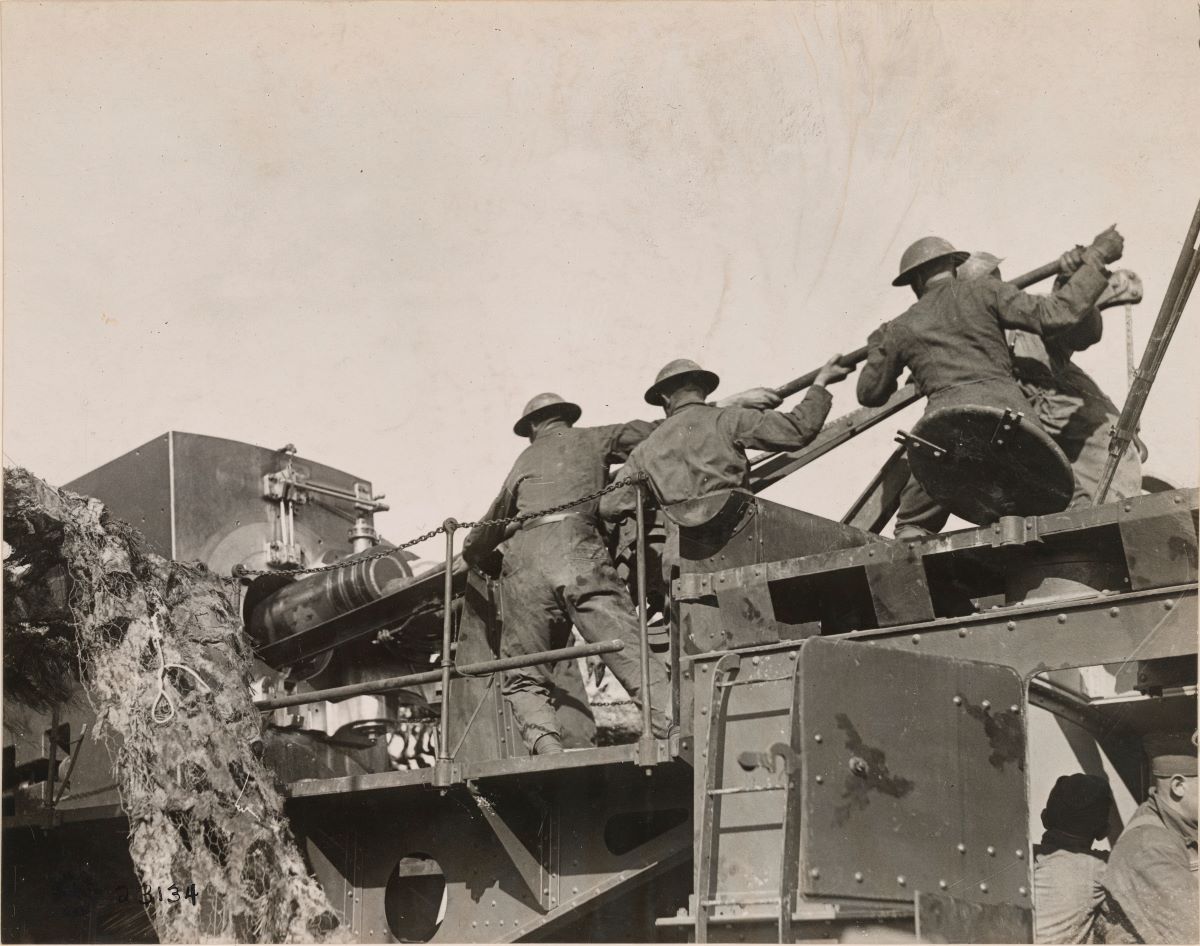
Coast Artillery Corps soldiers were deployed to France to man railway guns.
The task of planning this redeployment fell to Col. George C. Marshall. The movement began while the U.S. First Army was still reducing the St. Mihiel Salient 80 kilometers to the east. The troop movement was concealed at night, using three roads, over a two-week period. Marshall demonstrated the military genius that served the Americans so well in World War II. Artillery moved first, then six reserve divisions followed by the nine assault divisions. American troops and materiel were moved into position for attack on Sept. 25-26, 1918. French and American motorized and horse drawn transport units were key to success. On most of the front, French soldiers remained in the outpost positions until the very last moment, to keep the enemy from learning of the large American concentration.
The U.S. Army I Corps would advance through the Argonne Forest and the Aire River Valley; the V Corps would attack through the east side of the Aire Valley and the adjacent high ground, including Montfaucon; finally, the III Corps would drive over the ridges and bottom land adjacent to the Meuse River. The massed French and American artillery amounted to almost 4,000 pieces, from 3-inch “French 75s” to 14-inch railroad guns, which provided one gun for every 8 meters of the frontline.
The Argonne Forest covers steep hills that provided observation and cover for infantry positions and artillery. Its wooded ridgelines stretch east into the valley of the Aire River, which runs north toward Sedan. It is interrupted by the valley around Grandpré. Tributaries to the Aire cut a number of long ravines into the valley’s eastern slopes, rising to a rolling plateau of farmland. Toward the Meuse River, it is increasingly interrupted by wooded high ground. The nature of the Meuse-Argonne terrain made it ideal for defense.
To protect this vitally important area, the enemy had established almost continuous defensive positions for a depth of up to 20 kilometers behind the front lines. Vauquois Hill and Montfaucon were dominating heights that were well defended and important for distant observation. Behind the southern German front line were three stronger defense lines. Every village and nearly every forest was lined with prepared positions. German artillery observers in the Heights of the Meuse and the Argonne Forest could direct frequent artillery bombardments and harassing fire on the American advance. Most roads were poor and the broken ground was not well suited to the 190 light Renault tanks in use by the Americans.
Following a three-hour bombardment, where the Army fired more ammunition than was fired during the entire U.S. Civil War, the First Army jumped off at 5:30 a.m. on Sept. 26. On the left, I Corps penetrated the Argonne Forest and advanced along the valley of the Aire River. In the center, V Corps attacked at Montfaucon. It was held up temporarily in front of the hill. On the right, III Corps moved north past the east side of Montfaucon. The crest was in American hands by noon of the second day, as the advance continued north in the other corps areas. Though complete surprise was achieved, the enemy was stubbornly contesting every foot of terrain. Profiting from the temporary holdup in front of Montfaucon, the Germans brought forward reinforcements. By Sept. 30, the U.S. First Army had driven the enemy back 10 kilometers in some places. The advance bogged down due to inexperienced units and commanders, poor logistics and roads, as well as lack of coordination between artillery and infantry.
The opening days of the Meuse-Argonne Offensive had succeeded. Key terrain was taken in a surprise attack. The American Expeditionary Forces were not as effective in the middle phase of the campaign. The month of October would prove to be the worst of times for Gen. John J. Pershing’s troops. This was especially true for the period Oct. 8–18, when the First Army was attacking the highly defensible heights of the central Argonne. On the right flank of the sector the 33rd and 29th Divisions, operating under the French XVII Corps, made a forced crossing of the Meuse River on bridges constructed by the 108th Engineers. Attacking the heights of the Meuse north of Verdun reduced German observation of the offensive west of the river.
The Americans suffered high casualties during the opening days of the offensive. By Oct. 8, fighting had become severe for the First Army across a 37-kilometer front. Across the front, thousands of American soldiers fought resolutely against the unbroken German Army. Daily, multiple American soldiers performed courageous acts.
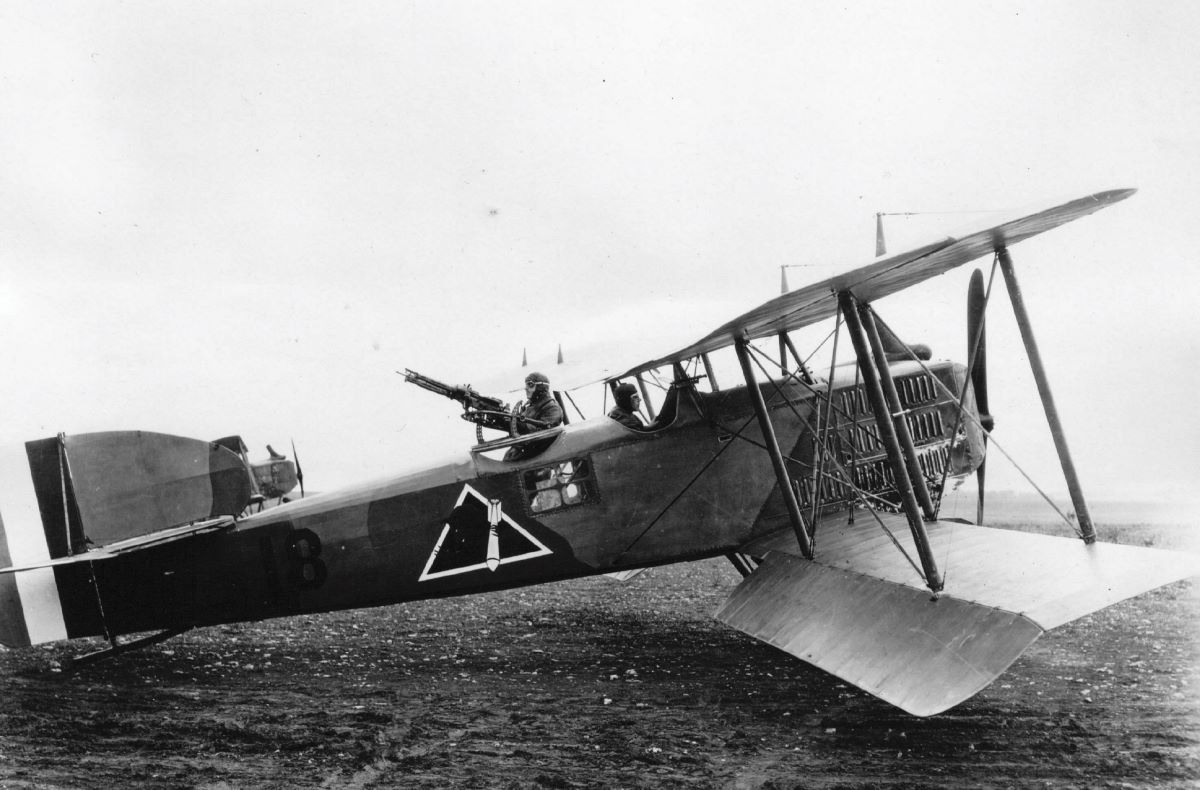
A French-built Breguet bomber of the American 96th Aero Squadron as used in the Meuse-Argonne Offensive.
The Army Air Service made important contributions to the operations of American Expeditionary Forces ground forces in the Meuse-Argonne Offensive. The First Army had to learn how to operate as a combined force while continuing the attack. This made German ground forces fearful of any Allied aircraft appearing; plus, the sight of aircraft attacking the enemy encouraged American soldiers. Pursuit aircraft in large numbers aggressively attacked enemy artillery observation balloons on both sides of the Meuse River. This restricted German ability to fully use their artillery to attack the full depth of Americans on the frontlines or the supply routes. The American Pursuit Groups made daily low altitude sweeps with all available squadrons. Their sheer numbers overwhelmed enemy anti-aircraft fire and German aircraft flying in defense of their balloons.
Pershing brought in experienced divisions and more combat engineers. He relieved officers who were not performing, and focused attention on traffic control for the limited roads bringing supplies and reinforcement and evacuating casualties. He appointed his best senior general, Hunter Liggett, to command the First Army.
The final phase of the Meuse-Argonne Offensive began at daybreak on Nov. 1. It was one of the most important and successful American operations of the war. A two-hour artillery preparation began with more American artillery than ever had previously assembled. Mobility and supply organization was improved to support a rapid advance. The lessons of the earlier battles had been absorbed and previous errors corrected. The attack exceeded all expectations.
By early afternoon of Nov. 1, the last formidable Hindenburg Line position on Barricourt Heights had been captured, ensuring success of the whole operation. That night the German Army issued orders to withdraw across the Meuse River. Their retreat became a rout. American Expeditionary Forces units racing north overtook broken German units. By Nov. 4, after an additional Meuse crossing by the First Army, the enemy was in full retreat on both sides of the river. Three days later, the First Army was on the heights above Sedan, dominating the critical railroad supply junctions. The German High Command could no longer sustain the Western Front.
The American Expeditionary Forces’ attention shifted to another strategic objective, the city of Metz east of Verdun. The First Army began shifting its axis of operations in that direction. The Second Army was renewing action on the St. Mihiel sector northeast of Pont-a- Mousson. The Armistice halted further offensive operations.
The final phase of the Meuse-Argonne Offensive was the most influential operation for the American military. It convinced future American military leaders that taking objectives with minimal casualties required overwhelming firepower, while employing high mobility to maintain momentum. The legacy continued beyond World War II. It became an essential part of the American way of war. Historian John Eisenhower wrote that his father, “thought Operation Overlord undoable without the experience the Army gained in the Argonne.”
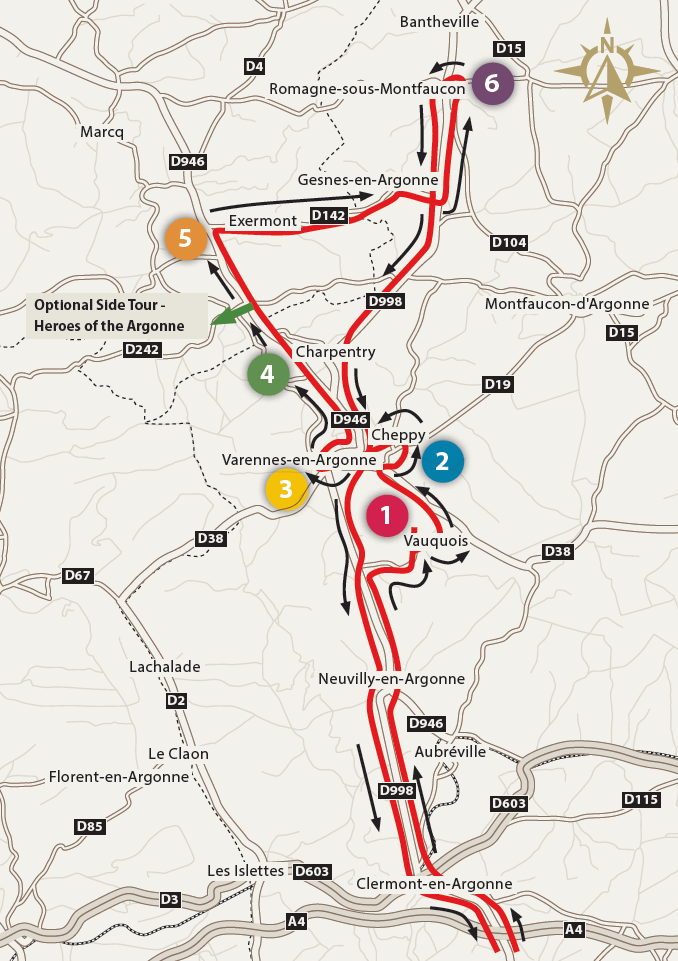
Stop 1 – Vauquois Hill
From the observation terrace by the large monument on Vauquois Hill, you can see that this was a commanding height with a sweeping view. The slopes were bare of trees by war’s end. In 1918, the German line was on the north side of the main line of craters. The craters are from subterranean mining by the French and Germans between 1914 and 1918 that completely destroyed the town that once sat atop the hill. World War I trenches are preserved here, and beneath the surface are the remains of mining galleries that can be toured with guides.
The 35th Division captured Vauquois Hill on the first day of the offensive, Sept. 26, 1918. The 35th was a Kansas and Missouri National Guard division. To hide the presence of the 35th Division, the French remained in the front line until hours before the attack. Artillery struck the German defenses for three hours before the 5:30 a.m. assault and laid smoke and poison gas on the hill. The main attack went around both sides of the hill in thick fog, preceded by a rolling barrage from artillery and machine guns. The 35th sent a brigade forward reinforced with engineers, machine guns, and light artillery. The first elements bypassed the hill to the left and headed for the second line of defense. Two following battalions split to mop up the hill from the flanks.
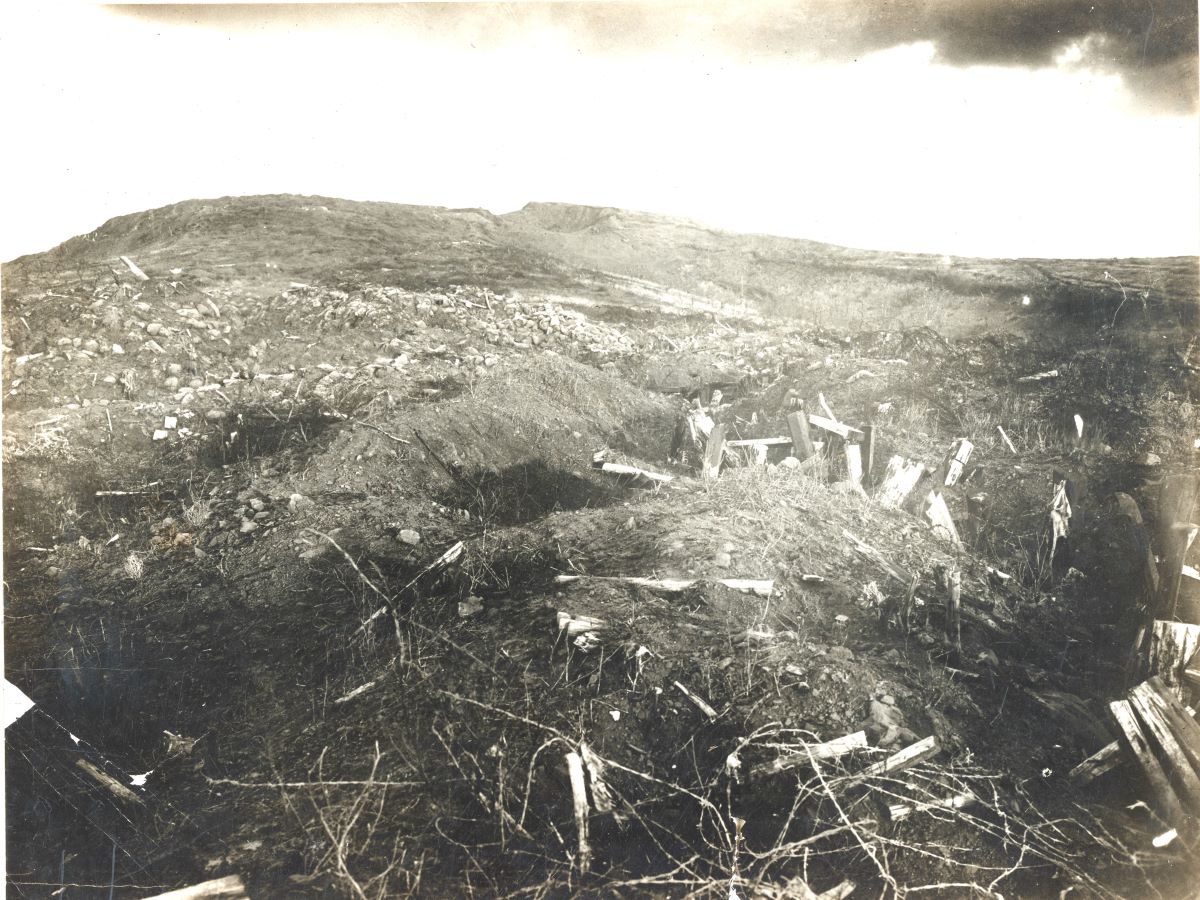
German defenses in the Argonne Forest, a mass of shell holes and craters filled with barbed wire on Vauquois Hill, 1919.
The crushing bombardment had torn apart much of the frontline defenses. Enemy batteries were bombarded with high explosives and poison gas. Divisional artillery laid rolling barrages to protect the attack waves, which were also concealed by the thick fog. The lead units of the 35th continued north, overrunning trenches almost 1 kilometer behind the front. They stopped to reorganize 1.5 kilometers further on near the villages of Cheppy and Varennes.
Stop 2 – Cheppy and the Missouri Memorial
Designed by Nancy Coonsman Hahn to honor all the Missourians who died in France during World War I, it was the first overseas American monument designed by a woman. From the platform, you can get a good sense of fighting here. Cheppy was part of the forward positions of the Hindenburg Line.
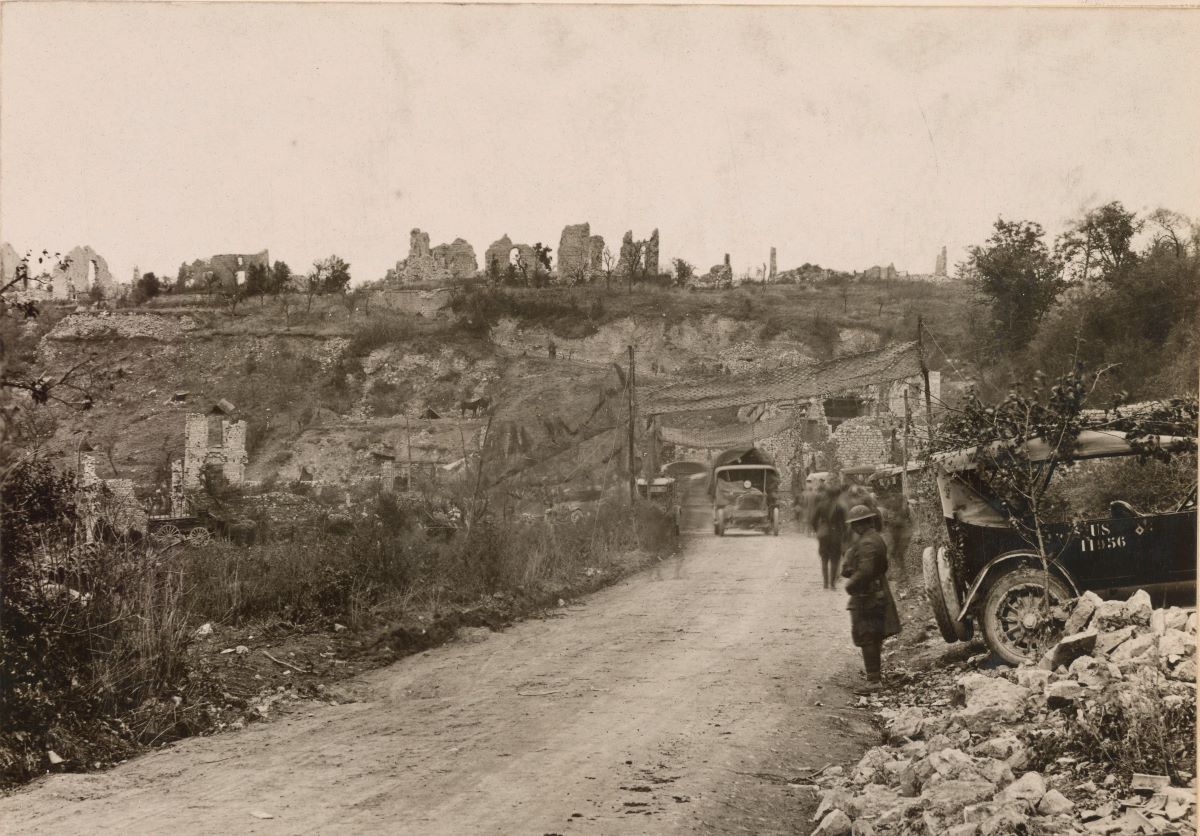
The ruins of Cheppy after the battle.
Around 9 a.m. the fog began to lift. Soldiers reported an increase in German machine gun fire from the front and from bypassed pockets of resistance. The rolling barrage had stopped on the flat behind the monument an hour earlier just as the 35th Division arrived. Across the valley to the north was the village of Cheppy, an outpost of the Hindenburg Line with concrete pill boxes. From a strongpoint just past the bridge, a trench ran west up to the high ground across the road. The high ground to the right held another. Despite earlier bombardment by 155 mm howitzers of the 130th Field Artillery and the French 317th Colonial Heavy Artillery, the defenses were coming back to life.
Under machine gun fire, the 35th reorganized for an assault. The light tanks of the American 304th Tank Brigade caught up with the infantry at this point. These were small, two-man, French Renault tanks armed with a machine gun or small cannon. The brigade commander of the 304th, Lt. Col. George S. Patton, arrived and directed the tanks on foot. He was soon wounded. Multiple other officers and men were killed and wounded leading others through the wire and trenches into the town, which fell by 12:30 p.m. To the east and west, other units of the division were penetrating Cheppy Woods and the town of Varennes. Many prisoners of the Prussian Guard were captured in Cheppy, along with numerous machine guns and antitank rifles.
Stop 3 – Varennes Pennsylvania Monument
The Pennsylvania Monument honors all Pennsylvanians who served in World War I. The street approaching the monument is Rue Louis XVI. Down the hill from the Pennsylvania Monument is the tower where Louis XVI was arrested during his attempt to flee Revolutionary France.
The part of Varennes on the east side of the Aire River was captured by the 35th Division about the same time that it seized Cheppy. Troops entered this town, a part of the Hindenburg Line, around 11:30 a.m. and cleared the town with the assistance of tanks that had arrived late because of smoke and fog. A number of Germans surrendered to the leading tanks whose crews turned them over to the infantry.
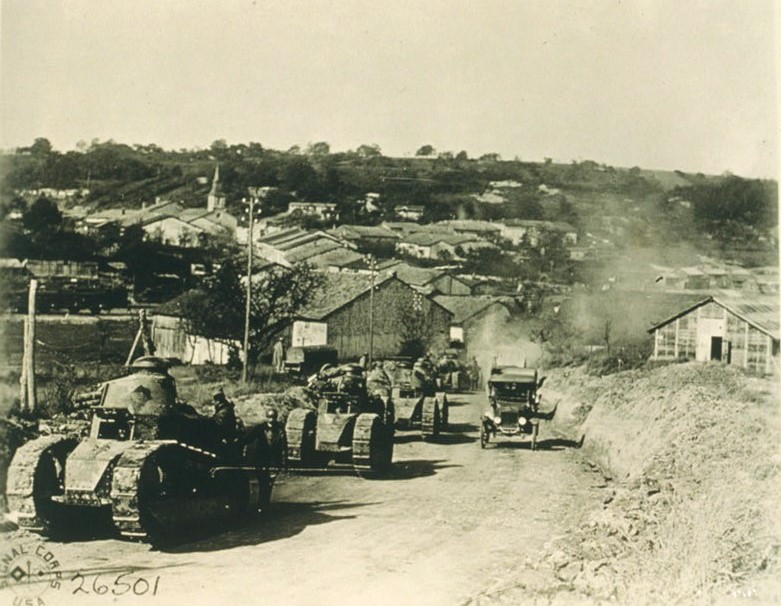
Light Renault tanks in Varennes.
The part of Varennes on the west bank of the Aire River was captured by the 28th Division, a National Guard Division from Pennsylvania. The 28th began the attack west of Vauquois Hill, with two battalions of the 110th Infantry Regiment making assaults and passing through each other in turn.
They attacked Varennes together. Mopping up resistance took until 2 p.m., though the rest of the division was slowed down by the wooded broken terrain of the Argonne Forest on their left.
Go to the north overlook of the monument. From Varennes, the 110th pushed forward further north, crossing the Aire River bend twice and climbing to the plateau beyond. The 110th was stopped there by machine gun fire from the town of Montblaineville beyond the ridge.
Stop 4 – Capt. Harry Truman
At 6 p.m. on Sept. 27, 1918, the 35th Division continued its advance from Cheppy. Capt. Harry Truman, commanding Battery D, 129th Field Artillery, was on the west side of the road between here and the fork to Charpentry. His observation post was in the open under a camouflage net strung to a hedge. West across the valley, Truman’s observers noticed an American aircraft dropping a flare over a German battery on the near side of Montblainville. To avoid casualties from friendly fire, Truman’s unit was not supposed to engage targets in the adjacent division’s lane. Contrary to these orders, Truman called for fire that destroyed the enemy guns. On the next morning, west across the valley, the 28th Division’s lead regiment was in Montblainville, but the remainder of the division lagged behind. Truman observed a German observation post over 3 kilometers northwest near Chene-Tondu, and again broke the rules, and called for fire on the observers who retreated quickly. Shortly after, they observed a German battery setting up close to the previous target. Forty-three rounds hit the enemy battery. Six field guns were later found abandoned on the site. Batteries A and B fired similar missions later in the day. Though admonished for this action, Truman never regretted his work along this road, even after he attained the U.S. presidency.
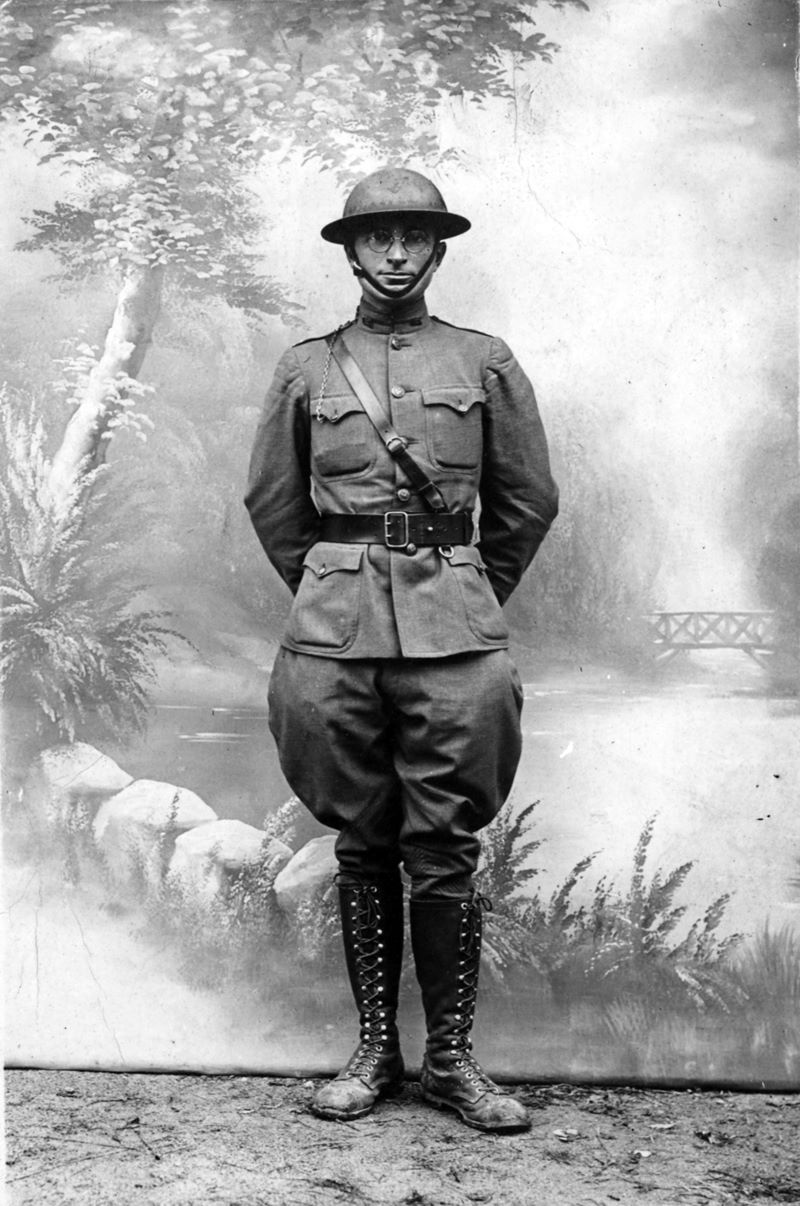
Capt. Harry Truman in uniform.
Stop 5 – Exermont
Look back to the southeast. On the skyline you can see the Montfaucon Monument. The forested hills to the northeast are the heights of Romagne which concealed lines of fortifications with steel and concrete shelters and pillboxes. From there and from the northern Argonne Forest to the west, artillery could strike Americans in these fields. The forward position of the 35th Division on Sept. 28, 1918, was the wooded hill immediately to the southwest of Montrebeau. On Sept. 29, the division advanced 1.2 kilometers north toward the heights of Romagne under heavy fire, supported by a few tanks and a light artillery barrage. The division had fought tenaciously through the German lines, advancing 10 kilometers in three days. The infantry of the 35th Division was reorganized into two provisional brigades that incorporated division machine gunners and engineers.
The Germans waited in force around Exermont, a village hidden in the folds of the forest to the northeast. German artillery concentrated on the American tanks forcing them back. After some initial gains, the 35th was forced to withdraw to Montrebeau. There it held out against two days of German shelling and infantry attacks. On Oct. 1, the 35th was withdrawn from the line except for its artillery brigade. It was replaced by the 1st Division, which renewed the attack on Oct. 4.
Stop 6 – Meuse-Argonne American Cemetery
This is the largest American World War I cemetery, and lies on land captured from German forces by the 5th and 32nd Divisions. A temporary cemetery was established here in mid-October of 1918. There are more than 14,000 Americans interred here, including more than 450 whose identities are unknown. Nearly 1,000 names are recorded on the Tablets of the Missing. Among the tablets are names of the missing of the American Expeditionary Forces’ Services of Supply, and the missing from American operations in Northern Russia.
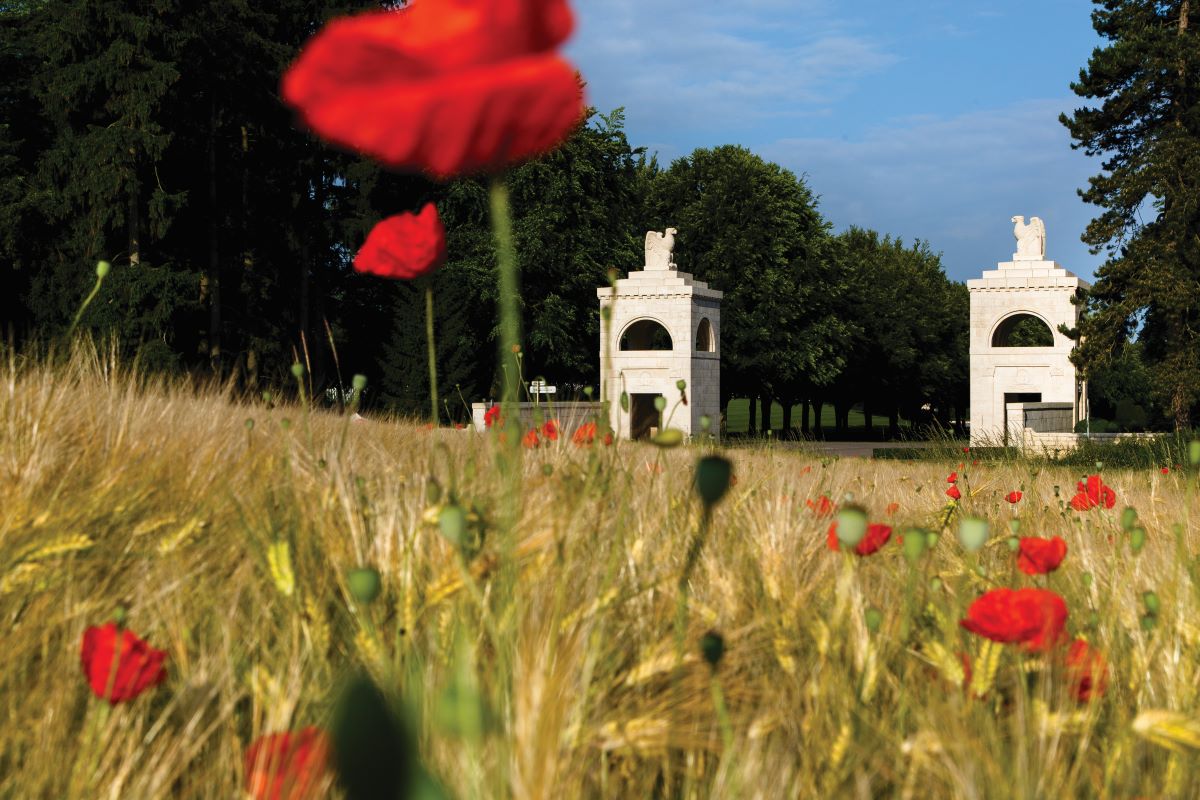
Poppies grow near the entrance to Meuse-Argonne American Cemetery.
The best way to begin the visit is with a stop in the visitor center. Newly renovated in 2016, the building includes exhibits, films and digital interactives that help tell the story of the Meuse-Argonne Offensive. Entrance is free and reservations are not required.
Map this route: https://maps.app.goo.gl/NYs1PTz8MtzNbjoP8
Download a PDF of ABMC’s full World War I Battlefield Companion.
