


Corporal Albert Alvis Vincent
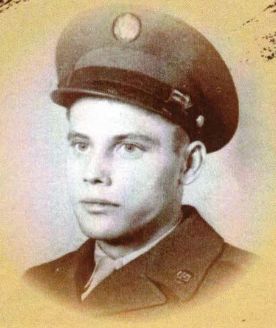
Early Life
Albert Alvis Vincent was born to Orville G. Vincent and his wife Nellie in Marceline, Missouri, in May 1929. Albert was one of eight siblings in the household. In 1935, the Vincent family moved from Marceline to rural Clay County, Missouri, near Kearney.
Orville Vincent worked as a laborer throughout his life, anything from odd jobs to being a farmhand and working at a rock quarry. Many of Vincent’s siblings followed suit. John worked as a dairy helper, and Ed worked as a farm laborer.
Albert Vincent attended school at Kearney Public Schools, worked as a farmhand, and by 1948, enlisted in the U.S. Army.
Photo carousel gallery
Home Front
Vincent grew up in rural Clay County, Missouri, near the town of Kearney. During these years, Kearney saw minimal population growth; however, nearby Kansas City was beginning to encroach on this area. To divide political power, some Kansas City politicians incorporated parts of southern Clay County into North Kansas City.
With Kansas City rapidly expanding, the city found itself playing its part in the war effort. The Lake City Army Ammunition Plant operated through World War II and during the Korean War. Approximately one billion rounds were manufactured at the Remington Arms plant in Lake City, Missouri, annually. Closer to Kearney, most of their economy revolved around agriculture.
Throughout the area, local newspapers reported on the war. They informed the public of the progress of growing conflict throughout the world during and after World War II. They informed through the written word and pictures and attempted to sway public opinion through the use of political cartoons.
Photo carousel gallery
Military Experience
Following World War II and at the brink of the Korean War, Vincent enlisted in the U.S. Army on December 15, 1948. A local memorial states that he trained at Camp Chaffee in Arkansas with the 5th Armored Division. In May 1949, Vincent departed the U.S. for Camp Wood in Japan to join the 21st Infantry Regiment as a private first class.
General Douglas McArthur thought that a U.S. presence on the Korean Peninsula might deter the southern advance of the North Koreans. As North Korea began to encroach upon South Korea, the 21st Infantry Regiment was a part of the first instances of armed combat in the Korean War.
Led by Lieutenant Colonel Brad Smith, the 21st Infantry Regiment was assigned to a unit called Task Force Smith. Their assignment was to repel the invading North Koreans from invading further south. While they fought credibly, they lacked experience, technology, and supplies. They were quickly overwhelmed by enemy forces and forced to retreat.
On July 5, 1950, the 21st Infantry Regiment engaged enemy forces. Facing greater firepower and an unexpected bypassing maneuver, Task Force Smith was forced to retreat quickly. During this retreat, Vincent was taken captive.
I
Photo carousel gallery
Commemoration
On July 12, 1950, Vincent was reported as Missing in Action. In August 1950, near Chochiwon, South Korea, Vincent and other Prisoners of War were forced to march in what is now known as the Tiger Death March. On this march between Mampo, South Korea, and Chunggang-jin, North Korea, Vincent died.
In 1953, Vincent was promoted to the temporary grade of corporal. In 1954, his Report of Death was filed, stating that he died on October 31, 1951, from malnutrition. His remains were never recovered.
Despite disaster striking Task Force Smith in their retreat at Chochiwon, their legacy stands. Due to their bravery and endurance, they defied the odds and gave their allies at Pusan ample time to prepare their defenses. Their urgent stand enabled South Korean and allied troops to drive the North Korean army back north of the 38th parallel. Corporal Vincent gave the ultimate sacrifice being a part of this stand, it is necessary for him to be commemorated and remembered.
Corporal Vincent was awarded the Purple Heart, the Combat Infantryman’s Badge, the Prisoner of War Medal, the Korean Service Medal, the United Nations Service Medal, the National Defense Service Medal, the Korean Presidential Unit Citation and the Republic of Korea War Service Medal.
He is memorialized on the Court Five of the Honolulu Memorial at the National Memorial Cemetery of the Pacific in Honolulu, Hawaiʻi.
Photo carousel gallery
Primary Sources
Albert A. Vincent. U.S., Korean War Casualties, 1950-1957. https://ancestryclassroom.com
Albert Alvis Vincent. Individual Deceased Personnel File. National Archives and Records Administration – St. Louis.
Clay County, Missouri. Map. c.1955. The Kansas City Public Library (3000418). https://kchistory.org/image/clay-county-missouri?solr_nav%5Bid%5D=306921938a3757879827&solr_nav%5Bpage%5D=0&solr_nav%5Boffset%5D=1
“Clay County Youth Is Missing In Korean Area.” The Richmond News [Richmond, MO], July 28, 1950. Newspapers.com (138421530).
“Enemy Troops Flee in Panic Toward ‘Haven’ of Boundary.” The Ponca City News [Ponca City, OK], September 28, 1950. Newspapers.com (603225959).
Herblock. Bringing the Little Nations into a Common Front. Political Cartoon. Poplar Bluff Republican [Poplar Bluff, MO], December 14, 1939. Newspapers.com (937764534)
Kearney, Missouri. Photograph. c.1950. The Kansas City Public Library (10012800). https://kchistory.org/image/kearney-missouri-2.
“La Plata Boy Is Missing In Korean Action.” Mason Chronicle-Herald [Macon, MO], July 28, 1950. Newspapers.com (138421463).
“Missing in Korea Action.” The Kansas City Star {Kansas City, MO], July 26, 1950. Newspapers.com (138421664).
Missouri. Clay County. 1940 U.S. Census. Digital images. https://ancestryclassroom.com.
Missouri. Marceline County. 1950 U.S. Census. Digital images. https://ancestryclassroom.com.
“U.S. Abandons Key Airfield; Fall of Taejon Feared Near.” The Ponca City News [Ponca City, OK], July 17, 1950. Newspapers.com (603222820).
Secondary Sources
“21st Infantry Regiment.” 25th Infantry Division Association. Accessed February 28, 2025. https://www.25thida.org/units/infantry/21st-infantry-regiment/
“21st Infantry Regiment.” The Army Historical Foundation. Accessed February 25,2025. https://armyhistory.org/21st-infantry-regiment/
“Albert Alvis Vincent.” American Battle Monuments Commission. Accessed March 30, 2025. https://weremember.abmc.gov/#!/details?id=114430
“CPL Albert Alvis Vincent.” Defense POW/MIA Accounting Agency. Accessed March 30, 2025. https://dpaa-mil.sites.crmforce.mil/dpaaProfile?id=a0Jt0000009JHvHEAW.
Crane, Conrad C. et al. “‘Come As You Are’ War: U.S. Readiness for the Korean Conflict.” Army War College. Accessed February 26, 2025. https://ahec.armywarcollege.edu/documents/U.S._Readiness.pdf
“Corp Albert Alvis Vincent.” Find a Grave. Updated October 18, 2013. Accessed December 12, 2024. https://www.findagrave.com/memorial/118937192/albert-alvis-vincent
“Kansas City vs. North Kansas City: 1940s Political Tussle for (More) Space on the Map.” Kansas City Public Library. Accessed January 27, 2025. https://kclibrary.org/news/2021-05/kansas-city-vs-north-kansas-city-1940s-political-tussle-more-space-map.
“KC in WWII: The Fairfax, Pratt and Whitney and Lake City Defense Plants.” KC Backstories. Updated June 18, 2020. Accessed January 27, 2025. https://kcbackstories.com/2021/07/15/kc-in-wwii-the-fairfax-pratt-whitney-and-lake-city-defense-plants/
Kearney-Holt Fallen Warriors Memorial. Accessed March 24,2025. https://www.kearney-holtfallenwarriors.com/.
Kolb, Rich. “Korean War: Albert Alvis Vincent.” Kearney-Holt Fallen Warriors Memorial. 2023.
“Lake City Army Ammunition Plant.” U.S. Army Joint Munitions Command. Accessed March 17, 2025. https://www.jmc.army.mil/Installations.aspx?id=LakeCityOverview.
“Missouri Population 1900-1990.” Missouri Census Data Center. Accessed January 27, 2025. https://mcdc.missouri.edu/population-estimates/historical/cities1900-1990.pdf.
Contributor
Contributed by Mr. Cody Lee
East Buchanan High School
2024-2025
