


Corporal Daniel Dwain Schoonover
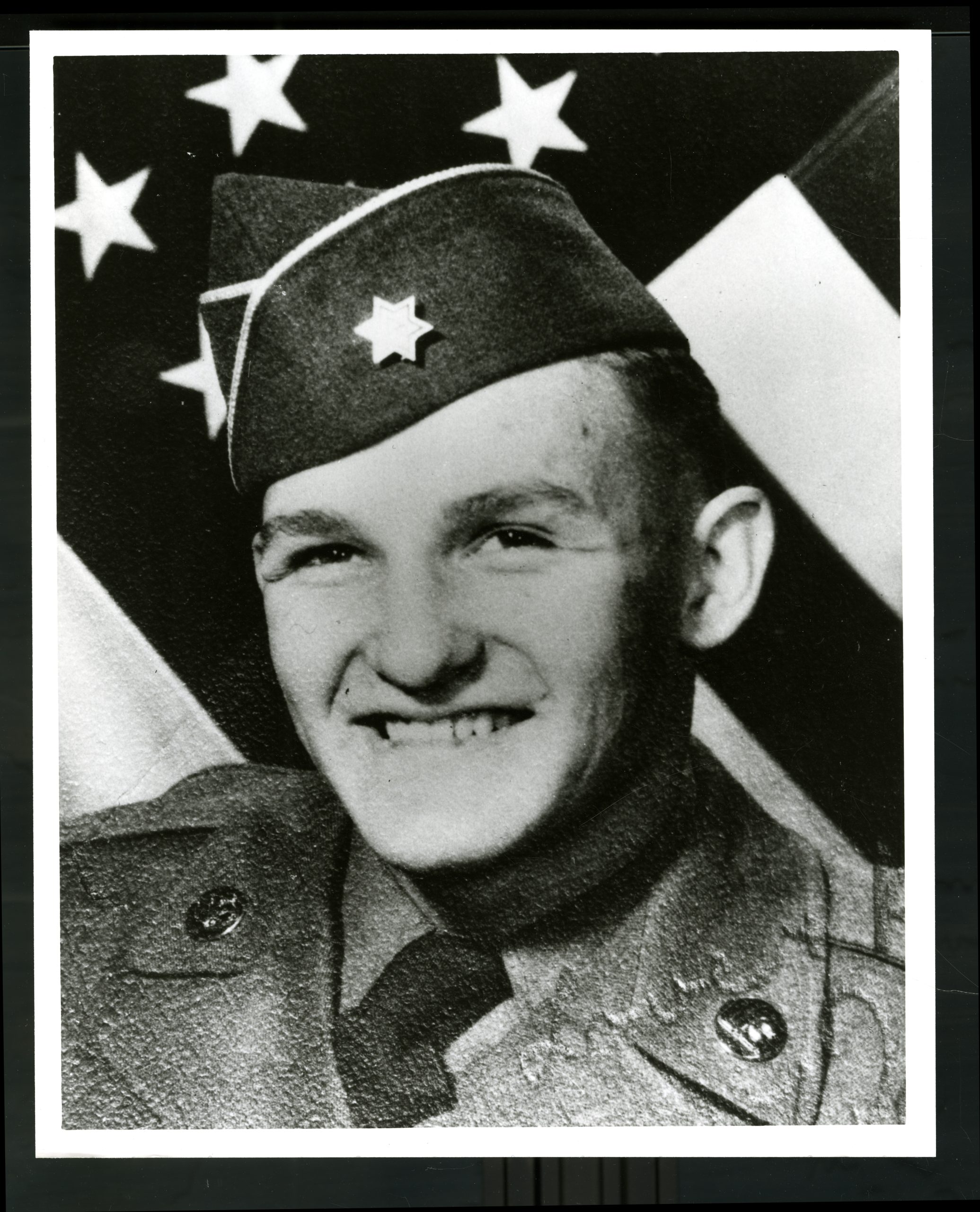
Early Life
Daniel (Dan) Dwain Schoonover was born on October 8, 1933, in Boise, Idaho. His parents were Velda Alice Nixon and Gail Dell Schoonover. He was born into a multi-generational home and lived in a boarding house. Schoonover’s family owned and ran an ice factory and provided ice to the community. He had one stepbrother, Richard, and three full siblings, Jerry, Patrick, and Lois
By 1940, Schoonover’s mother lived with her parents, and the children were scattered. Local newspaper articles document that Dan’s father, Gail Schoonover, struggled with alcoholism and was arrested for drunken disorderliness on multiple occasions.
In 1949, Schoonover was placed in the Idaho Industrial Training School for truancy. The school records read, “Father and Mother separated 12 years. Mother remarried. Boy did not get along with stepfather. Played truant from school so much was finally expelled. Wanted to travel so took this way of traveling. Would not pay attention to mother’s instructions or wishes.” At the reform school, Dan Schoonover attained the ninth grade and was taught the trade of dairyman.
The school ledger indicated under “habits” that he smoked. Schoonover stayed at the Idaho Industrial School until he was released to join the armed forces in 1951.
The school ledger indicated under “habits” that he smoked. Schoonover stayed at the Idaho Industrial School until he was released to join the armed forces in 1951.
Photo carousel gallery
Home Front
Boise grew significantly from the 1940s into the 1950s. Rural areas became suburban as family cars became more commonplace. As the state government grew, so did the state’s capital.
Boise, known affectionately as the City of Trees, supported the World War II war effort by bond and scrap drives. The U.S. Army Air Corps established Gowen Field in Boise in 1941. This became a school for combat crews training for the B-17 Flying Fortresses and later for the B-24 Liberators.
During World War II, Boise and the state of Idaho helped feed American troops. Local entrepreneurs, including Jack Simplot, dehydrated potatoes and onions to ship overseas in troop rations. This continued through the Korean War. Between 1948 and 1950, Idaho shipped out over 659 million pounds of potatoes and over 24 million pounds of onions.
Following World War II, Gowen Field re-established itself with the creation of Idaho’s First Air Guard, the 190th Fighter Squadron. The original pilots of the 190th Fighter Squadron were World War II Veterans. They flew the P-51D Mustang. By 1951, the 190th Fighter Squadron and its F-51 Mustangs were activated for the Korean War. In a message to Idahoans, Len Jordan, governor of the state, said, “We need to plan with calmness and deliberation as opposed to snap judgments and hysteria . . . None can say how long the period of international conflict [in Korea] will last; no one knows how deeply we may become enmeshed in the crisis. Each day’s news brings more confusion and more sense of heartbreak and terror.”
Photo carousel gallery
Military Experience
Daniel Schoonover enlisted in the U.S. Army in January 1951 in Boise, Idaho, after he was released from the Idaho Industrial School. He was 17 years old. He received basic training at Fort Eustis, Virginia, where he completed training in railroad car repair. He was deployed to Pusan, South Korea, with the 765th Transportation Military Railway Service Battalion. A few months later, he requested a transfer to Company A, 13th Engineer Combat Battalion, to join his older brother, Sergeant Pat Schoonover.
By the time Schoonover became a member of the Engineer Combat Battalion, North Korea and the United States were in a bitter stalemate. Schoonover’s unit handled route clearance and mine removal, shored up defensive positions, and supported fellow troops out on the battlefield.
On July 6, 1953, the stalemate ended with a second fierce battle over the same terrain known as the Battle of Pork Chop Hill. On July 9, “The 19-year-old corporal [Dan Schoonover], in charge of a demolition squad, because of heavy enemy fire ‘voluntarily employed his unit as a rifle squad’ and, forging up the steep, barren slope, participated in the assault on hostile positions.” Fighting was intense and it was documented that Corporal Schoonover’s “two days of sustained bravery” and “heroic achievements . . . saved the lives of many of his fellow Americans.” On July 11, the U.S. military commanders decided to abandon Pork Chop Hill. The 7th Infantry Division withdrew.
Photo carousel gallery
Commemoration
Corporal Daniel D. Schoonover died as the result of enemy indirect fire. He fought valiantly for two days and remained behind when his company was relieved. According to Schoonover’s brother, Sergeant Pat Schoonover, his younger brother was on the other side of Hill 255.
Notably, Sergeant Pat C. Schoonover was “awarded the Bronze Star for heroism during a special mission to keep supply lines open for the front line troops.” As a result of Corporal Daniel Schoonover’s brave actions, he was posthumously awarded the Medal of Honor. His citation reads:
“Cpl. Schoonover, distinguished himself by conspicuous gallantry and outstanding courage above and beyond the call of duty in action against the enemy. He was in charge of an engineer demolition action squad attached to an infantry company which was committed to dislodge the enemy from a vital hill. Realizing that the heavy fight and intense enemy fire made it impossible to carry out his mission, he voluntarily employed his unit as a rifle squad and, forging up the steep barren slope, participated in the assault on hostile positions. When an artillery round exploded on the roof of an enemy bunker, he courageously ran forward and leaped into the position, killing 1 hostile infantryman and taking another prisoner. Later in the action, when friendly forces were pinned down by vicious fire from another enemy bunker, he dashed through the hail of fire, hurled grenades in the nearest aperture, then ran to the doorway and emptied his pistol, killing the remainder of the enemy. His brave action neutralized the position and enabled friendly troops to continue their advance to the crest of the hill. When the enemy counterattacked he constantly exposed himself to the heavy bombardment to direct the fire of his men and to call in an effective artillery barrage on hostile forces. Although the company was relieved early the following morning, he voluntarily remained in the area, manned a machine gun for several hours, and subsequently joined another assault on enemy emplacements. When last seen he was operating an automatic rifle with devastating effect until mortally wounded by artillery fire. Cpl Schoonover’s heroic leadership during 2 days of heavy fighting, superb personal bravery, and willing self-sacrifice inspired his comrades and saved many lives, reflecting lasting glory upon himself and upholding the honored traditions of the military service.”
Corporal Daniel D. Schoonover’s body was never recovered. His last known location was in the demilitarized zone between North and South Korea in the vicinity of 52S CH 27060 34166 Military Grid Reference System (MGRS). His selfless sacrifice contributed to the establishment of the Democratic Republic of South Korea.
He was remembered by fellow soldier Mario Galli in 2024, who stated, “I knew Danny only a short time. He was one of the nicest guys I ever knew. Everyone liked him. A quiet[,] soft-spoken but tough[,] brave guy.”
Daniel D. Schoonover is memorialized at the Honolulu Memorial at the National Memorial Cemetery of the Pacific in Honolulu, Hawaiʻi.
Photo carousel gallery
Primary Sources
“Army Honors Boise Hero, Cpl. Dan D. Schoonover.” The Idaho Statesman [Boise, ID], June 11, 1954.
Cpl Dan D. Schoonover who received the Medal of Honor posthumously for gallantry in action in Korea. Photograph. National Archives and Records Administration (SC 494564). Idaho State Archives
Dan D. Schoonover. U.S., Headstone Applications for Military Veterans, 1861-1985. https://www.ancestry.com.
Dan Dwain Schoonover. Individual Deceased Personnel File. National Archives and Records Administration – St. Louis.
“Dan Schoonover.” Idaho Industrial Training School Ledgers (1949-1954). Ledger no. 20240315, Idaho State Archives.
“District Court.” The Idaho Statesman [Boise, ID], March 11, 1937. https://infoweb.newsbank.com.
“District Court.” The Idaho Statesman [Boise, ID], May 7, 1936. https://infoweb.newsbank.com.
Gail Dell Schoonover. Oregon, U.S., State Marriages, 1906-1971. Digital Images. https://ancestry.com.
Idaho. Ada County. 1910 U.S. Census. Digital Images. https://www.ancestry.com.
Idaho. Ada County. 1920 U.S. Census. Digital images. https://ancestry.com.
Idaho. Ada County. 1930 U.S. Census. Digital Images. https://www.ancestry.com.
Idaho. Ada County. 1940 U.S. Census. Digital Images. https://www.ancestry.com.
Idaho. Fremont County: Idaho Industrial Training School. 1950 U.S. Census. Digital images. https://ancestry.com.
“Idahoans in Service: SGT. Pat C. Schoonover.” ”Idaho Statesman [Boise, ID], March 10, 1958. https://infoweb.newsbank.com/.
“Purple Heart Medal Awarded to Boise Soldier Posthumously.” The Idaho Statesman [Boise, ID], December 3, 1953. https://infoweb.newsbank.com.
Secondary Sources
“12 Series MOS.” Operation Military Kids. Last modified 2025. Accessed March 14, 2025. https://www.operationmilitarykids.org/12-series-mos/#combatmos
“13th Engineer Combat Battalion Association 7th Infantry Division.” 13th Engineer Combat Battalion. Updated September. 2024. Accessed March 19, 2025. https://13thengineerbn.com/.
“1952-1953” 13th Engineer Combat Battalion Association. Last modified September 2024. Accessed March 15, 2025. https://13thengineerbn.com/1952-1953/.
“Battlefield Chronicles- Pork Chop Hill.” Army Together We Served Reconnecting Soldiers Since 2003. Updated 2025. Accessed February 8, 2025. https://army.togetherweserved.com/dispatches-articles/63/797/Battlefield+Chronicles+-+Pork+Chop+Hill.
“Battle of Pork Chop Hill.” Alchetron. Last modified October, 2, 2024. Accessed March 14, 2025.https://alchetron.com/Battle-of-Pork-Chop-Hill
Boise Scrap Drive Parade. Photograph Collection. September 1942. Idaho State Historical Society (72-201.189/M, 72-201.189/P, 72-201.189/Q).
“CPL Dan Dwain Schoonover.” Defense POW/MIA Accounting Agency. Accessed March 30, 2025. https://dpaa-mil.sites.crmforce.mil/dpaaProfile?id=a0Jt000000E0tnlEAB.
“Dan Dwain Schoonover.” American Battle Monuments Commission. Accessed March 30, 2025. https://weremember.abmc.gov/#!/s?v=G&a=c&q=*&type=16&criteria=title%3Dsch.
Fisher, Franklin. “Stadium Bears Name of War Hero.” U.S. Army. Updated January 7, 2014. Accessed March 30, 2025. https://www.army.mil/article/117888/stadium_bears_name_of_war_hero.
Gilson, Fred. Pork Chop Hill. Map. 2025.
History of Gowen Field World War II and the Cold War. U.S. Air Force. Idaho Historic Preservation Office.
“A History of the Potato in Idaho: Aristocrat in Burlap.” The Idaho Potato Commission. Accessed January 31, 2025. https://idahopotato.com/aristocrat-in-burlap/online/105.
Hoarn, Steven. “Engineers in the Korean War Photos.” Defense Media Network. Last modified August 8, 2012. Accessed February 25, 2025. https://www.defensemedianetwork.com/stories/the-korean-war-anniversary-in-photos-part-2/.
The Idaho Industrial Training School: 1903-1970 (Idaho Youth Services) St. Anthony, Idaho A New Social History Investigation .pdf. LA 264.13 B7 1980) Idaho State Archives. Accessed January 25, 2025.
Images of America Idaho in World War II. Arcadia Publishing, 2020.
Jordan, Len. Governor’s Message to the Legislature of Idaho Thirty-First Session. Speech. 1951. Idaho State Historical Society.
“The Korean War in Rare Historical Pictures, 1951-1953.” Rare Historical Photos. Last modified 2024. Accessed March 15, 2025. https://rarehistoricalphotos.com/korean-war-rare-pictures-1951-1953/.
“Schoonover, Dan D.” US, Medal of Honor Recipients, 1863-2013 (pages 781-782). https://www.fold3.com/image/310762015/1863-1978-page-782-us-medal-of-honor-recipients-1863-2013.
“The U.S. Army Corps of Engineers Shaped the Combat Environment during the Korean War.” U.S. Army Corps of Engineers. Last modified June 2022. Accessed January 8, 2025.
Contributor
Contributed by Mrs. Janelle Gilson
Renaissance High School
2024-2025
