


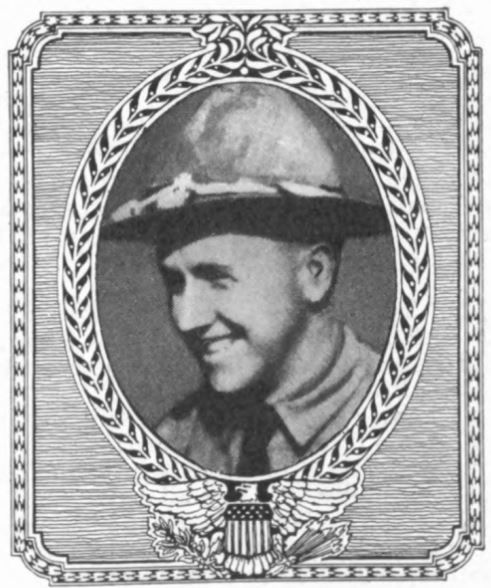
Corporal Frederick Osmond Gaskins
Early Life
Frederick Gaskins was born on January 5, 1896, in Court House Township, Chesterfield County, South Carolina. Court House was a small, rural township of about 500 people. In comparison, the county had a population of 26,000 people and 20,401 farms, with a primarily agricultural economy based on grains, tobacco, and cotton farms.
His parents, Ella and Thomas Gaskins, owned and worked their own farmland. Although Frederick and his brothers, Harrold and Carlton, attended school and could read and write, by 1910, they were working the family farm with their father. His older sister, Genevieve, left the home and was married, while his younger sisters, Lealla, Athline, Louise, and Madge, lived at home but did not work with the boys. At age 16, Frederick joined Hopewell Baptist Church as a member.
Home Front
As early as 1915, Chesterfield farmers were encouraged to focus on self-sufficiency. For instance, it was suggested that they grow more vegetables. Irish or sweet potatoes were highly recommended. The next recommendation advised farmers to grow feed crops like corn, oats, and hay to feed farm animals. Farmers were told to consider growing cotton only after meeting these needs. These suggestions were meant to ensure farms could weather uncertainty.
Cotton farmers had to worry about boll weevil infestations destroying their cotton crops, so the push to diversify crops was seen as a way to help the local economy and support the war effort.
By 1916, local canning clubs were established to teach girls food preservation techniques. Boys could join clubs focused on corn cultivation, pig rearing, or dairy farming. These clubs were created to instill agricultural skills in youth and promote self-sufficiency among families during the war.
Photo carousel gallery
Military Experience
A Family at War
Frederick Gaskins joined Company I, 118th Infantry Regiment, of the South Carolina National Guard in April 1917. Records show that his brother Carlton joined Company B, 105th Engineers, 30th Division. His brother Harrold also served in the war, but no records specify which unit he joined.
Training for the Front
Frederick Gaskins’s first mission was guard duty in the port city of Charleston, South Carolina. Next, he traveled to Camp Sevier in Spartanburg, South Carolina, where his unit became federalized and joined the 30th Division. He sailed to France on May 11, 1918, from New York, NY, on the SS Orduna, a British passenger ship. The 30th Division landed at Calais, France, on May 24, 1918.
Fighting in Belgium and France
From July 16 to August 18, 1918, the 30th Division was assigned to the British Second Army for training. It moved to its sector southwest of Ypres, Belgium, to organize and defend a portion of the East Poperinghe Line in Belgium.
Gaskins fought his first battle in Voormezeele, Belgium, between August 19 and September 4, 1918. The British lost Voormezeele in April 1918, but the 30th U.S. Division recaptured it on August 31, 1918.
Breaking the Hindenburg Line
From September 24-30, 1918, Gaskins’s unit participated in the Battle of Bellicourt, France, which was part of the larger Battle of St. Quentin Canal. American and Australian forces broke through the heavily defended Hindenburg Line near Bellicourt, France, on September 29, 1918. The Australian Corps pierced a vital portion of the German defenses along the St. Quentin Canal. The 30th Division successfully took the Hindenburg Line from the Germans. The 27th and 30th Divisions took around 13,000 casualties. Around 36,000 German Prisoners of War were captured during the attack.
In early October 1918, the 118th Infantry Regiment battled German forces at Brancourt le Grand and St. Souplet, France, continuing the Hundred Days Offensive. They successfully took the area on October 8, 1918.
Final Sacrifice
The second half of October was consumed with the Battle of the Selle River. The decision was made to commence the assault at night, and as the Selle was not very wide at this point, planks were used for soldiers to cross in a single file. On October 16, 1918, Corporal Gaskins was engaged at Mazinghie, where he led his squad to rush two German machine gun nests. Under intense gunfire, he rushed the position, took it and killed two of the gun crew. His men followed him as he rushed a second post alone with his rifle and killed one of the crew. However, he was struck and killed before he could reach the second post.
An eyewitness, Corporal Samuel W. McCants, Company I, 118th Infantry Regiment, from Trio, South Carolina, gave a statement to commanding officers about Gaskins’s death: “The front line was moving on October 17, 1918, near the village of La Haie Menneressem, France, when this man was struck by shrapnel from enemy shell fire, causing instantaneous death.”
There are two dates for Corporal Frederick Osmond Gaskins’s death. Some reports give the date as October 16, 1918, and others as October 17, 1918.
Photo carousel gallery
Commemoration
Memorials
Corporal Frederick Osmond Gaskins was buried on October 19, 1918, in Jackson Military Cemetery, a temporary cemetery near the battle site. On February 7, 1921, he was reinterred at the Somme American Cemetery in Bony, France.
Gaskins received the Distinguished Service Cross for the initiative he took on October 16, 1918. The medal was sent to his father, who also accepted a certificate of thanks from the French government for his son, “Who died for Liberty in the Great War.” Corporal Gaskins was one of 40 Chesterfield men who died during World War I.
In 1919, Gaskins’s father sent a letter requesting a headstone for their local cemetery. He was informed that the government did not provide more than one headstone. There is a cenotaph, a monument in honor of a person buried elsewhere, in Hopewell Baptist Cemetery, commemorating Corporal Gaskins.
Gold Star Mothers’ Pilgrimage
Frederick’s mother, Ella Gaskins, joined the Gold Star Mothers’ Pilgrimage in 1930. The U.S. government arranged this program for mothers and wives to say their final goodbyes. She traveled by train to New York before sailing to France on the SS Roosevelt on August 9, 1930. Mrs. Gaskins was initially set to sail on the SS America on August 27, 1930, but her departure was changed so she could travel with Mrs. Patterson of Fort Mill, South Carolina. The two women stayed overnight at the Astor Hotel in New York City before departing on August 9.
Upon arrival, the group stayed at the Hotel D’lena in Paris, France. As part of the scheduled itinerary, Mrs. Gaskins visited St. Quentin on August 21, 1930, and stayed the evening at a local hotel. From August 22-26, they visited the Somme American Cemetery daily and participated in local sightseeing. They spent the last few days on scheduled sightseeing tours of Paris and the surrounding areas.
They set sail back to New York on September 2, 1930, aboard the SS Washington, and arrived on September 10, 1930.
Photo carousel gallery
Primary Sources
“500 Farmers Pledge in Pageland; Pledge 600 Acres For Melons.” The Chesterfield Advertiser [Chesterfield, SC], January 11, 1917. https://www.loc.gov/resource/sn93067951/1917-01-11/ed-1/?sp=1&r=-0.149,-0.082,1.254,0.729,0.
“Canning Club Girls Meet Corn and Pig Boys.” The Chesterfield Advertiser [Chesterfield, SC], July 6, 1916. https://www.loc.gov/resource/sn93067951/1916-07-06/ed-1/?sp=1&r=0.116,0.033,0.619,0.36,0.
“Cheraw Company in Charleston.” The Chesterfield Advertiser [Chesterfield, SC], May 3, 1917. https://historicnewspapers.sc.edu/lccn/sn93067951/1917-05-03/ed-1/seq-1.pdf.
“Fred Gaskins Awarded Distinguished Service Medal For Great Heroism.” The Chesterfield Advertiser [Chesterfield, SC], January 02, 1919. Newspapers.com (863526231).
Frederick O. Gaskins. U.S., Army Transport Service Arriving and Departing Passenger Lists, 1910-1939. Digital images. https://www.fold3.com.
Frederick Osmond Gaskins. Burial Case File. National Archives and Records Administration – St. Louis.
Frederick Osmond Gaskins. Official Military Personnel File. National Archives and Records Administration – St. Louis.
“French Troops Enter Important St. Quentin.” The Chesterfield Advertiser [Chesterfield, SC], October 3, 1918. https://www.loc.gov/resource/1918-10-03/ed-1/?sp=1&r=-0.043,0.045,0.684,0.311,0.
“In Memoriam.” The Chesterfield Advertiser [Chesterfield, SC], January 2, 1919. Newspapers.com (863526231).
“Its Onward March” The Chesterfield Advertiser [Chesterfield, SC], January 23, 1916. https://www.loc.gov/resource/sn93067951/1916-01-27/ed-1/?sp=2&st=image&r=0.018,-0.16,0.549,0.319,0.
“Letter from Laurence Caulder of Camp Sevier.” The Chesterfield Advertiser [Chesterfield, SC], November 29, 1917. https://historicnewspapers.sc.edu/lccn/sn93067951/1917-11-29/ed-1/seq-1.pdf.
“Letters From Our Boys.” The Chesterfield Advertiser [Chesterfield, SC], July 3, 1918. https://tile.loc.gov/storageservices/service/ndnp/scu/batch_scu_hookandcook_ver03/data/sn93067951/00295861976/1918070301/0337.pdf.
“MEN OF CHESTERFIELD COUNTY!” The Chesterfield Advertiser [Chesterfield, SC], March 29, 1917. https://www.loc.gov/resource/sn93067951/1917-03-29/ed-1/?sp=1&st=image.
Mills, Robert. Chesterfield District, South Carolina. Map. 1825. Library of Congress (2006636722). https://www.loc.gov/item/2006636722.
“Muster Roll of Co. ‘I’; Will Soon Be Absorbed in Larger Unit.” The Chesterfield Advertiser [Chesterfield, SC], September 06, 1917. https://historicnewspapers.sc.edu/lccn/sn93067951/1917-09-06/ed-1/seq-1.pdf.
NH 43532 SS Orduna British Merchant Passenger Ship. Photograph. c.1910-1919. Naval History and Heritage Command (NH 43532). https://www.history.navy.mil/ourcollections/photography/numerical-list-of-images/nhhc-series/nh-series/NH-43000/NH-43532.html.
“Self-Sustaining Farming” The Chesterfield Advertiser [Chesterfield, SC], March 29, 1917. https://www.loc.gov/resource/sn93067951/1917-03-29/ed-1/?sp=1&st=image.
South Carolina. Chesterfield County. 1910. Abstract. https://www2.census.gov.
South Carolina. Chesterfield County. 1910 U.S. Census. Digital images. https://www.ancestry.com.
U.S., Records of the 27th Division of the American Expeditionary Forces, 1917-1919. https://www.fold3.com.
Secondary Sources
American Armies and Battlefields in Europe. U.S. Government Printing Office, 1938.
“Camp Sevier.” Greenville County Historical Society. Accessed February 10, 2025. https://greenvillehistory.org/photogallery/camp-sevier/.
“Corp. Frederick Osmond Gaskins.” Find a Grave. Updated December 27, 2009. Accessed December 23, 2024. https://www.findagrave.com/memorial/45829097/frederick-osmond-gaskins.
“Corp. Frederick Osmond ‘Fred’ Gaskins.” Find a Grave. Updated August 6, 2010. Accessed December 23, 2024. https://www.findagrave.com/memorial/56098323/frederick-osmond-gaskins.
Distinguished Service Cross Recipients, World War I, 1917-1918. U.S. Department of Defense. Updated March 29, 2013. Accessed April 19, 2025. https://valor.defense.gov/Portals/24/Documents/ServiceCross/ArmyDSC-WWI.pdf.
“Fred O. Gaskins.” American Battle Monuments Commission. Accessed February 1, 2025. https://weremember.abmc.gov/#!/details?id=50807.
“Frederick O. Gaskins.” Hall of Valor. Accessed December 23, 2024. https://valor.militarytimes.com/recipient/recipient-12061/.
Peek, Matthew M. “30th Division Leaves for France 100 Years Ago.” NC Department of Natural and Cultural and Resources Blog. May 10, 2018. https://www.dncr.nc.gov/blog/2018/05/10/30th-division-leaves-france-100-years-ago.
“The Story of the Battle of St. Quentin.” Commonwealth War Graves Blog. September 25, 2023. https://www.cwgc.org/our-work/blog/the-story-of-the-battle-of-st-quentin-canal/.
“Thirtieth Division.” AMEDD Center of History & Heritage. Accessed February 18, 2025. https://achh.army.mil/history/book-wwi-fieldoperations-combatdivs.
Walker, Donna Isbell. “100 years ago Camp Sevier in Greenville played key role in fighting, ending World War I.” Greenville News Online, January 18, 2018. https://www.greenvilleonline.com.
This profile was researched and created through the Researching Silent Heroes program, sponsored by the American Battle Monuments Commission.
Contributor
Contributed by Ms. Kim Guthrie
Homeschool Support
2024-2025
