


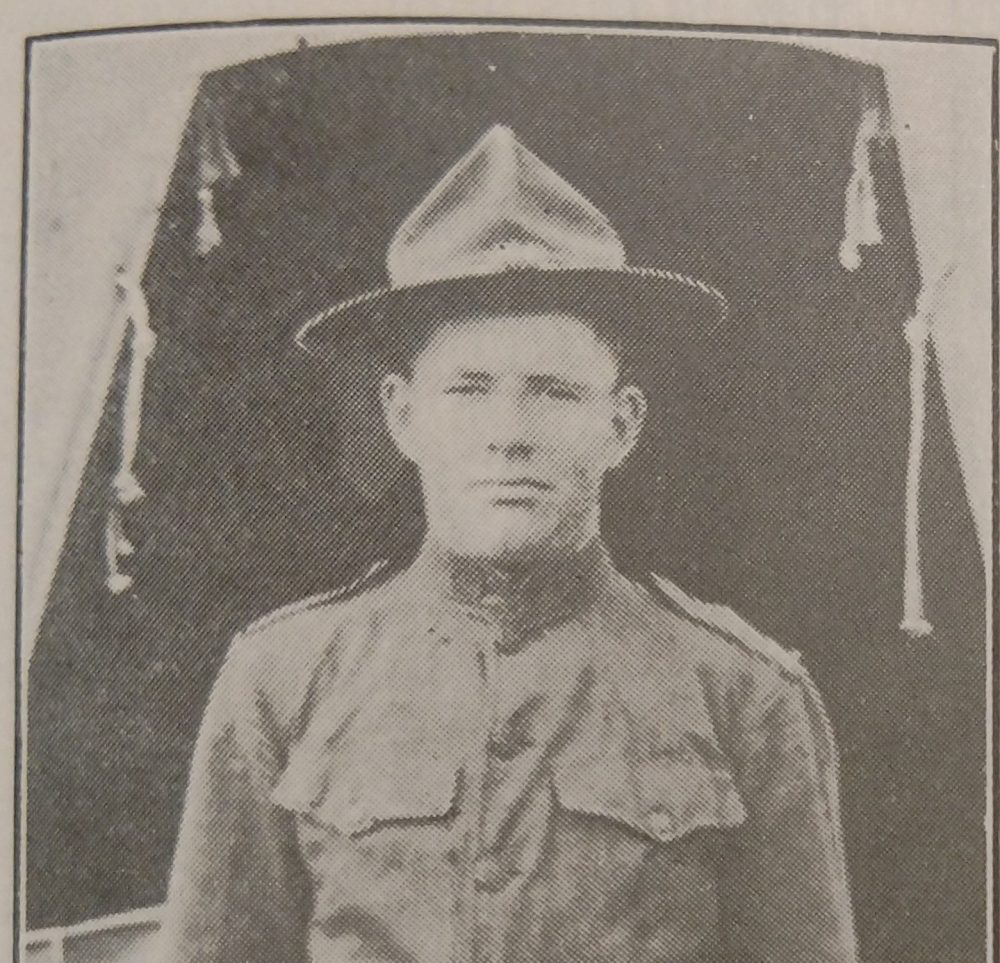
Corporal Millard W. Corson
Early Life
On January 5, 1897, Millard W. Corson was born in Athens, Maine and was one of five children born to Perley Cyrus Corson and his wife Martha (Mattie) Corson. His father worked as a millman, initially in a saw mill and later in the novelty works business. His work led the family to move around quite a bit but they eventually settled in Skowhegan, Maine.
Corson was living in Madison, Maine when he enlisted in the National Guard in May 1917, and may or may not have been still living with his family. He was 22 years old at the time. No occupation is given in his enlistment entry.
Military Experience
Military Experience
Corson joined Company E of the Maine National Guard, which was headquartered in Somerset County in Skowhegan, Maine. By early July 1917, Company E began training at Camp Keyes in Augusta, Maine. In August, Company E was sent to Camp Bartlett in Westfield, Massachusetts.
The 103rd Infantry Regiment was intended to be made up entirely of men from Maine, but there were not enough, and 1,500 men from the 1st New Hampshire Infantry and 8th Massachusetts Infantry were added. The combined company became the new 103rd Infantry Regiment of the 52nd Brigade, 26th “Yankee” Division.
On September 24, 1917, the Yankee Division boarded the S.S. Saxonia and made its way to Great Britain. Because of the dangers of U-boats, nothing was published about the ship’s movements and they took a long route to Great Britain. On October 10, the Yankee Division landed in Liverpool and took a train to Camp Borden in southern Britain. They made the channel crossing to Le Havre, France, on the night of October 19. Corson and his fellow soldiers next went by train to Neufchateau, France. Here, Corson was promoted to the rank of corporal on January 15 and the Yankee Division trained until February 1918. After training, the men marched to the Chemin des Dames sector.
The Front Lines
From February 6 to March 21, 1918, the division entered the front lines of the Chemin des Dames sector. The Yankee Division filled the line near Chevregny, along the southern bank of the Oise-Aisne Canal, moving through the Foret de Mortier to Quincy-Basse and Bassoles-Aulers.
After this campaign the men moved to St. Mihiel. On May 10, the Germans launched a gas attack. This was the first time Corson and his fellow soldiers experienced a gas attack, which took a heavy toll on the men in the 103rd Infantry Regiment with over 200 casualties.
The Battle of Château-Thierry
Near the end of June, the Yankee Division moved to the sector where the U.S. Marines had held the line at the Battle of Belleau Wood. Here the men participated in the Battle of Château-Thierry and the Second Battle of the Marne in July 1918. On July 18, the men were ordered over the top of the trenches and marched into Belleau Wood, which the Germans abandoned. They soon discovered the Germans had dug in with machine gun nests on the other side of the wood.
On July 22, 1918, Corson’s Company E of the Yankee Division attacked at daylight. The men formed for the attack in the woods east of the Epieds-Trugny line on Hill 215. French troops formed to their left and the 1st Battalion of the 103rd Infantry Regiment was on their right. Company E supported Company F on the left edge nearest the French lines.
The left edge of the line turned out to be an unlucky spot. At 3:20 p.m., Company E advanced 800 yards before German machine gun fire raked the lines, high explosives rained from above, and gas filled the air. Several unsuccessful attempts to advance were made. In the same wheat field where U.S. Marines had fallen just a few weeks earlier, Corson was killed by machine gun fire to the abdomen. According to his commanding officer, he died instantly.
Eulogy
Millard W. Corson was buried at the Oise-Aisne American Cemetery, in Seringes-et-Nesles, France. His mother, Martha Corson, visited his grave site on September 15, 1930 as part of the Gold Star Mothers Pilgrimage to France. Corson’s parents also placed a memorial for him at their family grave plot in Skowhegan, Maine.
Close up of Field Kitchen during training period. 26th Division. Neufchateau, Vosges, France. Photograph. January 10, 1918. National Archives and Records Administration (111-SC-78926). Image.
Close up of Machine Gun Detachment during training period. 26th Division. Neufchateau, Vosges, France. Photograph. January 10, 1918. National Archives and Records Administration (111-SC-78924). Image.
Danforth, F. Somerset County in the World War. Lewiston: Journal printshop and bindery, 1920.
Doyle, Alfred Cyril, William Mitchell Haulsee, and Frank George Howe. Soldiers of the Great War, Volume I. Washington, D.C.: Soldier Record Publishing Association, 1920. archive.org/details/SoldiersOfTheGreatWarV1.
LeBlanc, Mark D., and John M. LeBlanc. From Maine to France and Somehow Back Again: World War I Experiences of John M. Longley and The 26th Yankee Division. S.l.: Lulu Publishing Services, 2018.
Maine. Adjutant General. Roster of Maine in the Military Services of the United States and Allies in the World War, 1917-1919. Augusta: The Legislature, 1929.
Maine. Somerset County. 1900 U.S. Census. Digital Images. ancestry.com.
Maine. Somerset County. 1930 U.S. Census. Digital Images. ancestry.com.
Men of 26th Division burying dead Marines and Germans at crossroads of Belleau Woods, after advance by 26th Div. Photograph. July 20, 1918. National Archives and Records Administration (111-SC-26338). Image.
“Millard Corson.” American Battle Monuments Commission. Accessed May 22, 2018. abmc.gov/node/340775#.XAgHlhNKhE4.
Millard Corson, Maine Birth Records, Augusta, Maine, 1715-1918. Maine State Archives. Digital Images. ancestry.com.
Millard Corson World War I Burial Case File; Correspondence, Reports, Telegrams, Applications and Other Papers relating to Burials of Service Personnel, Records of the Quartermaster General’s Office, 1915-1935, Record Group 92; National Archives and Records Administration – St. Louis.
Contributor
Contributed by Mr. Shane Gower
Marancook Community High School
2017-2018
