


Corporal Robert Samuel Quirk
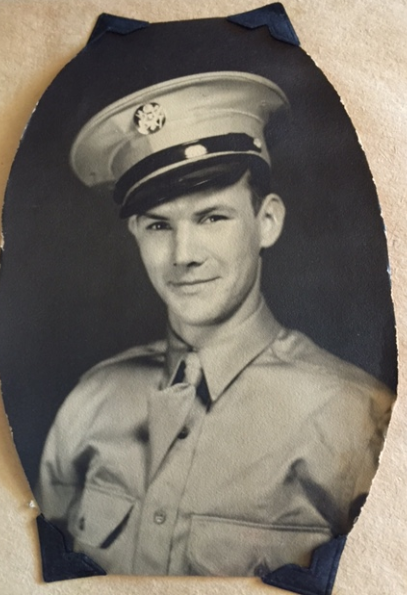
Early Life
Robert Samuel Quirk was the second child and only son born to Samuel Joseph Quirk and Evelyn M. Nilson. He was of Irish and Norwegian descent. His paternal grandparents were born in Ireland, while his mother was born in Norway, immigrating in 1903 and gaining citizenship in 1916. Quirk’s parents married in 1916, and were residing in Philadelphia by 1920. Samuel worked as a car inspector on the steam railroad for Standard Rollerbearing Company.
Evelyn and Samuel first welcomed a daughter, Thelma, in 1917. Robert was born in New Jersey in 1920, and he was followed by a younger sister, Norma, in 1923. The 1930 census reveals that the Quirks, like many other families, struggled during the Great Depression. They lived with Evelyn’s sister, Anna Bagley, and her husband, Dudley, in Norwood, Pennsylvania. Samuel’s work often required the family to relocate.
Quirk spent some of his formative years in Delaware County, Pennsylvania. By 1940, the family was back in New Jersey, living near Berlin. Quirk likely attended Haddonfield High School, but he dropped out after completing tenth grade.
His family remembers him as a mischievous, yet charming, child who won the affection of many of his teachers. Robert also had a reputation as an excellent roller skater, earning the nickname “Speedy” during his frequent trips to the Watsontown Skating Rink. He worked as a locomotive fireman before he entered the military.
Quirk signed up for service at Fort Dix, New Jersey, on April 18, 1942, just days after his father, Samuel, passed away. By this point, the family was living in Voorhees, New Jersey. Samuel Quirk was interred at Berlin Cemetery, but it appears that the young family he left behind struggled to afford a headstone.
Military Experience
A member of the Chemical Warfare Service, Quirk was attached to the Headquarters Company of the Fifth Army Base Section. The Fifth Army participated in Operation Avalanche and the September 1943 assault on the beaches of Salerno, Italy. These feats earned Quirk and his unit the distinction of being among the first American troops to land in mainland Europe during World War II.
Although the use of gas was a common and terrible occurrence in World War I, during the interwar years America’s Chemical Warfare Service strongly maintained its independence and successfully advocated against the ratification of the Geneva Protocol by the U.S. Senate. This move ensured complete autonomy over chemical weapons for the United States moving forward.
Chemical Weapons in World War II
President Franklin D. Roosevelt maintained a direct and straightforward position: the U.S. would not initiate the use of chemical warfare but would automatically retaliate in kind if the Axis Powers utilized such weapons. Mustard gas was prepared in case the nation needed to back up this threat. National policy prevented the Chemical Warfare Service from proposing any type of offensive plan for the use of chemical gas. As a result, the Chemical Warfare Service was beleaguered by supply and transport issues in their efforts to fortify the Mediterranean.
Frustrated chemical officers in the field often sought to convince the War Department that gas warfare supplies had non-gas application potential in hopes they would prioritize resupply. For instance, eyeshields could serve as sunglasses and decontaminating apparatuses could be used to fight fires, spray insecticide, or provide showers for the troops. Quirk likely had to brainstorm creative solutions to deal with shortages in the field.
These challenging field conditions led Lieutenant General Mark Clark’s Fifth Army, in which Quirk served, to set up a unique supply system. They constructed ammunition supply points (ASPs) close to the front for each corps and maintained one additional ASP for troops not assigned to a specific corps. The Ordnance Department commanded a chemical, an ordnance, and an engineer section at each ASP.
Combat troops drew what they needed from the ASP and a single convoy was used to pick up the supplies each day from the various ASPs. Chemical Warfare Service officers and men would resupply each of the ASPs before daylight using materials drawn from Naples. As the Fifth Army advanced, forward area depots were expanded to make sure the distance to resupply remained stable and did not increase. Even with these innovations, shortages of manpower and equipment ensured that the Chemical Warfare Service “found themselves hard put to keep up with Fifth Army needs.”
On a daily basis, individual Chemical Warfare Service members supplied chemical mortars to support the infantry. They also made chemical smoke generators to create a haze to protect high profile targets like ports from air attack as well as provide cover for soldiers during river crossings and other offensive operations.
As he served with the Fifth Army, Quirk likely took part in both the ASP resupply runs and the production of key chemical weapons. Quirk was killed on October 7, 1943, when he stepped on a land mine as the Fifth Army crossed the Volturno River.
Eulogy
Robert S. Quirk’s body was buried in a temporary grave and his mother, Evelyn Quirk, was notified of his death. She was deeply affected by the loss of her only son, and her children noted that she was never the same after his passing. Quirk’s remains were ultimately transferred to Sicily-Rome American Cemetery, which was dedicated in 1956.
5th Army; Records of the Adjutant General’s Office, World War II Operations Reports 1940-1948, Record Group 407 (Box 1619); National Archives at College Park, College Park, MD.
5th Army; Records of the Adjutant General’s Office, World War II Operations Reports 1940-1948, Record Group 407 (Box 1623); National Archives at College Park, College Park, MD.
5th; Records of the Adjutant General’s Office, World War II Operations Reports 1940-1948, Record Group 407 (Box 1928); National Archives at College Park, College Park, MD.
Camden Courier Post. “Samuel J.Quirk Death Notice.” April 16, 1943. Camden County Historical Society.
Ellis van Courtland Moon, John. “United States Chemical Warfare Policy in World War II: A Captive of Coalition Policy?” The Journal of Military History 60, no. 3 (July 1996): 495-511. www.jstor.org/stable/2944522.
Hayden, Harry. Phone interview by author. May 2, 2016.
Hayden, Linda. Email interview by author. June 20, 2016.
Kleber, Brooks E. and Dale Birdsell. “III: CWS Administration and Supply: Mediterranean.” In The Chemical Warfare Service: Chemicals in Combat. Office of the Chief of Military History, United States Army. Washington: Government Printing Office, 1966.
New Jersey. Camden County. 1940 U.S. Census. Digital Images. ancestry.com.
Pennsylvania. Philadelphia County. 1920 U.S. Census. Digital Images. ancestry.com.
Pennsylvania. Delaware County. 1930 U.S. Census. Digital Images. ancestry.com.
Photograph No. SC-122397; “This is how the U.S. Army Doughboy will appear to the enemy, gas mask included,” Photo by Mr. Frank Muto, Bureau of Public Relations, August 1941; National Archives at College Park, College Park, MD.
Photograph No. 190639; “Troops in action in gas attack, Fort McClellan, Alabama, 1943,” Department of the Army, U.S. Signal Corps, Photo #480-533-43-290-3, Maneuvers 9th Battalion, Lot #1461, National Archives at College Park, College Park, MD.
Quirk Family Photographs. Courtesy of Harry and Linda Hayden.
Records for Robert S. Quirk; World War II Army Enlistment Records, 1938-1946 [Electronic File]. ancestry.com.
“Robert S. Quirk.” American Battle Monuments Commission. Accessed February 25, 2016. www.abmc.gov/node/426629#.VwMQleZXF62.
Robert S. Quirk. Headstone and Interment Records for U.S. Military Cemeteries on Foreign Soil 1942-1949 [Electronic File]. ancestry.com.
Robert S. Quirk. U.S. World War II Enlistment Records, 1938-1946 [Electronic File], retrieved from ancestry.com.
“Samuel J. Quirk.” Philadelphia, Pennsylvania Marriage Index 1885-1951 [Electronic File]. ancestry.com.
“U.S. Army Chemical Corps History.” Chemical Corps Regimental Association. Last modified 2012. Accessed April 1, 2016. ccrassn.org/history/.
This profile was researched and created with the Understanding Sacrifice program, sponsored by the American Battle Monuments Commission.
Contributor
Contributed by Mrs. Amanda Reid-Cossentino
Garnet Valley High School
2015-2016
