


Private First Class Edward Francis Rogers
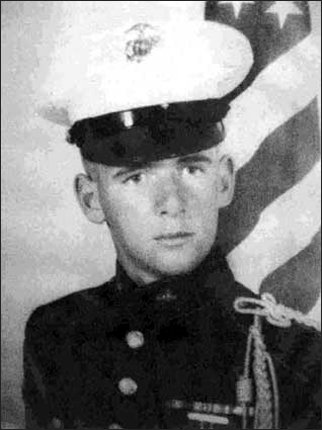
Early Life
Edward Francis Rogers was born in Boston, Massachusetts, on September 29, 1948, to parents Geraldine M. and William A. Rogers. Rogers grew up on Burr Street in Roslindale, a Boston neighborhood where his father worked as a book salesman and his mother as a homemaker. Rogers was the third of four children, with two sisters, Barbara and Elizabeth, and a brother, William.
Rogers attended Roslindale High School, where he was a member of the Key Club (a community service organization), a representative for the Red Cross, and ran cross country track. After graduation, he enlisted in the U.S. Marine Corps and was sent to Vietnam.
Photo carousel gallery
Home Front
Rogers was raised in Roslindale, Massachusetts, a neighborhood in the southwest section of Boston. Originally part of the Town of Roxbury (founded in 1630), it was annexed to the City of Boston in 1873.
For most of the nineteenth century, the area was relatively rural. However, with the rise of the railroad it became more commercial. Roslindale became even more residential towards the end of the nineteenth century and was known as a “streetcar suburb.” According to the 1950 federal census, residents of Rogers’ neighborhood held a variety of jobs, including salesman/woman, general laborer, stenographer, baker, packer, machinist, waitress, movie operator, and many others.
The commercial center of the neighborhood thrived into the 1960s. However, when a shopping mall and grocery stores opened in nearby Dedham, Massachusetts, things started to change. The neighborhood experienced a decline through the 1970s, due to the Boston Busing Crisis, a rise in crime, and other factors, which prompted families to move to suburban areas.
Eight men from Roslindale died in service to the nation during the Vietnam War. Though Rogers willingly enlisted via regular military and was not drafted, overall public opposition to the war and the draft increased in the city of Boston throughout the late 1960s. In fact, the largest anti-war protest in New England history occurred on the Boston Common in 1969.
Opposition to the war in Massachusetts was so widespread that the state legislature formally challenged the legality of the Vietnam War with the passage of the Shea Act in 1970.
Photo carousel gallery
Military Experience
Enlistment
Edward Francis Rogers enlisted in the U.S. Marine Corps after high school graduation. He was assigned to the 2nd Battalion, 4th Marines, nicknamed the “Magnificent Bastards,” a unit which saw increased combat during the Tet Offensive in 1968. While preparing for combat, the unit was stationed at Camp Evans, and then Camp Carroll in the Quang Tri Province.
“Magnificent Bastards”
With a rank of private first class, Rogers was new to the Marine Corps. He was a rifleman with Company F, part of an infantry ground crew that was stationed in South Vietnam during the Tet Offensive and Battle of Khe Sanh. On March 12, 1968, during the Siege of Khe Sanh, Rogers was on patrol with Company F, in Lam Xuan East, Quang Tri Province, when they were ambushed by enemy forces. Rogers was killed by enemy small arms fire along with several others in his company.
The Vietcong were entrenched in the area with significant support including artillery, rockets, and mortars. This was considered a “very active area,” though Company E seized the village on March 15, 1968. The 2nd Battalion, 4th Marines continued to operate in the area through the rest of the month, inflicting high casualties on the enemy.
While accounts of the operation vary slightly, it is estimated that 18 Marines died during this operation. Private First Class Rogers’s body is the only one that was not recovered.
Photo carousel gallery
Commemoration
Edward Rogers, along with four other Marines, earned a Bronze Star with “V” for Valor, for saving others during the ambush. A few days after the ambush, Company E was sent to recover the bodies of Private First Class Rogers and his fellow fallen servicemembers; however, while loading the bodies into the helicopter, the group came under enemy fire.
While trying to evade the enemy fire, it is presumed that Rogers’ body fell out of the helicopter, because when the group returned to base, his remains were missing. While his remains have never been recovered, fellow Marine veterans who recounted the events of the day believe he was lost somewhere over the Cua Viet River.
Private First Class Edward Francis Rogers is memorialized on the Vietnam Veterans Memorial in Washington D.C., Panel 44E, Line 30, and at the Courts of the Missing, Court Five, National Memorial Cemetery of the Pacific in Honolulu, Hawaiʻi.
Photo carousel gallery
Primary Sources
“1300 Shells Blast Khe Sanh; Rockets Rip Saigon Air Base.” Boston Globe [Boston, MA], February 24, 1968. Newspapers.com (434615584).
Condlin, Robert. “The Shea Act.” 1970 Annual Survey of Massachusetts Law. Accessed January 19, 2025. https://core.ac.uk/download/56359619.pdf.
Edward Francis Rogers. U.S. Vietnam Military Casualties, 1956-1968. https://ancestry.com.
Hollander, David N. and Carol R. Sternhell. “Boston: 100,000 Rally.” Harvard Crimson [Cambridge, MA], October 16, 1969. https://www.thecrimson.com/article/1969/10/16/boston-100000-rally-pmore-than-100000/.
Massachusetts. Suffolk County. 1950 U.S. Census. Digital images. https://ancestry.com.
“Positions of major U.S. newspapers.” Boston Globe [Boston, MA], February 18, 1968. Newspapers.com (434561696).
Roslindale High School Yearbook. U.S., School Yearbooks, 1880-2012. https://ancestry.com.
“Vietnam disrupting U.S. colleges.” Boston Globe [Boston MA], March 23, 1968. Newspapers.com (433800379).
Secondary Sources
“Anti-War Activists Sentenced to Prison.” Mass Moments. Accessed January 30, 2025. https://www.massmoments.org/moment-details/anti-war-activists-sentenced-to-prison.html.
“April 1, 1970: Massachusetts Legislature Challenges the Vietnam War.” Historic Ipswich. Accessed January 28, 2025. https://historicipswich.net/2021/04/01/massachusetts-vietnam-war/.
“Changing Attitudes: 1969.” Northeastern University. Accessed January 20, 2025. https://nuhistory.library.northeastern.edu/changing-attitudes-1969/.
Commercial Casebook: Roslindale Village. Historic Boston Incorporated. Boston Public Library.
“Early Protests: 1965-1968.” Northeastern University. Accessed January 16, 2025. https://nuhistory.library.northeastern.edu/early-protests-1965-1968/.
“Edward Francis Rogers.” American Battle Monuments Commission. Accessed December 31, 2024. https://www.abmc.gov/decedent-search/rogers%3Dedward-2.
“Edward Francis Rogers.” The Virtual Wall, Vietnam Veterans Memorial. Accessed April 22, 2025. https://www.virtualwall.org/dr/RogersEF01a.htm.
“Edward Francis Rogers.” Wall of Faces, Vietnam Veterans Memorial Foundation. Accessed February 21, 2025. https://www.vvmf.org/Wall-of-Faces/44220/EDWARD-F-ROGERS/.
“History.” 2/4 Association. Accessed February 20, 2025. https://www.2-4association.org/history/.
“Marine Corps Ranks.” United States Marine Corps. Accessed February 24, 2025. https://www.marines.com/about-the-marine-corps/roles/ranks.html.
“Napalm and the DOW Chemical Company.” PBS. Accessed January 27, 2025. https://www.pbs.org/wgbh/americanexperience/features/two-days-in-october-dow-chemical-and-use-napalm/.
Neighborhood of Roslindale. Map. 2016. Boston Planning and Development Agency. https://www.bostonplans.org/getattachment/cd302fb0-20ba-429e-a3e1-25906f92eb38/.
“PFC Edward Francis Rogers.” Defense Personnel POW/MIA Accounting Agency. Accessed December 17, 2024. https://dpaa-mil.sites.crmforce.mil/dpaaProfile?id=a0Jt00000001UIMEA2.
“PFC Edward Francis ‘Ed’ Rogers.” Find a Grave. Updated October 9, 2012. Accessed December 31, 2024. https://www.findagrave.com/memorial/98558669/edward-francis-rogers.
“PFC Edward Francis Rogers.” Find a Grave. Updated June 13, 2021. Accessed December 31, 2024. https://www.findagrave.com/memorial/98558669/edward-francis-rogers.
Shore II, Captain Moyars S. The Battle for Khe Sanh. U.S. Marine Corps Historical Branch, 1969.
Shulimson, Jack, Lieutenant Colonel Leonard A. Blasiol, Charles, R. Smith, and Captain David A. Dawson. U.S. Marines in Vietnam The Defining Year 1968. History and Museums Division Headquarters, U.S. Marine Corps, 1997. https://www.usmcu.edu/Portals/218/US%20Marines%20In%20Vietnam%20The%20Defining%20Year%201968%20%20PCN%2019000313800.pdf.
Villard, Erik. The Tet Offensive Battles of Quang Tri City and Hue. U.S. Army Center of Military History, 2008. https://www.govinfo.gov/content/pkg/GOVPUB-D114-PURL-gpo84637/pdf/GOVPUB-D114-PURL-gpo84637.pdf.
“Wall of Honor.” 2/4 Association. Accessed February 20, 2025. https://www.2-4association.org/history/wall-of-honor/.
Contributor
Contributed by Ms. Jamie Zelenka
Hingham High School
2024-2025
