


Lieutenant (junior grade) John Robert Laubach
Early Life
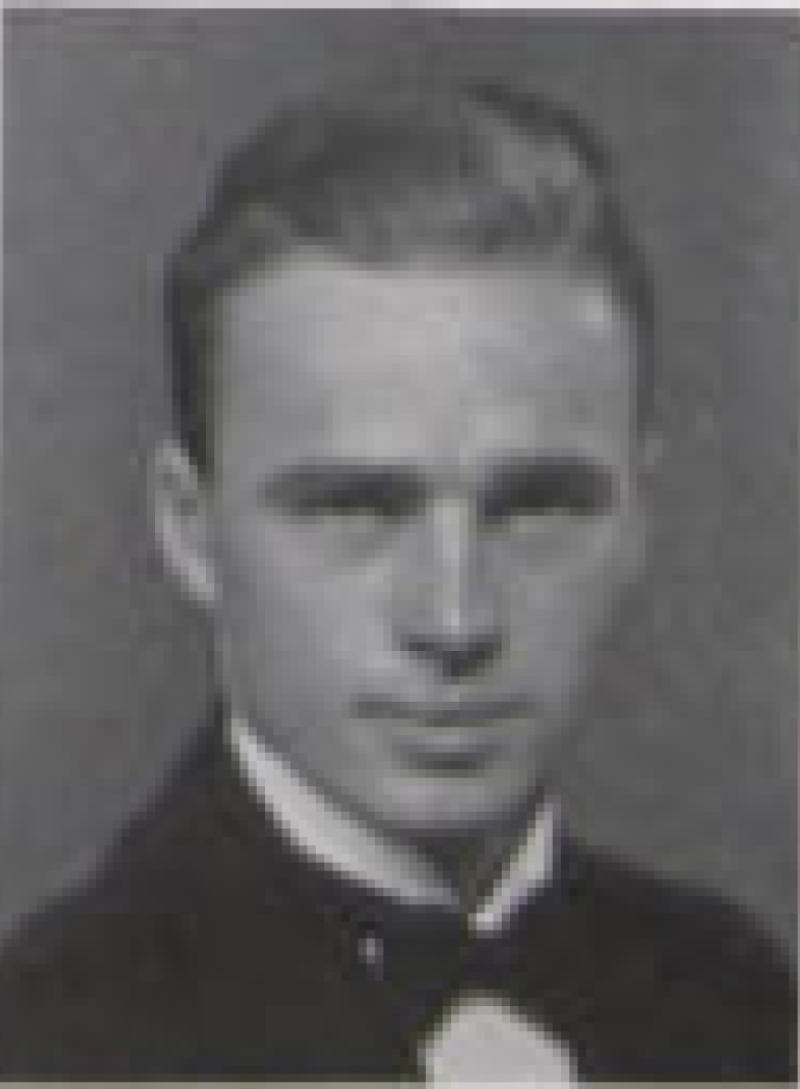
On December 21, 1915, John Robert Laubach was born in Baltimore, Maryland. His father, Charles Adam Laubach, was a physician who served in the U.S. Army Medical Corps during World War I. His mother, Natalie Escher Laubach, was a homemaker who devoted herself to raising John — better known as Jack — and his younger brother, Charles. Although the family moved several times, Jack returned to Maryland often, spending his summers swimming and boating on the shores of the Chesapeake Bay.
The family settled for a while in Pennsylvania, where Jack graduated from Norristown Senior High School (NSHS) in 1933. Noted for his sense of humor and studious looks, Jack participated in many clubs that showed his love of science and sports. Although his time at NSHS was short, the class yearbook noted that he was, “…a friend that will be hard to forget.”
Jack enrolled at The Pennsylvania State College (now The Pennsylvania State University) the following fall. He studied science, graduating with a degree in forestry in 1937. After working as a salesman, Jack got a job with the U.S. Department of Agriculture (USDA). He travelled the country making detailed soil inspections. Evaluations in his USDA file revealed a dedicated worker who was respected by his managers.
Perhaps the brightest part of Jack’s post-college years was his marriage to Virginia (Ginny) Dawson. The two had known each other since childhood, and though Jack’s moves had separated them, they kept their bond alive and wed on September 10, 1938. They would rarely be apart again until Jack’s death.
Military Experience
Shortly after the United States entered World War II, Laubach sought ways to serve his country through his work with the USDA. He requested a transfer to any position related to the war effort. However, it did not take long before Laubach made the decision to join the U.S. Navy. In October 1942, he received a direct commission as an ensign.
After training in Boston, Massachusetts, Laubach became a deck officer, assigned to the USS Eagle 56 (PE-56). The U.S. Navy used eagle boats for anti-submarine patrols and as training vessels. In 1942, the Eagle 56 transferred to Key West, Florida. As an officer in the ship’s 60-man crew, Laubach’s job was to keep the vessel and crew in top condition to carry out its mission. Laubach did well and received high marks from his commanders.
In June 1944, the U.S. Navy sent the Eagle 56 to Maine. There it towed targets for pilots practicing attacks on the enemy. Laubach was promoted to lieutenant (junior grade) and served as the ship’s second in command. Shortly after noon on April 23, 1945, the Eagle 56 suddenly exploded a few miles off the New England coast. Only a handful of men managed to escape the ship as it sank and 13 survivors were pulled from the ocean. Laubach was not among them.
After the explosion, the U.S. Navy held an investigation which determined that the ship sank because its boiler exploded. Many of the survivors believed that the explosion was not an accident, and several swore they saw a submarine as they abandoned ship. Even Admiral Felix Gygax, who oversaw the investigation, noted that there was a strong case for other causes. Still, the findings were approved. As World War II ended, the USS Eagle 56 was all but forgotten except by those who lost someone aboard.
Eulogy
In the late 1990s, a lawyer named Paul Lawton heard the story of the Eagle 56 and began looking into the sinking. Lawton proved that the Eagle 56 was not destroyed by a boiler explosion, but by a torpedo from the German submarine U-853. The submarine had orders to sink Allied shipping vessels in the weeks before Germany’s surrender. The U.S. Navy reviewed and accepted Lawton’s findings and reversed the decision from the 1945 investigation. Each crewmember from the USS Eagle 56 who died had their status changed to Killed in Action and was awarded the Purple Heart. Laubach’s medal was received by Ginny, who still deeply felt his loss over fifty years later.
It seemed that the final chapter had been written in the story of the USS Eagle 56. Then, in 2018, a team of eight divers known as the Nomad Exploration Team discovered the wreck of the ship. Their discovery further proved the true cause of the sinking and sparked renewed interest in the fate of the ship and its crew.
Today, John R. Laubach is memorialized in Hecktown, Pennsylvania, State College, Pennsylvania, and the East Coast Memorial in New York, New York. The memory of his service and sacrifice stands as a testament to all of those who, through accident or enemy fire, gave their lives in defense of their country.
Eagle 56 (PE-56) May 1944 to March 1945; Deck Logs, 1941-1950; Records of the Bureau of Naval Personnel, Record Group 24 (Box 3138); National Archives at College Park, College Park, MD.
Eastman, Peggy. Godly Glimpses: Discoveries of the Love That Heals. Huntington: Our Sunday Visitor, Inc., 1999.
“John Laubach.” American Battle Monuments Commission. Accessed January 1, 2019. www.abmc.gov/node/490223.
John Laubach in Service Dress Blue Uniform. Photograph. Official Military Personnel File, Department of the Navy, Records of the Bureau of Naval Personnel, RG 24, National Archives and Records Administration – St. Louis. Image.
John R. Laubach, Official Military Personnel File, Department of the Navy, Records of the Bureau of Naval Personnel, RG 24, National Archives and Records Administration – St. Louis.
John R. Laubach, Personnel File, Department of Agriculture, RG 16, National Archives and Records Administration – St. Louis
John R. Laubach’s Memorial Headstone. Photograph. February 2019. Collection of Leif Liberg. Image.
Norristown Senior High School. Spice. Norristown: Norristown Senior High School, 1933. Montgomery County — Norristown Public Library, Public History Collection.
Oklahoma. Oklahoma County. Marriage License. Digital Images. ancestry.com.
Pennsylvania State University. La Vie 1937. State College: Senior Class of 1937, 1937. Penn State University Archives. digital.libraries.psu.edu/digital/collection/lavie/search/searchterm/1937/field/format/mode/all/conn/and/order/title/ad/asc/cosuppress/1.
Puleo, Stephen. Due To Enemy Action: The True World War II Story of the USS Eagle 56. Guilford: Lyons Press, 2005.
Seid to Sentinel, Records Relating to Naval Activity During World War II, World War II Action and Operational Reports; Records of the Office of the Chief of Naval Operations, Record Group 38 (Box 1425); National Archives at College Park, College Park, MD.
Selfridge (DD-357) January 1945 to October 15, 1945 and Selinur (AKA-41) April 21, 1945 to June 1945; Deck Logs, 1941-1950; Records of the Bureau of Naval Personnel, Record Group 24 (Box 8769); National Archives at College Park, College Park, MD.
Tow Craft Eagle 57 (PE-57) and Spar. Photograph. August 19, 1944. National Archives and Records Administration (80-G-277969). Image.
USS Eagle 2. Photograph. c. 1910-1919. U.S. Navy (030415-N-0000X-001). Image. www.navy.mil/view_image.asp?id=6741.
This profile was researched and created with the Understanding Sacrifice program, sponsored by the American Battle Monuments Commission.
Contributor
Contributed by Mr. Leif Liberg
Saint Mary’s Ryken High School
2018-2019
