


Musician Third Class Morris Wilbur Bennett
Before the War
From a Large Family
Morris Wilbur Bennett was born on December 20, 1895 in Thurmont, near Frederick, Maryland. He was the first of 11 sons and one daughter born to William Comfort and Netty J. Stull Bennett. Within a few years, the Bennett family moved to Frederick, Maryland, where his father worked as a cabinetmaker in a local lumberyard.
With so many siblings born quickly one after another, it is likely that, as the eldest, Morris played an important role in helping his parents bring up his younger siblings. By age 14, Morris, nicknamed “Red,” was helping to support the family, working as a hosier at the Union Manufacturing Company, along with his brother Russell.
Active Member of the Community
The Bennett family attended the Evangelical Lutheran Church. According to the Frederick News, Morris and brothers Russell and Howard were confirmed on May 31, 1914. Morris was 19 years old. Morris regularly attended church and received communion from January 1915 through April 1917.
Music was an important part of Morris’s youth. In July 1913, Morris and his brother Russell joined the Loyal Order of Moose Lodge Band in Frederick. Russell played the mellophone and Morris played the clarinet. The lodge purchased and provided the instruments for its 45 members who performed at various community events. Morris also was an active member of his community, becoming a volunteer fireman and elected assistant pipeman with the Independent Hose Company No. 1 in 1912 at age 16. By 1917, Morris was elected to the position of Assistant Foreman.
Home Front
Producing for the War Effort
During the first half of the nineteenth century, German immigrants settled in the town of Frederick and in Frederick County. The economy of the county was based on agriculture, while small industries such as granaries and lumberyards developed in the town.
By the turn of the next century, the largest employer in town was the Union Manufacturing Company (Union Knitting Mills). The factory produced silk hosiery for women, and by 1905 more than “400 men, women, and children” worked there. In 1917, the factory was converted into a war plant, producing more than 400,000 socks for the U.S. Army.
After the United States entered the war against Germany, Frederick’s residents of German ancestry faced a new challenge. Proud of their heritage, they nevertheless actively showed their patriotism in supporting the war effort.
Boys of Frederick
Segregated education existed in the town of Frederick. Russell Bennett indicated he and his siblings likely attended the all white South Street School. However, because the high schools charged a fee, the majority of boys in Frederick could not afford to attend the tuition-based schools. In 1891, local citizens lobbied for a new school for white boys only. The Frederick Boys High School opened in September. The school mandated military training which was reflected in the uniform and team name, The Cadets.
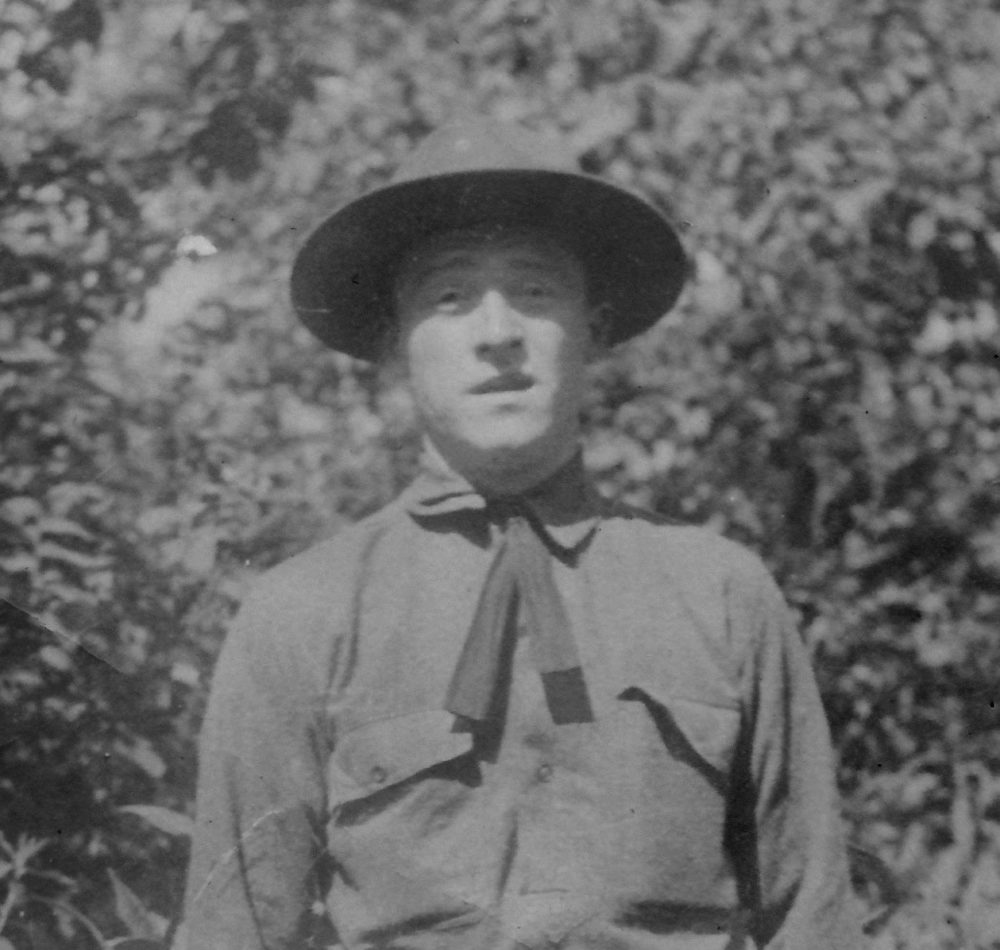
Although Morris worked at the local factory, he likely attended the Frederick Boys’ High School. In one of the few existing photos of Morris, he is wearing the school’s cadet uniform. The goal of the school was to develop boys into disciplined young men who would participate in school and civic life. Many of its graduates answered the call to enlist in Company A of the 1st Maryland Infantry.
The Dreaded Flu
While soldiers overseas faced mud and bullets, they also were hit by the ever spreading Spanish Flu pandemic surging across Europe. As soldiers came home, the flu often came with them, infecting scores of citizens, including those in Frederick County. More than 2,000 cases of the flu were reported in September of 1918, around the same time as the flu hit members of the 115th Infantry in the Alsace region of France.
Military Experience
Joining the Army
Bennett was 5 feet, 7 inches tall, had wavy, red hair, and brown eyes. He was single and working as a foreman at the Union Manufacturing Company when he enlisted in the First Regiment Band of the Maryland National Guard as a private on July 11, 1917, at the age of 21. He was a member of Company A of the 1st Maryland Infantry (which later consolidated with the 4th and 5th Maryland Regiments in August 1917 to form the 115th Infantry).
Training with the Newly Formed 29th Division
In September, he was transferred to Headquarters Company at Hagerstown, Maryland where he joined the Headquarters Company Band. With his clarinet in tow, Musician Third Class Morris Bennett was sent to Camp McClellan in Anniston, Alabama for training. Upon arrival, the members of the 115th Infantry spent their first weeks building camp facilities. Intensive training then began which included all-day marches, hikes, and drills. Soldiers who at first tried to evade mud and puddles soon learned to march right through as they trained for the fields of France.
Shipping Out to France
Nine months later, on May 9, 1918, Musician Third Class Bennett took the troop train to Hoboken, New Jersey, passing through Maryland and boarded the USS Covington with the 115th Infantry of the 29th Division bound for France with 4,200 soldiers. The band played concerts to ease the boredom aboard ship before the USS Covington docked in the harbor near Brest, France on June 17, 1918.
Marching to Alsace-Lorraine sector
From Brest, the troops were transported across France by train. The company celebrated the Fourth of July and later Bastille Day on July 14, parading with flags flying and the Headquarters Band playing.
On July 18, the 115th Infantry began heading toward Centre Secto, Haute Alsace, marching 20 miles on the first day. From July to October, Musician Bennett marched with the 115th Infantry across the fields of France, playing his clarinet with the band, boosting morale with the tunes of “Dixie”, “Maryland,” and “Goodbye Broadway, Hello France”. But once near the front, the few performances of the band were restricted to playing “Nearer My God to Thee” at burial ceremonies.
Laying Down the Clarinet for a Shovel
The Headquarters Band of the 115th was so close to the front line that its members could smell the mustard gas and count the hundreds of shells that fell day after day. Instead of making music, band members were required to dig ditches and trenches and serve as stretcher-bearers. Musician Bennett likely laid down his clarinet to pick up a shovel to dig graves.
By the end of September, the 115th Infantry suffered 806 casualties with 659 cases of the flu. Among them was Morris Bennett. Evacuated to a field hospital, Musician 3rd Class Bennett died of bronchial pneumonia on October 8, 1918, as the 115th Infantry began another offensive.
Reflection
Although your parents and siblings found it too difficult to talk about you after your death, I want you to know that your mother and father, your sister and nine brothers were proud of your service to our country and honored to know that you inspired the troops with the sound of your music. Your nieces and nephews and all of the members of the large Bennett family are proud that you, Uncle Morris, were willing to give the ultimate sacrifice in the pursuit of freedom. With love and respect, your niece and brother Paul’s daughter, Pam Bennett.
Perhaps his lungs were weakened by gas, and no doubt due to the flu, Musician Third Class Bennett died of bronchial pneumonia on October 8, 1918, as the 115th began another offensive. He was posthumously awarded the Order of St. Sava by Serbia for meritorious achievement in the arts. Serbia awarded only 19 such awards to its allies.
Uncle Morris passed away from one of the worst diseases to afflict one who needed his breath to make music. No longer able to breathe deeply and perform the songs that inspired the troops to press on, Uncle Morris took his last, rasping breath under the tent of a makeshift army hospital in the fields of France. But as the sun set each night thereafter, and if the troops listened closely, perhaps they continued to hear the distant sound of Musician Bennett’s golden clarinet.
And the band played on.
Commemoration
During the first week in October, William and Netty Bennett received a letter from their son telling them he was well. However, on the evening of November 8, 1918, the Bennetts received a telegram from the War Department informing them of Morris’s death.
On September 28, 1919, William and Netty Bennett attended the unveiling of a memorial plaque in memory of their son. The plaque was placed on the wall of the Sunday school at the Evangelical Lutheran Church of which Morris had been a member. In November 1924, the city of Frederick erected a monument to the “loyal sons of Frederick county . . . who made the supreme sacrifice . . . during the World War.” One of the eight bronze tablets includes the name of Musician Third Class Morris W. Bennett.
Morris Bennett passed away from one of the worst diseases to afflict one who needed his breath to make music. No longer able to breathe deeply and perform the songs that inspired the troops to press on, Musician Bennett took his last, rasping breath under the tent of a makeshift army hospital in the fields of France. But as the sunset each night thereafter, and if the troops listened closely, perhaps they continued to hear the distant sound of Musician Bennett’s golden clarinet.
“29th’s Battleground Unchanged in 6 Years: Col. Markey Sees Graves of Local Men in France.” The News [Frederick, Maryland], August 2, 1924. https://ancestry.com.
29th Division; Records of the American Expeditionary Forces (World War I), Combat Divisions, 115th Infantry Regiment Field Orders 1917-1919, Record Group 120 (Box 10); National Archives at College Park, College Park, MD.
29th Division; Records of the American Expeditionary Forces (World War I), Combat Divisions, 115th Infantry Regiment Field Orders 1917-1919, Record Group 120 (Box 9); National Archives at College Park, College Park, MD.
29th Division; Records of the American Expeditionary Forces (World War I), Combat Divisions, Headquarters Casualties Jan-Apr. 1919, Record Group 120 (Box 85); National Archives at College Park, College Park, MD.
“Among the Sick.” The News [Frederick, Maryland], September 29, 1919. Newspapers.com (7422912).
“Another Chance to Serve Nation: First Regiment Band is Being Recruited–Seventeen Musicians Needed.” The Frederick Post [Frederick, Maryland], July 17, 1917. https://ancestry.com.
Beall, William H. Letter to the editor. The Musical Messenger: A Monthly Band and Orchestra Journal 12, no. 1: 26. books.google.com/books?id=fdZCAQAAMAAJ&lpg=RA3-PA26&ots=74KU65QI_2&dq=Frederick%20%22Moose%20Band%22&pg=RA3-PA26#v=onepage&q=Frederick%20%22Moose%20Band%22&f=false.
Bennett Family Photograph Collection. 1917-1918. Courtesy of Pamela Bennett.
Bennett, Pamela. Interview by Dr. Cathy Gorn. Indianapolis, Indiana. May 1, 2016.
“Captain John E. Bennett.” The Baltimore Sun [Baltimore, Maryland], May 21, 1900. Newspapers.com (53884614).
Crawford, A. E. 115th Headquarters Band with the 29th Division at Camp McClellan, Alabama. Photograph. December 14, 1917. Alabama Department of Archives and History.
Cutchins, John A. and George Scott Stewart, Jr. History of the Twenty-Ninth Division “Blue and Gray” 1917-1919. Philadelphia: MacCalls & Company, 1921. https://books.google.com/books?id=yhDOAAAAMAAJ&printsec=frontcover&source=gbs_ge_summary_r&cad=0#v=onepage&q&f=false.
“Escort to Company A.” The News [Frederick, Maryland], October 1, 1916. Newspapers.com (8810128).
“Evangelical Lutheran Church.” The News [Frederick, Maryland], June 1, 1914. Newspapers.com (20421070).
“Fire Company 100 Years Old in 1918: Independents Plan Celebration.” The Frederick Post [Frederick, Maryland], January 13, 1917. https://ancestry.com.
Ford, Joseph, Lynne Wells, and Melissa Conroy. The History of the Union Manufacturing Company from 1887 to 1957. Frederick: Fredericktowne Print and Graphics, 1997.
“Forty-Eight Members in the Moose Band.” The News [Frederick, Maryland], July 1913. Newspapers.com (52124518).
“Frederick Boys.” The Frederick Post [Frederick, Maryland], September 14, 1917. https://ancestry.com.
“From Near-By Towns: Chronicle of Happenings Amongst Our Friends.” The Democratic Advocate [Westminster, Maryland], July 4, 1910. Newspapers.com (52122385).
“From Near-By Towns: Chronicle of Happenings Amongst Our Neighbors.” The Democratic Advocate [Westminster, Maryland], July 29, 1910. Newspapers.com (52123849).
Haugh, Chris. “The Great War’” Stories in Stone Blog, Mount Olivet Cemetery. November 19, 2017. https://www.mountolivethistory.com/stories-in-stone-blog/the-great-war.
Haugh, Chris. “The Labor Chief of the Union Knitting Mills.” Stories in Stone Blog, Mount Olivet Cemetery. August 31, 2019. https://www.mountolivethistory.com/stories-in-stone-blog/the-labor-chief-of-the-union-knitting-mills.
Haugh, Chris. “No Ordinary Flu Season.” Stories in Stone Blog, Mount Olivet Cemetery. October 9, 2018. https://www.mountolivethistory.com/stories-in-stone-blog/no-ordinary-flu-season.
“The History of IHC.” Independent Hose Company. Last modified 2020. Accessed January 18, 2023. https://www.ihc-1.org/content/history/.
“Inspiring Ceremonies Mark the Unveiling and Dedication of Frederick’s Tribute to Her Service Men and Women.” The Frederick Post [Frederick, Maryland], November 24, 1924. https://ancestry.com.
“Local Brevities.” The Democratic Advocate [Westminster, Maryland], July 22, 1905. Newspapers.com (52123065).
Lynch, Colonel Charles, Colonel Joseph H. Ford, and Lieutenant Colonel Frank W. Weed. The Medical Department of the United States in the World War, Field Operations (Volume VIII). Washington, D.C.: Government Printing Office, 1925. https://collections.nlm.nih.gov/bookviewer?PID=nlm:nlmuid-14120390RX8-mvpart.
Marks, Alfred T. “274 Musicians Killed and Hurt in Army Bands.” Musical America 29, no. 17 (February 22, 1919).
“Make Nominations – Independent Hose Company Holds Regular Meeting.” The News [Frederick, Maryland], January 13, 1912. Newspapers.com (7593870).
Maryland. Frederick County. 1900 U.S. Census. Digital image. ancestry.com.
Maryland. Frederick County. 1910 U.S. Census.Digital image. ancestry.com.
Maryland. Frederick County. 1920 U.S. Census. Digital image. ancestry.com.
Military and Naval Service Records. Vol. 1 of Maryland in the World War 1917-1919. Baltimore: Maryland War Records Commission, 1933.
“MORRIS BENNETT, Frederick, Dies in France–Another Frederick boy has died in France.” The Daily News [Frederick, Maryland], November 9, 1918.
“Morris W. Bennett.” American Battle Monuments Commission. Accessed June 22, 2020. www.abmc.gov/decedent-search/bennett%3Dmorris.
“Morris W. Bennett.” U.S., Army Transport Service, Passenger Lists, 1910-1939. Records of the Office of the Quartermaster General, 1774-1985 (Record Group 92, Box 420). National Archives at College Park, College Park, Maryland.
“Morris Wilbur Bennett.” World War I Draft Registration Cards, 1917-1918. Digital images. https://ancestry.com.
Panuska, Mallory. “Disease of a Century: Records Recount 1918 Spanish Flu and Similarities to COVID in Frederick County.” The Frederick News-Post [Frederick, Maryland], April 15, 2020. www.fredericknewspost.com/terms/printview/72_hours/disease-of-a-century-records-recount-1918-spanish-flu-and-similarities-to-covid-in-frederick/article_f4657a8c-4816-5953-932a-434170178571.html.
“Personal.”Catoctin Clarion [Mechanicstown, Maryland], July 5, 1917. Newspapers.com (52122385).
Reynolds, Frederick C. 115th Infantry U.S.A., in the World War. Baltimore: The Read-Taylor Company, 1920. archive.org/details/115thinfantryusa00reyn/mode/2up.
“Sham Battles One of Labor Day Events.” The News [Frederick, Maryland], August 25, 1916. Newspapers.com (52127329).
“Soldier Musician.” The Frederick Post [Frederick, Maryland], July 26, 1917. https://ancestry.com.
“Thirty New Moose in the Frederick Lodge.” The News [Frederick, Maryland], February 26, 1914. Newspapers.com (8736514).
Williams, T. J. C., and Folger McKinsey. History of Frederick Maryland. Baltimore: Regional Publishing Company, 1979.
Contributor
Contributed by Dr. Cathy Gorn
National History Day
2017–2018
