


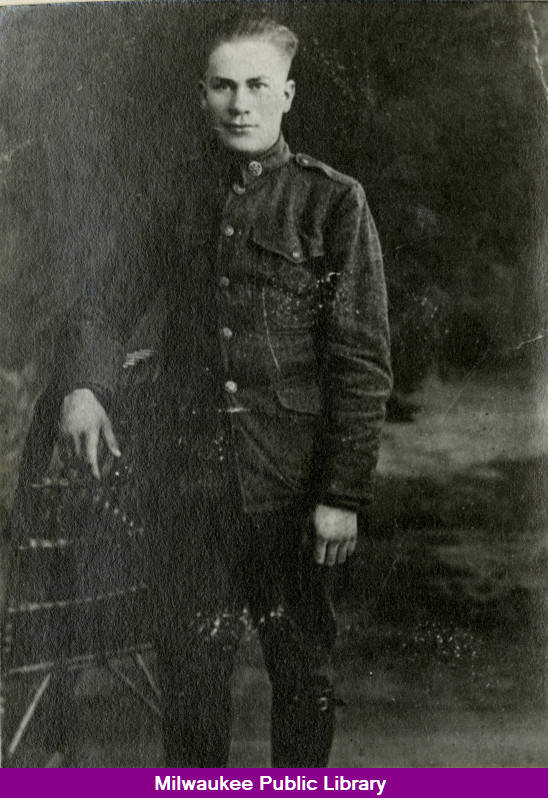
Private Edward J. Bresler (Eddie Clarence Roy Bresler)
Early Life
Eddie Clarence Roy Bresler was born to German immigrant Louis Bresler (Ludwig Wilhelm Johann “Louis” Bresler) and Mary Teresa Denz Bresler on April 8, 1899, in Milwaukee, Wisconsin. He was the youngest of 12 children. At some point, his name was changed to Edward J. Bresler. His father died in 1912 due to complications from a streetcar accident.
The exact details of Bresler’s schooling are unclear. Census records from 1910 indicate that Edward attended school and was literate. His older brother attended Grant School in Milwaukee, a nearby public school. Edward is listed as Catholic, the original religion of his mother, Mary.
By 1916, Edward was listed as a “helper” in the Milwaukee City Directory, possibly assisting in the family shoemaking trade. In early 1917, however, he enlisted in the United States Army. Military service was not new to the Bresler family. Edward’s grandfather, Ludwig, served in the 6th Infantry during the Civil War. In addition, Edward’s brother Herman followed him into service in World War I, joining the military in July 1918 as part of the 27th Field Artillery.
Photo carousel gallery
Home Front
Known as the “Machine Shop of the World,” Milwaukee was a major American industrial city at the turn of the twentieth century. The city contributed to the war effort through manufacturing and agriculture.
Milwaukee industries provided essential war materials, from leather shoes to saddles, rifle grenades, truck frames, ship plates and engines, field artillery pieces, and motorcycles from Harley-Davidson. Meatpacking plants and canneries produced food for the war effort. Before enlisting, Edward Bresler worked for the Nunn Bush Weldon Shoe Company, a business that later manufactured boots for soldiers during the war.
Called the “German Athens” and “The Munich of the Midwest,” Milwaukee had a strong German-American presence. Around the time of World War I, there were more German-born Milwaukeeans than native born. Prior to the American entrance into the conflict, the city supported the German people in Europe. The charity War Bazaar held in 1916 became one of the biggest events of the decade in Milwaukee. Organized to benefit German and Austrian war sufferers, including the widows and orphans of fallen soldiers, the event was attended by 175,000 people and raised more than $150,000.
As the United States entered World War I, Milwaukee experienced a shift from its earlier German sympathies to a surge of patriotic support for the war effort. Milwaukee saw a surge in enlistments and consistently exceeded its Liberty Loan quotas, a clear sign of loyalty to the Allied powers and the U.S. troops.
As a result of the conflict, Milwaukee saw a decline in its strong German cultural identity. The Wisconsin Loyalty League identified the city as a potential hotspot for sedition, leading to intense scrutiny of German Americans. Anti-German sentiment penetrated all aspects of Milwaukee’s life. Many German Americans broke from their heritage by changing their last names and the names of places. The largest German-language newspaper in the country, The Germania, changed its name and format, even removing a German statue from its building. The German-English Academy was renamed Milwaukee University School, and the Deutscher Club became the Wisconsin Club. The Pabst Theater, once known for its German plays, stopped offering them altogether. Almost all schools removed the German language from their curricula.
Photo carousel gallery
Military Experience
Edward Bresler enlisted in the U.S. Army on January 16, 1917, before the United States officially declared war on Germany. He trained at Jefferson Barracks in Missouri before being assigned to the 6th Cavalry, Troop H. On March 16, 1918, Edward left from New York aboard the Adriatic, arriving in France shortly thereafter. His last recorded field address places him in France with the 6th Cavalry, likely near Gievres and Vendome.
Five cavalry regiments operated on the Western Front in 1917 and 1918. The use of the U.S. cavalry changed in World War I due to the advent of trench warfare and the mechanization of transportation. Cavalry regiments moved away from traditional horseback combat. Instead, most cavalry units during World War I were utilized for remount stations, military police duties, and motorized transport support. Only one cavalry regiment, the 2nd Cavalry, is listed as seeing direct combat. However, the U.S. Cavalry performed important support duties.
Records indicate that Edward Bresler was transferred from active duty to “D/S at Motor Works” in April 1918, suggesting he played a role in vehicle maintenance or transportation operations.
Photo carousel gallery
Commemoration
Seven months after the armistice, Edward Bresler died in Vendome, France, on May 19, 1919. The cause of his death was complications related to periodontitis and a ruptured appendix. He was initially prepared to be sent home to Milwaukee in 1920 at the request of his mother. However, his mother made the difficult decision to leave his remains in France.
He was first laid to rest in Tours at St. Symphorien Military Cemetery, but he was disinterred and moved. There is a discrepancy in the identification of his remains, as the body tag read 1003509, while Bresler’s identification number was 1003959. His wooden casket was transferred to Seringes-et-Nesles in the Aisne region and buried at the Oise-Aisne American Cemetery in 1921.
His mother was eligible for the Gold Star Mothers’ pilgrimage to visit his grave, but she declined due to her age and declining health.
Photo carousel gallery
Primary Sources
“A Call to Americans.” Milwaukee Sentinel [Milwaukee, WI]. March 17, 1917. https://infoweb.newsbank.com/.
“Appeal for Funds for German Soldiers at Milwaukee Bazaar.” The Journal Times [Racine, WI], February 24, 1916. Newspapers.com (334013213).
“Asks Removal of School Teacher.” Milwaukee Sentinel [Milwaukee, WI], October 28, 1917. https://infoweb.newsbank.com/.
“Big Demand for Motorcycles, Says English Representative of Harley-Davidson Company Art Dinner for Officials.” Milwaukee Sentinel [Milwaukee, WI], April 6, 1919. https://infoweb.newsbank.com/.
Charity Bazaar for the Benefit of War Suffers. Poster. 1916. Wisconsin Historical Society (133082). https://www.wisconsinhistory.org/Records/Image/IM133082.
Eddie Clarence Roy Bresler. Milwaukee, Wisconsin, U.S., Births, 1839-1911. https://ancestryclassroom.com.
Edward Bresler. Point of Embarkation Passenger List. Digital image. https://www.fold3.com/
Edward Bresler, 1917. U.S, City Directories, 1822-1995. https://ancestryclassroom.com.
Edward Bresler, 1918. U.S City Directories, 1822-1995. https://ancestryclassroom.com.
Edward Bresler, 1919. U.S. City Directories, 1822-1995. https://ancestryclassroom.com.
Edward Bresler, 1920. U.S, City Directories, 1822-1995. https://ancestryclassroom.com.
Edward J. Bresler. Burial Case File. National Archives and Records Administration – St. Louis.
Edward J. Bresler. American War Mothers WWI Servicemen, Milwaukee Public Library. https://content.mpl.org/digital/collection/WWI/id/24931/.
Edward J. Bresler. Morning Reports, 1912-1939. https://www.fold3.com
“Even Milwaukee Grows Anti-German.” Iowa County Democrat [Mineral Point, WI], April 19, 1917. Newspapers.com (827916648).
“German English Academy Makes Name Change.” Leader-Telegram [Eau Claire, WI], May 26, 1918. Newspapers.com (239463833).
“German Newspaper Drops Teutonic Title.” Milwaukee Sentinel [Milwaukee, WI], May 27, 1918. https://infoweb.newsbank.com/.
“Great War-Time Showing of City’s Leather Industry.” Milwaukee Sentinel [Milwaukee, WI], May 7, 1918. https://infoweb.newsbank.com/.
Johan and Mary Bresler. Milwaukee, Wisconsin, U.S., Marriages, 1838-1911. https://ancestryclassroom.com.
“Loan Surplus Here, $7,080,850.” Milwaukee Sentinel [Milwaukee, WI], October 28, 1917. https://infoweb.newsbank.com/.
“Loyalty of City Proved to Nation.” Milwaukee Sentinel [Milwaukee, WI], July 16, 1916. https://infoweb.newsbank.com/.
“Milwaukee Airplane Entire New Departure.” Milwaukee Sentinel [Milwaukee, WI]. September 22, 1919. https://infoweb.newsbank.com/.
“Milwaukee’s Loyalty Pledged to President at Patriotic Meeting.” Milwaukee Sentinel [Milwaukee, WI], March 18, 1917. https://infoweb.newsbank.com/.
“People to Decide on Meatless Days.” Milwaukee Sentinel [Milwaukee, WI], September 22, 1919. https://infoweb.newsbank.com/.
“Phoenix Knitting Works to be Largest in World.” Milwaukee Sentinel [Milwaukee, WI], November 3, 1919. https://infoweb.newsbank.com/.
South Side Manufacturing District. Panoramic Sketch. In Anderson, W.J. and Julius Bleyer, Eds. Milwaukee’s great industries: a compilation of facts concerning Milwaukee’s commercial and manufacturing enterprises, its trade and commerce, and the advantages it offers to manufacturers seeking desirable locations for new or established industries. Association for the Advancement of Milwaukee, 1892. https://catalog.hathitrust.org/Record/008597843.
Statistics for Wisconsin. U.S. Census. 1910. https://www2.census.gov/library/publications/decennial/1910/abstract/supplement-wi.pdf.
“Students Drop German from Academy’s Name.” Milwaukee Sentinel [Milwaukee, WI], March 9, 1918. https://infoweb.newsbank.com/.
“The Spirit of the Bazaar.” The Milwaukee Leader [Milwaukee, WI], March 8, 1916. https://chroniclingamerica.loc.gov/lccn/sn83045293/1916-03-08/ed-1/seq-10/.
“Wisconsin News Stated in Brief.” The Wisconsin Tobacco Reporter [Edgerton, Wisconsin], May 10, 1918. https://chroniclingamerica.loc.gov/lccn/sn86086586/1918-05-10/ed-1/seq-7/.
“To Work for Big Bazaar.” West Bend News [West Bend, WI], February 9, 1916. Newspapers.com (1035400600).
“What You Should Eat.” Milwaukee Sentinel [Milwaukee, WI], November 9, 1917. https://infoweb.newsbank.com/.
Wisconsin Loyalty League. Sedition Map. Map. March 21, 1918. Wisconsin Historical Society (40882). https://www.wisconsinhistory.org/Records/Image/IM40882.
Wisconsin. Milwaukee County. 1900 U.S. Census. Digital images. https://ancestryclassroom.com.
Wisconsin. Milwaukee County. 1910 U.S. Census. Digital images. https://ancestryclassroom.com.
Secondary Sources
Abing, Kevin. A Crowded Hour: Milwaukee During the Great War, 1917-1918. America Through Time, 2017.
Bielakowski, Alexander M. From Horses to Horsepower: The Mechanization and Demise of the U.S. Cavalry, 1916-1950. Fonthill, 2019.
Davis, Daniel T. “The ‘Fighting Sixth’” 6th U.S. Cavalry.” The American Battlefield Trust. Updated May 24, 2024. Accessed January 8, 2025. https://www.battlefields.org/learn/articles/fighting-sixth-6th-us-cavalry.
Carriere, Michael. “Industrial Landscapes.” Encyclopedia of Milwaukee. Accessed April 1, 2025. https://emke.uwm.edu/entry/industrial-landscapes/.
“Edward J. Brelser.” American Battle Monuments Commission. Accessed November 1, 2024. https://www.abmc.gov/decedent-search/bresler%3Dedward.
“Friederike Schulz Bresler.” Find a Grave. Updated May 31, 2013. Accessed December 4, 2024. https://www.findagrave.com/memorial/111565490/friederike-bresler.
Glad, Paul. The History of Wisconsin – War, a New Era, and Depression. The State Historical Society of Wisconsin, 1990.
Gurda, John. The Making of Milwaukee. University of Wisconsin Press, 1999.
Kichen, Lee F. “The Death of the Horse Cavalry and the Birth of the Armored Force.” On Point 23, no. 3 (2018): 6–13. https://www.jstor.org/stable/26478369.
“Ludwig G. ‘Louis’ Bresler.” Find a Grave. Updated April 18, 2013. Accessed December 4, 2024 https://www.findagrave.com/memorial/108710186/ludwig_g-bresler.
Pifer, Richard L. The Great War Comes to Wisconsin: Sacrifice, Patriotism, and Free Speech in a Time of Crisis. Wisconsin Historical Society Press, 2017.
“PVT Edward J. Brelser.” Find a Grave. Updated August 8, 2010. Accessed November 1, 2024. https://www.findagrave.com/memorial/56636089/edward_j_bresler.
Rippley, Laverne J. “Wisconsin German-Americans and World War I: Wisconsin, ‘The German-American Homefront.’” Yearbook of German-American Studies, 2015. https://journals.ku.edu/ygas/article/download/18181/16356.
“The Rise Of Wisconsin’s ‘Hyper-Patriots’ During World War I.” PBS Wisconsin. Accessed January 8, 2025. https://pbswisconsin.org/news-item/the-rise-of-wisconsins-hyper-patriots-during-world-war-i/.
“Wartime Milwaukee.” The Encyclopedia of Milwaukee. Accessed January 8, 2025. https://emke.uwm.edu/entry/wartime-milwaukee/.
This profile was researched and created through the Researching Silent Heroes program, sponsored by the American Battle Monuments Commission.
Contributor
Contributed by Mr. Chuck Taft
University School of Milwaukee
2024-2025
