


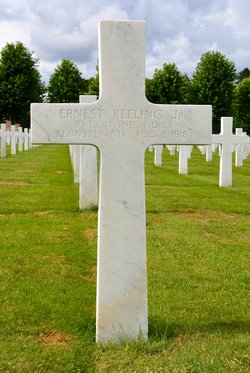
Private Ernest Keeling Jr.
Early Life
Private Ernest Keeling, Jr., was born in Niles, Ohio. He was the third of eight children born to Ernest and Agnes Brooks Keeling. Between 1900 and 1910, the family relocated across the state line to New Castle, Pennsylvania. New Castle was known as a manufacturing town, and his father worked in the tin mill industry throughout his life. Ernest was raised on the south side with the other mill workers’ families. He enjoyed hunting in the local area for small game, and as a young man, the New Castle Herald reported that he killed two rabbits with a single shot!
After attending school, Ernest worked at the New Castle Electrical Company before being drafted at the age of 25.
Photo carousel gallery
Home Front
Keeling’s hometown, New Castle, Pennsylvania, was known as the “Tin Plate Capital of the World” in the late 1800s and early 1900s. Tin plate is steel or iron coated with a thin layer of tin, which made it more durable and resistant to corrosion. The American Tin Plate Company played a crucial role in producing tin cans, which were essential for preserving food for soldiers, and made them ideal for long-term storage and transportation.
As the twentieth century arrived, steel manufacturing started to gain momentum in the area. In 1892, the Shenango Valley Steel Company opened. By 1903, the Carnegie Steel Company took it over, and the plant became known as the New Castle Works of the Carnegie Steel Company. In 1913, the company constructed a large playground on its property along South Jefferson Street, which was open during the summer months. It featured an auditorium for movies and an athletic field, which offered adult sports leagues. This steel was crucial for producing weapons, vehicles, and infrastructure during the war effort.
The new wave of labor for those industries often included southern Europeans—Italians, Slovaks, Russians, and Jews. They supplemented the Germans, Irish, and Welsh who arrived in the late 1800s. These immigrant groups formed the social fabric of the community. When the war began, they enlisted in large numbers to proudly protect their new country. The community often sent the boys off with parades and fanfare. As war bonds became a way to support the troops on the home front, many mills “strongly encouraged” workers to buy them. New Castle was proud of the fact that it often went above the quotas set for the area.
Photo carousel gallery
Military Experience
In early October 1917, Keeling’s draft number, 2461, came up, and he left with many other local boys for basic training at the U.S. Army’s Camp Sherman. Camp Sherman was a World War I training camp located in Chillicothe, Ohio, about 250 miles southwest of New Castle, Pennsylvania. Built in 1917, it was one of the largest training camps for the war effort.
Once there, he became a member of the 40th Company, 10th Training Battalion, and, later, the 40th Company, 11th Training Engineers, 158th Depot Brigade. As a member of the Depot Brigade, he helped equip soldiers as they departed for war, and he collected the equipment of those fortunate enough to return.
He was then transferred to Company D, 348th Infantry at Camp Pike in Little Rock, Arkansas. Although no formal records exist regarding Keeling’s actual job, he likely received training on the use of machine guns while serving with Company D.
Finally, he was transferred to Company E of the 47th Infantry Regiment, 4th Division, at Camp Greene in North Carolina. He arrived soon after the unit’s formation. The 4th Division was known as the Ivy Division, with an insignia that featured a green four-leaf ivy within a green circle. His infantry training continued as troops prepared to become replacement forces for the American Expeditionary Forces in France.
Keeling was then stationed at Camp Mills on Long Island in New York, where he embarked for the front on May 10, 1918, aboard the USS Princess Matoika. Keeling and his fellow soldiers were sent to Brest, France, as replacements for the American Expeditionary Forces, which had been in France since June 1917.
The company was moved inland and, by July, was placed under the command of the French VII Corps near the Bois du Châtelet. As the Aisne-Marne operations continued, the enemy was in retreat, and Keeling’s Company continued its advance to the Vesle River. The Vesle River was the front line of the Western Front. Both the Germans and the Allies coveted its strategic location. During this advance and entrenchment along the river, Private Ernest Keeling, Jr., was mortally wounded.
Photo carousel gallery
Commemoration
In the uncertainty of the offensives and counteroffensives of the Aisne-Marne operations, Keeling was initially reported as Missing in Action between August 3 and 13, 1918. The family received a letter from the U.S. War Department in April 1920, which changed his status to Killed in Action. His death was listed as occurring on August 8, 1918, near the Vesle River in St. Thibaut, France. He was initially buried near the site but was later moved to the Oise-Aisne American Cemetery in Seringes-et-Nesles, Aisne, France, in April 1921.
Photo carousel gallery
Primary Sources
“30 Per Cent Go Next Week,” New Castle Herald [New Castle, Pennsylvania], Sept. 27, 1917. Newspapers.com (75935446).
“Big Parade For Red Cross Stirs County.” New Castle Herald [New Castle, PA], May 17, 1917. Newspapers.com (76712523).
“Bond Slackers Stirred To Unusual Activity By Gang Of Earnest Tin Mill Men.” New Castle Herald [New Castle, PA], April 27, 1918. Newspapers.com (77043607).
“Deaths of the Day.” New Castle News [New Castle, PA], May 30, 1918. Newspapers.com (72803722).
“Ernest Keeling in France,” New Castle Herald [New Castle, Pennsylvania], May 30, 1918. (77044284).
Ernest Keeling, Jr.. Burial Case File. National Archives and Records Administration – St. Louis.
Ernest Keeling, Jr. World War I Draft Registration Cards, 1917-1918. Digital Images. https://ancestryclassroom.com.
“Is Some Shot.” New Castle Herald [New Castle, PA], November 24, 1913. Newspapers.com (75945806).
Ohio. Trumbull County. 1900 U.S. Census. Digital images. https://ancestryclassroom.com.
Pennsylvania. Lawrence County. 1910 U.S. Census. Digital images. https://ancestryclassroom.com.
Shanango Mills – American Tin Plate Co. New Castle, PA. Photograph, Albertype Company Photographs, circa 1880s – circa 1950. Wisconsin Historical Society. https://www.wisconsinhistory.org/Records/Image/IM73967.
U.S., Army Transport Service Arriving and Departing Passenger Lists, 1910-1939. Digital Images. https://ancestryclassroom.com.
“USS Princess Matoika (ID 2290) somewhere in the Atlantic, c.1917,” NavSource Online: Section Patrol Craft Photo Archive, https://www.navsource.org/archives/12/172290.htm.
Secondary Sources
“1918: the Second Battle of the Marne (27 May – 6 August).” Ministère Des Armées. Accessed February 28, 2024. https://www.cheminsdememoire.gouv.fr/en/1918-second-battle-marne-27-may-6-august.
Bach, Christian, and Hall, Henry. The Fourth Division: Its Services and Achievements in the World War. The Division, 1920.
“The entrance gate includes a stone column with the cemetery name engraved on it.” American Battle Monuments Commission. Accessed April 23, 2025. https://www.abmc.gov/multimedia/the-entrance-gate-includes-a-stone-column-with-the-cemetery-name-engraved-on-it/.
“Ernest Keeling, Jr.” American Battle Monuments Commission. Accessed November 1, 2024. https://www.abmc.gov/decedent-search/keeling%3Dernest.
Hazen, Aaron L. 20th Century History of New Castle and Lawrence County, Pennsylvania, and Representative Citizens. Richmond-Arnold Publishing Co., 1908.
“Italian Athletic Association WWI Soldiers.” Lawrence County Historical Society. Accessed Feb. 2, 2025. https://www.lawrencechs.com/italian-athletic-association-world-war-i-soldiers/.
“New Castle.” Encyclopedia Britannica. Accessed February 2, 2025. https://www.britannica.com/place/New-Castle-Pennsylvania.
Nuemann, Brian F. Ed. The U.S. Army Campaigns Of World War I Commemorative Series: The Marne. Center of Military History, 2018.
“Portrait of an American City 1798-1998.” Lawrence County Historical Society. Accessed Feb. 2, 2025. https://www.visitlawrencecounty.com/about-lawrence-county/history-of-lawrence-county/.
Order of battle of the United States Land Forces in the World War. Washington: United States. 1931.
“Pvt. Ernest Keeling, Jr.” Find a Grave. Accessed November 1, 2024. https://www.findagrave.com/memorial/9219586/ernest-keeling.
Shonk Family Tree. Ancestry Classroom.com. Accessed Nov. 1, 2024. https://www.ancestryclassroom.com/family-tree/person/tree/12924871/person/918930051/facts?_phsrc=LTw40&_phstart=successSource.
This profile was researched and created through the Researching Silent Heroes program, sponsored by the American Battle Monuments Commission.
Contributor
Contributed by Mrs. Shawn Lucas
Neshannock Township School District (New Castle, PA)
2024-2025
