


Private Evans Ernest Overbey
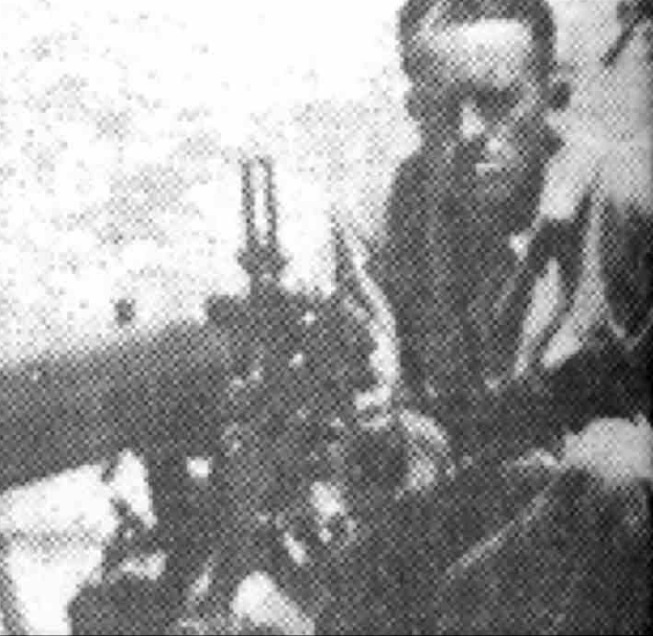
Early Life
In 1917, Evans Ernest Overbey was born in McDowell, West Virginia, to William and Mary Overbey. He had two older brothers, Jacob and Howard, and an older sister, Lillian. The family later moved to Wise County, Virginia, where his father worked as a sewing machine salesman to support the family, and Overbey attended two years of high school.
By 1940, as the Great Depression continued, Overbey was unemployed and living with his cousin, Dora Lewis, and her family in Carter, Tennessee. In June 1941, he enlisted in the U.S. Army Air Forces in Roanoke, Virginia at age 24.
Military Experience
Overbey was assigned to the 19th Bomber Group (Heavy) of the 93rd Bomber Squad. Under the command of Lieutenant Colonel Eugene Eubank, the squad deployed from California in 1941, flying B-17C bombers 2,400 miles to Hawaii. These were the first long-range bombers. The squad then moved to Clark Army Air Field in the Philippines as part of the Far East Air Force (FEAF).
On December 8, 1941 (December 7 in Hawaii), the Japanese attacked Clark Field and other areas of the Philippines. Within two days, elements of the 19th Bomber Group responded by hitting two Japanese troop transports, damaging one and destroying the other. After two weeks of continued conflict, the working B-17 bombers of the 19th Bomber Group withdrew to Australia, carrying General Douglas MacArthur with them and eventually took part in the Battle of the Coral Sea in 1942.
The members of the 19th Bomber Group who were left behind, including Overbey, fought valiantly in the Battle of Bataan but were captured by the Japanese after General Edward P. King, Jr., surrendered on April 9, 1942.
Overbey was reported as a prisoner of war on May 7. He and 75,000 American and Filipino service members were forced by the Japanese to march 65 miles across the peninsula. The treatment of American and Filipino prisoners was deplorable. Soldiers marched for up to 24 hours without food or water. Those who fell behind risked attack by their Japanese captors. There are accounts of prisoners being crushed by Japanese vehicles, buried alive, bayoneted, and beheaded. Ten thousand prisoners perished during what is now referred to as the Bataan Death March, which lasted up to two weeks.
Conditions did not improve once the survivors reached the camps that served as their prisons, Camp O’Donnell and Camp Cabanatuan. Prisoners were beaten and tortured and subjected to crowded, unsanitary conditions. Moreover, prisoners suffered from malnutrition and received minimal medical treatment of numerous diseases including malaria, dysentery, and beriberi.
Eulogy
Evans Overbey died on November 19, 1942, in Cabanatuan Camp #1 as a result of pellagra, a disease caused by a lack of Vitamin B and compounded by severe malnutrition. He was buried in a mass grave (later referred to as common grave 717). He was 25 years old.
In 1949, the remains listed as X-815 Manila #2 and, later, X-4857 were temporarily identified as Overbey, but the Memorial Division determined there was insufficient evidence to make a positive identification. Overbey was memorialized on the Walls of the Missing at Manila American Cemetery in the Philippines.
In 2015, the Armed Forces Medical Examiner System’s Armed Forces DNA Identification Laboratory positively identified Overbey’s remains, and he was returned to his family’s home state of Tennessee. On July 15, 2016, he was buried at Mountain Home National Cemetery in Johnson City, Tennessee.
Capitulo, Alejandro P., “The Death March,” Projects of the Enemy Regime, Record Group 319 (Box 13), National Archives at College Park, College Park, MD.
Carden, Curtis. “Pvt. Overbey finishes final campaign, laid to rest at Mountain Home VA.” Elizabethton Star, July 18, 2016. www.elizabethton.com/2016/07/18/pvt-overbey-finishes-final-campaign-laid-to-rest-at-mountain-home-va/.
Deever, William R. Historical Report: WWII Incident 425, Grave 717,Cabanatuan POW Camp, Nueva Ecija Province, Luzon Island, Republic of Philippines. Defense POW/MIA Accounting Agency. December 9, 2015. Courtesy of Phillip Erwin.
Erwin, Phillip. Telephone interview by the author. January 2, 2017.
“Evans E. Overbey.” American Battle Monuments Commission. Accessed February 22, 2017. www.abmc.gov/node/521150#.WOuSG4grLIV.
Evans E. Overbey, Individual Deceased Personnel File, Department of the Army.
Evans E. Overbey, Quartermaster Pay Voucher, Department of the Army, National Archives and Records Administration – St. Louis.
“Evans E. Overbey.” Virginia War Memorial Foundation. Accessed September 5, 2017. <a href=”vawarmemorial.org/veteran/evans-e-overbey” target=”blank”>vawarmemorial.org/veteran/evans-e-overbey</a>.
Evans Overbey’s burial service in Tennessee. Photograph, November 2016. Courtesy of Valley Funeral Home.
Illegal Acts By Japanese in Philippines, 1945-47; Supreme Commander for the Allied Powers, Legal Section, Manila Branch, Allied Operational & Occupation Headquarters, World War II, Record Group 331(Box 1994); National Archives at College Park, College Park, MD.
The March of Death. Along the March [on which] these prisoners were photographed, they have their hands tied behind their backs. Photograph. c. May 1942. National Archives and Records Administration (535565). Image.
Memorandum for Chief, Past Conflict Repatriations Branch from LTC, AG Wil B. Newbauer, Chief, Awards and Decorations Branch. “Awards and Decorations for PVT Overbey, Evans E., 13 035 026.” Department of the Army, U.S. Human Resources Command, Fort Knox, KY. April 11, 2016.
“New Mexico National Guard’s involvement in the Bataan Death March.” New Mexico National Guard Museum. Last Modified 2016. Accessed May 30, 2017. www.bataanmuseum.com/bataanhistory/
This photograph shows a buried detail at Camp O’Donnell. Photograph. c. 1942. National Archives and Records Administration (535565). Image. catalog.archives.gov/search?q=bataan%20death%20march&tabType=image.
Rickard, J. “19th Bombardment Group.” Military Encyclopedia on the Web. Last modified 2013. Accessed January 12, 2017. www.historyofwar.org/air/units/USAAF/19th_Bombardment_Group.html.
Sides, Hampton. Ghost Soldiers: The Forgotten Epic Story of World War II’s Most Dramatic Mission. New York: Doubleday, 2001.
Tennessee. Carter County. 1940 U.S. Census. Digital Images. ancestry.com.
“Triumph in the Philippines,” Projects of the Enemy Regime, Record Group 319 (Box 13), National Archives at College Park, College Park, MD.
Unknown, X-825 (Manila #2); Department of the Army.
Virginia. Wise County. 1930 U.S. Census. Digital Images. ancestry.com.
West Virginia. McDowell County. 1920 U.S. Census. Digital Images. ancestry.com.
This profile was researched and created with the Understanding Sacrifice program, sponsored by the American Battle Monuments Commission.
Contributor
Contributed by Nicole Winter
Cosby High School
2016-2017
