


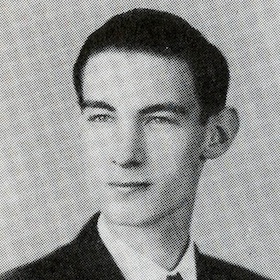
Private First Class Clark Bradford Allen
Early Life
Born in Westerleigh, New York, Clark Bradford Allen, Jr. was the oldest of four children. He grew up on Staten Island, New York. After Clark’s graduation from Port Richmond High School, his family moved to Marion, Massachusetts. His father, Clark B. Allen, Sr., was an executive for National Fireworks Company in Rockland, Massachusetts. His mother, Bessie M. Allen, stayed at home to care for the children: Clark, Helen, William, and John. After high school, Clark enrolled at Wagner College. During October of his sophomore year, Clark enlisted in the U.S. Army.
Military Experience
After enlisting in October 1942, Clark reported to Fort Devens, Massachusetts on June 19, 1943. He completed his basic training at North Camp Hood in Texas, and the Army accepted him into the Army Specialized Training Program (ASTP).
Army Specialized Training Program
ASTP condensed a four year undergraduate course of study into eighteen months and trained enlisted men at approved colleges and universities in fields like engineering, science, and foreign language. Candidates had to qualify for the program with high test scores. Almost a year to the day after his enlistment, Clark began his studies at Rutgers University. That winter, however, increased concern from military leadership regarding a critical shortage of infantrymen on the front led to the dismantling of ASTP. Clark was “separated [from the ASTP] for the convenience of the government” in April 1944 and joined the infantry, where the need for men was more acute.
“…the toughest soldiers in the Army”
Clark, along with several other “ASTPers” joined the 104th Infantry Division as part of the 414th Regiment’s Company F. Originally activated in September 1942 at Camp Adair in Oregon, the 104th Infantry Division was known as the Timberwolves. When Clark joined its ranks, the division was commanded by Major General Terry de la Mesa Allen.
After a summer of training at Camp Carson, Colorado, including numerous drills preparing for the 104th’s famed night attacks, Major General Allen reviewed the troops in observation of Infantry Day on June 15, 1944. Impressed with his division’s preparations, he predicted, “…this war will be won by the infantry; the man who can strike on the ground, engage the enemy hand to hand and hold ground once won. That is why the infantry has to be there, the toughest soldiers in the Army.”
The Timberwolves set sail at the end of August as part of the first convoy to travel directly from the United States to France. During the following weeks in Normandy, the division trained for combat. In October, they received combat orders. Their first attack began in Belgium; within days they had crossed into Holland, earning the commendation of British Field Marshal Bernard Montgomery for their performance.
“Nothing in Hell Can Stop the Timberwolves”
While the rest of the division moved closer to Aachen, Germany, the 414th stayed behind in Holland to shore up the town of Moerdijk. On November 8, Clark earned the Silver Star for gallantry in action, as he lived up to the motto of his division, “Nothing in Hell Can Stop the Timberwolves.” In the face of heavy machine gun fire, Clark’s 27-man combat patrol suffered heavy casualties. According to his Silver Star citation:
With complete disregard for his personal safety…Private Allen worked his way back across 600 yards of open, fire-swept terrain in search of medical aid men, and skillfully led them back over the same route. Constantly exposing himself to heavy fire from a firmly entrenched enemy only 150 yards to his front, Private Allen administered first aid to four of his wounded comrades and directed their evacuation. Still under heavy enemy fire he returned to his company commander with accurate information as to the situation.
Hill 287
The effort to push into the heart of the Reich would require the Timberwolves to topple some heavily fortified towns. On November 9, Division Field Order 10 required the 414th to join the rest of the division. Clark was in Germany where, just outside of Stolberg, planning was underway for a major assault. The 414th would be charged with taking Hill 287, which was known for offering German forces a vantage point on all the Allied advances. Without Hill 287, Allied progress into Stolberg and Eschweiler, towards the Roer River and onto Cologne, would be stymied.
During the course of the three-day battle, soldiers encountered seemingly endless rain, mud, and cold. Their stomachs ached for something more than foraged beets and turnips. In the midst of this relentless fighting, in service to his nation, PFC Clark B. Allen, Jr. was killed.
Eulogy
Clark’s parents received an initial telegram on December 7, 1944 informing them that their son was declared missing in action (MIA) on November 18, 1944. His status did not change to killed in action (KIA) until December 26 when his parents received a second telegram informing them that Clark had been killed on November 18. Clark was buried in a temporary grave in Belgium. After the war his parents decided to have him interred permanently at Henri-Chapelle American Cemetery where he was laid to rest in November 1948.
104th Infantry Division; Records of the Adjutant General’s Office, World War II Operations Reports 1941-1948, Record Group 407 (Box 11946); National Archives at College Park, College Park, MD.
Astor, Gerald. Terrible Terry Allen: Combat General of World War II – The Life of an American Soldier. New York: Ballantine Books, 2003.
“Clark B. Allen, Jr.” American Battle Monuments Commission. Accessed October 26, 2014. www.abmc.gov/search-abmc-burials-and-memorializations/detail/WWII_10705#.VcJYy0X59Rk.
Clark B. Allen, Jr., Individual Deceased Personnel File, Department of the Army.
Clark B. Allen, Jr., Official Military Personnel File, Department of the Army, RG 319, National Archives and Records Administration – St. Louis.
Clark B. Allen, Jr. Photograph. Kallista. 1943. Courtesy of Wagner College Archive, Horrmann Library, Wagner College.
Combat History 414th Regiment, 104th Infantry Division. Courtesy of Paula M. (Zisson) Connor.
Connor, Paula (Zisson). E-mail message to author. March 23, 2015.
Gabb, Wes. “Hill 287 ‘Stolberg’.” National Timberwolf Association. Last modified October 6, 2010. Accessed March 23, 2015. www.104infdiv.org/arch4.htm#35.
Highfield, Diana Logan. Letter to author. March 25, 2015.
Hoegh, Leo A. and Howard J. Doyle. Timberwolf Tracks: The History of the 104th Infantry Division 1942-1945. Washington: Infantry Journal Press, 1946.
Keefer, Louis E. Scholars in Foxholes: The Story of the Army Specialized Training Program in WWII. North Carolina: McFarland and Co. Inc. Publishing, 1988.
“Marion Hero Is Awarded Silver Star Posthumously.” Sippican Historical Society. Marion, Massachusetts. sippican.pastperfect-online.com/33386cgi/mweb.exe?request=record;id=D027E291-F42B-44DA-9EB0-581313625325;type=301.
“Marion Soldier Killed Overseas.” Sippican Historical Society. Marion, Massachusetts. sippican.pastperfect-online.com/33386cgi/mweb.exe?request=record&id=569CEE67-4C26-42E6-AFD3-969263372987&type=301.
McManus, John C. September Hope: The American Side of a Bridge Too Far. New York: Penguin Group, 2012.
Miller, Edward G. Nothing Less Than Full Victory. Annapolis: Naval Institute Press, 2007.
New York. Richmond County. 1925 New York State Census. Digital Images. ancestry.com
New York. Richmond County. 1930 U.S. Census. Digital Images. ancestry.com
New York. Richmond County. 1940 U.S. Census. Digital Images. ancestry.com
Palmer, Robert R., Bill I. Wiley, and William R. Keast. The Procurement and Training of Ground Combat Troops. Washington, D.C.: Center for Military History, 1948.
Records for Clark B. Allen, Jr.; World War II Army Enlistment Records, 1938-1946 [Electronic File], Record Group 64; National Archives at College Park, College Park, MD [retrieved from the Access to Archival Databases at aad.archives.gov/aad/fielded-search.jsp?dt=466, October 26, 2014].
Ricks, Thomas E. The Generals: American Military Command from WWII to Today. New York: Penguin Books, 2012.
“Wagner College Bulletin.” February 1945. Courtesy of Wagner College Archive, Horrmann Library, Wagner College.
War Stories of WWII, edited by Katherine P. Clark and Sandra U. Eberhard. Newton: Mennonite Press, Inc., 2011.
This profile was researched and created with the Understanding Sacrifice program, sponsored by the American Battle Monuments Commission.
Contributor
Contributed by Ms. Christina O’Connor
Hingham High School
2014-2015
