


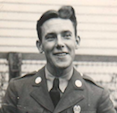
Private First Class Edward E. Elewicz
Early Life
Born on October 25, 1919, Edward Elewicz grew up in Chicago, Illinois. Since the family was Catholic, he was baptized at Holy Cross Church—just one block from his house—on November 23, 1919. His parents, Agnes and Peter, emigrated from Lithuania in the early 1900s. They married on February 14, 1909, and settled on the southwest side of Chicago, where many other immigrants from southern and eastern Europe also lived. Elewicz had one older sister, Bernice, who also lived with the family until she married.
His father, Peter, according to the 1940 census, was a carpenter in the stockyards in Chicago. Remembered by his family for his artistic skills, Elewicz became a photographer after attending high school for just two years.
Military Experience
A Citizen Soldier
On July 20, 1940, at the age of 20, Elewicz volunteered for military service. Family records indicate that he served for the first four years as an officer, training paratroopers stateside. His father took frequent train rides during the war to visit him. Elewicz never felt that he was doing enough to help the war effort. For this reason he gave up his officer’s commission and volunteered to serve in the infantry, assigned to the 18th Infantry Regiment of the 1st Infantry Division as a replacement.
“No mission too difficult, no sacrifice too great, duty first.”
The 1st Infantry Division, or “Big Red One,” was established during World War I. During the interwar years the 1st Infantry Division was one of only three divisions that maintained its full peacetime strength. The infantry was commonly called the “Queen of Battle” and faced the most difficult task of directly confronting enemy forces during World War II in Africa and Europe. The 18th Infantry Regiment participated in landings on both continents and on D-Day followed the initial assault of the 16th Infantry Regiment. For its valor that day the 18th Infantry Regiment was given a unit citation.
Subsequently the 1st Infantry Division fought in Belgium, western Germany, and the Hurtgen Forest. After almost six months of continuous fighting, on December 7, 1944, the 1st Infantry Division was replaced on the front lines to rest and refit. However, when Germany began its counterattack on December 16, which became the Battle of the Bulge, the 1st Infantry Division was called back into service to help stop the advance.
The 1st Infantry Division experienced extensive casualties and needed replacements to help shore up its ranks. For this reason, Private First Class Edward Elewicz was assigned to the 18th Infantry Regiment. From January to March 1945, Elewicz and the 1st Infantry Division drove the German soldiers back across the Siegfried Line and the Ruhr Valley in western Germany.
Crossing the Rhine River
Fighting intensified between the Allies and Germans in central Germany. The job of the Army west of the Rhine River was to take control of German towns and deal with civilian resistance. Elewicz and the 18th Infantry Regiment worked to achieve these objectives from January to March 1945. On March 16, the Allies reached the Rhine River and crossed it by the Remagen Bridgehead, one of the few bridges that the Germans failed to destroy during their retreat. The Allies pushed many divisions across the river quickly to take advantage of the bridgehead.
Once the Army crossed the Rhine, its objectives were to take the high ground and expand the bridgehead. Fighting intensified as German soldiers, with additional armor and artillery, attempted to push the Allies back across the Rhine. The 1st Infantry Division faced a difficult fight with numerous attacks and counterattacks by both sides.
Elewicz’s K Company of the 3rd Battalion moved from Bonn across the Rhine River on March 16, 1945. The 18th Infantry Regiment’s next objective was to cut the military highway between Cologne, France and Frankfurt, Germany, with K Company in support. On March 17, in attempting to seize ground south of Ittenbach, Germany, Elewicz’s company was attacked by several hundred Germans with tanks. By the morning of March 18, 1945, the Germans were turned back and the Autobahn was crossed, so that the battalion controlled the high ground near Hurscheid, Germany. That same day 25-year-old Elewicz was killed in combat.
Eulogy
On April 7, 1945, Peter Elewicz received a Western Union telegram that his son was missing in action, and the military shortly thereafter determined that Elewicz had been killed in action. Bernice Zebus, Elewicz’s sister, wrote to the military to determine the exact details of his death. She received a reply from John P. Adamowski, 18th Infantry Regiment Chaplain, on June 11, 1945. In it he wrote, “Allow me to assure you that our Catholic boys enter combat fortified with the graces brought to them by Mass and the Sacraments. Edward has been remembered too, in the Masses which I have offered since his death and I share with you the fond hope that a loving God shall early reward your brother’s supreme sacrifice on the field of battle.”
Peter Elewicz chose to have his son’s remains permanently interred in Europe. From September 1945, to October 1948, Elewicz’s body was interred at Henri-Chapelle, Belgium, just seven miles southwest of where he fought in Aachen, Germany. His remains were moved on October 13, 1948, to the current gravesite at the cemetery, “side by side with comrades who also gave their lives for their country.”
Abraham Lincoln, also from Illinois, showed appreciation for the sacrifices soldiers made during the American Civil War. In the Gettysburg Address Lincoln asserted,
But, in a larger sense, we can not dedicate–we can not consecrate–we can not hallow–this ground. The brave men, living and dead, who struggled here, have consecrated it far above our power to add or detract…It is for us the living, rather, to be dedicated…to the great task remaining before us–that from these honored dead we take increased devotion to that cause for which they gave the last full measure of devotion–that we resolve that these dead shall not have died in vain….
Although replacements for those who were wounded or killed in combat certainly faced discrimination, they were needed to assure Allied victory during the war. Surely their sacrifices, including Elewicz’s, helped preserve the freedom, democracy, and opportunities that so many nations enjoy today. Elewicz exemplified the 1st Infantry Division’s motto of “no mission too difficult, no sacrifice too great, duty first” by volunteering to serve during World War II and giving his “last full measure of devotion” for the United States.
1st Infantry Division; Records of the Adjutant General’s Office, World War II Operations Reports 1940-1948, Record Group 407 (Box 5001); National Archives at College Park, College Park, MD.
1st Infantry Division; Records of the Adjutant General’s Office, World War II Operations Reports 1940-1948, Record Group 407 (Box 5004); National Archives at College Park, College Park, MD.
1st Infantry Division, March 13, 1945 – March 18, 1945; Records of the Adjutant General’s Office, World War II Operations Reports 1940-1948, Record Group 407 (Box 5092); National Archives at College Park, College Park, MD.
1st Infantry Division, April 1945; Records of the Adjutant General’s Office, World War II Operations Reports 1940-1948, Record Group 407 (Box 5263); National Archives at College Park, College Park, MD.
Baumer, Robert W. and Mark J. Reardon. American Iliad: The 18th Infantry Regiment in World War II. Bedford: Aberjona Press, 2004.
Combat Interviews; Records of the Adjutant General’s Office 1917-, World War II Operations Reports 1941-1948, Record Group 407(Box 19024); National Archives at College Park, College Park, MD.
Cook County Clerk’s Office, Genealogy Records. Medical Certificate of Death for Agnes Elewicz. Accessed November 12, 2014. cookcountygenealogy.com/.
“Edward Elewicz.” American Battle Monuments Commission. Accessed November 10, 2014. www.abmc.gov/search-abmc-burials-and-memorializations/detail/WWII_12387#.VcNINvlViko.
Edward Elewicz Individual Deceased Personnel File. Department of the Army.
Edward Elewicz Family Records. 1940-1962. Courtesy of Ed Zebus.
Edward Elewicz, Official Military Personnel File, Department of the Army, Records of the Army Staff, RG 319, National Archives and Records Administration – St. Louis
“History of the First Division.” First Division Museum at Cantigny. Accessed January 6, 2015. www.firstdivisionmuseum.org/history/history/wwii.aspx.
Illinois. Chicago. 1940 U.S. Census. Digital images. ancestry.com.
Johnson, Franklyn A. One More Hill. Toronto: Bantam Books, 1983.
Lypka, Demetrius “Pete.” A Soldier Remembers: A Memoir of Service in the 1st Infantry Division, 1941-1945. Chicago: Cantigny First Division Foundation, 2007.
Records for Edward Elewicz; World War II Army Enlistment Records, 1938-1946 [Electronic File], Record Group 64; National Archives at College Park, College Park, MD [retrieved from the Access to Archival Databases at aad.archives.gov/aad/fielded-search.jsp?dt=893&tf=F&cat=WR26&bc=,sl, November 10, 2014].
Vaitkute, Katile. Email message to author regarding Edward Elewicz family genealogy. January 6, 2015.
Wheeler, James Scott. The Big Red One: America’s Legendary 1st Infantry Division from World War I to Desert Storm. Lawrence: University Press of Kansas, 2007.
This profile was researched and created with the Understanding Sacrifice program, sponsored by the American Battle Monuments Commission.
Contributor
Contributed by Mr. Donald Davis
George Washington High School
2014-2015
