


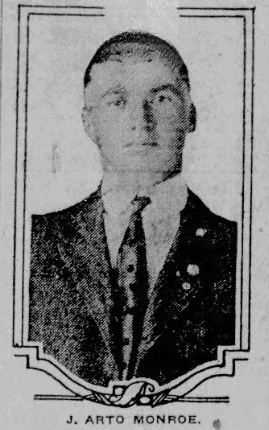
Private First Class Joseph Arto Monroe
Early Life
Joseph Arto Monroe, known as J.A., was born on July 1, 1891, to Joseph B. and Ida B. Dantzeisen Monroe. Born in Shelby County, Indiana, as the oldest of five children, J.A. had two brothers, Farres and Harry, and two sisters, Nova and Zora. Monroe also lost one sibling at birth, a brother named Clyda.
The first few years of Monroe’s life were spent in Noble Township, but he lived most of his life in the northeast corner of Washington Township on his family’s modest farm. He most likely attended a small primary school in his area of the county, but did not pursue any higher education. Monroe’s focus was farming the family’s land.
Photo carousel gallery
Home Front
Shelby County is a predominantly rural area, comprised of numerous unincorporated communities. While Shelby County had a thriving furniture industry and a small canning industry during Monroe’s life, the county’s economy was heavily based on agriculture. The largest crop produced was corn, followed by wheat, oats, and potatoes.
The county quickly provided support for the war effort when it became clear that the United States would enter the war in 1917. Citizens held meetings to discuss production and methods of support. Residents were encouraged to grow their own gardens, allowing major farms to supply their products to the soldiers.
Many groups sprang up in Shelby County to promote patriotism and send care packages to soldiers. The Boy Scouts, the American Red Cross, and other smaller groups all pitched in to help. Some women were active in the America’s War Mothers chapter in Indianapolis before Shelby County’s chapter started in 1919.
Photo carousel gallery
Military Experience
Enlistment and the Selective Service Act
A formal declaration of war occurred on April 6, 1917, and President Woodrow Wilson signed the Selective Service Act of 1917 into law on May 18, 1917. The Selective Service Act enabled the federal government to expand the military through mandatory enlistment for all men aged 21 to 45.
Monroe dutifully arrived and registered for the draft on Shelby County’s first day of registration, June 5, 1917.
On August 29, Monroe’s name was chosen by the Exemption Board. He became one of the first seven men to help fulfill Shelby County’s draft quota through the Selective Service Act.
Training
After entering into service, Monroe headed for training at Camp Taylor in Kentucky on September 17, 1917. He trained until he was called upon as part of a replacement draft for the 42nd Rainbow Division.
Monroe set sail on the SS Megantic on June 12, 1918, bound for the frontlines of Europe.
Aisne-Marne Offensive
The Aisne-Marne offensive was intended to break the German salient that threatened Paris. A salient is created when part of a military line projects into enemy territory. The German line had created a bulge that was getting dangerously close to Paris. It was a significant test for the American Expeditionary Force (AEF) to break the salient. Monroe had been deployed just ahead of the offensive.
Monroe participated in what became some of the fiercest fighting that the 42nd Rainbow Division ever encountered. The division was tasked with helping drive the Germans back from their threatening position, specifically around the Croix Rouge Farm and the Ourcq River.
The fighting was intense, and ground was gained and lost, back and forth, for days. Monroe’s regiment, the 165th Infantry Regiment, was the first to successfully cross the Ourcq River and establish itself on the east bank. The regiment was able to take its objective, Meurcy Farm, on July 28, but was pushed back across the Ourcq on July 29. After one more push, the division crossed the Ourcq again, took their objective, and maintained their hold.
Ultimately, the offensive was successful, and the Germans were driven back. The success of the campaign helped end the threat to Paris from that particular salient.
Monroe was believed to have fallen in the vicinity of the Ourcq River and Meurcy Farm during the division’s brave push on July 29, 1918. He was 27 years old.
Photo carousel gallery
Commemoration
Monroe’s parents were informed that their son was missing in action. Joseph and Ida did not give up on their son. They wrote to the Army repeatedly asking them to investigate their son’s whereabouts.
There was some confusion around the deaths at the Ourcq River, as the nature of the battle made it hard to keep an accurate death record. After an investigation, the Army determined that Monroe died on July 29, 1918, the same day he was initially listed as missing. Monroe’s parents were informed that their son had been killed in action in the vicinity of the Ourcq River and Meurcy Farm in France during the Aisne-Marne offensive, many months after receiving the initial report that he was missing in action.
Even after receiving notice of his death, Monroe’s parents still pressed on, looking for answers. One soldier, who had returned home to Hope, Indiana, told the Monroes that he had seen their son at a hospital after the day he supposedly died. The Monroes placed ads in the Indianapolis Star and the Republic, seeking information about their son.
Tragically, Monroe’s parents never found closure. His father passed away, and his mother never made the trip overseas through the Gold Star Mothers’ Pilgrimages to pay homage to her son.
Monroe’s name resides on the Tablets of the Missing in the Aisne-Marne Cemetery near Belleau, France. Because his family did not want him to be forgotten at home, his sister, Nova, applied for a memorial marker that was placed in the Lewis Creek Baptist Cemetery.
He is also honored on a memorial in Morrison Park in Shelbyville, Indiana, alongside all the men of Shelby County who gave their lives in World War I. Monroe’s name will live on through these many monuments and records. May his story stand as a tribute to the courage and sacrifice of brave men, even from the most rural parts of our great nation.
Photo carousel gallery
Primary Sources
Arto J. Monroe. U.S. Army Transport Service Arriving and Departing Passenger Lists, 1910-1939. https://ancestry.com.
The Farm Journal Directory of Shelby County, Indiana. Wilmer Atkinson Co., 1916. https://indianamemory.contentdm.oclc.org/digital/collection/p1819coll6/id/67951.
Indiana. Shelby County. 1900 U.S. Census. Digital images. https://ancestry.com.
Indiana. Shelby County. 1910 U.S. Census. Digital images. https://ancestry.com.
Indiana’s Part in the War: Shelby County. War Register and Biographical Publishing Co., 1918. https://indianamemory.contentdm.oclc.org/digital/collection/p16066coll47/id/994/rec/4.
J.A. Monroe. World War I Draft Registration Cards, 1917-1918. Digital images. https://ancestry.com.
Johnson, Harold Stanley. Roster of the Rainbow Division (Forty-Second) Major General Wm A. Mann Commanding. Eaton & Gettinger, Inc., 1917. https://archive.org/details/rosterofrainbowd00johnrich/page/n11/mode/2up.
Joseph Arto Monroe. Burial Case File. National Archives and Records Administration – St. Louis.
Joseph Arto Monroe. Headstone Applications for Military Veterans, 1861-1985. https://ancestry.com.
Kenyon Company. Map of Shelby County, Indiana. Kenyon Company. Map. 1916. Indiana State Library Digital Collections. https://indianamemory.contentdm.oclc.org/digital/collection/p15078coll8/id/1067.
“Parents Ask For Word Of Son, Was In War.” The Indianapolis Star [Indianapolis, IN], August 12, 1919. Newspapers.com (1047536604).
“Seen In Hospital.” The Republic [Columbus, IN], July 11, 1919. Newspapers.com (130824173).
“Shelby County.” The Indianapolis News [Indianapolis, IN], August 30, 1917. Newspapers.com (37337938).
Tompkins, Raymond Sidney. The Story of the Rainbow Division. Boni & Liveright, Inc. 1919.
Women’s Liberty Loan Committee of Daviess County Song During World War I. , American War Mothers Collection, Daviess County Historical Society. https://daviesscounty.pastperfectonline.com/archive/56D2BE18-3B7C-4FF7-B0B7-311275354179.
Secondary Sources
“165th Infantry Regiment (69th New York).” New York State Military Museum and Veterans Research Center. Accessed February 28, 2025. https://museum.dmna.ny.gov/unit-history/conflict/world-war-1-1914-1918/165th-infantry-regiment-69th-new-york.
“The Furniture Industry.” Shelby County, Indiana Family, History, and Genealogy. Accessed January 26, 2025. https://www.shelbycountyindiana.org/historical_articles/history_furniture_industry.htm.
“Joseph Arto Monroe.” Find a Grave. Updated February 26, 2013. Accessed April 18, 2025. https://www.findagrave.com/memorial/105836197/joseph-arto-monroe.
“Lewis Creek Baptist Cemetery.” Shelby County, Indiana INGenWeb. Accessed December 30, 2024. https://www.shelbycountyindiana.org/cemetery_records/cem_lewis_creek_bapt4.htm.
McFadden, Marian. Biography of a Town: Shelbyville, Indiana 1822-1962. Tippecanoe Press Inc., 1968.
Montgomery, Hortense H. Shelby County in The World War. War History Committee.
“PVT 1CL Joseph Arto Monro.” Find a Grave. Updated August 5, 2010. Accessed April 18, 2025. https://www.findagrave.com/memorial/55947971/joseph-arto-monroe.
Stewart, Richard W. American Military History Volume II: The United States Army in a Global Era (1917-2008). U.S. Army Center for Military History, 2010.
Young, Julie. A Brief History of Shelby County, Indiana. The History Press. 2010.
This profile was researched and created through the Researching Silent Heroes program, sponsored by the American Battle Monuments Commission.
Contributor
Contributed by Ms. Hilary Hilycord
Central Middle School
2024-2025
