


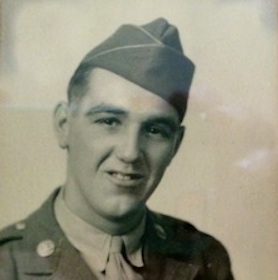
Private First Class Stanley Victor Clark
Early Life
Stanley Clark was born on July 14, 1924 and grew up during the Great Depression as one of the youngest of 12 children in a one-floor apartment in downtown Lewiston, Maine. He had seven older brothers: Percy, Allen, Harold, Hazen, John, Ralph, and Gerald, as well as four sisters: Alma, Mildred, Ernestine, and Evelyn.
His parents, Flora and George Clark, immigrated to Maine from English-speaking Canada in 1911. Throughout Stanley’s childhood his mother remained at home while his father supported the family by working in a paper mill and, later on, a shoe factory. When each sibling completed the eighth grade he or she would typically leave school to work in the local Lewiston textile mills to support the large family.
Stanley Clark’s family members and his former neighbor describe him as having had a temperament that was different from the rest of his brothers. As the youngest male child, he was considered the “baby of the family.” He was “kind-natured,” “open,” and “happy-go-lucky.” He would often bring his mother flowers and candy for no reason. He was also known for whistling a tune wherever he went.
Clark was 17 years old on the day the Japanese attacked Pearl Harbor. Five of his older brothers soon enlisted in the U.S. military. Family members describe how Stanley desperately wanted to join, too; instead, he left during his sophomore year of high school to take over his brother Gerald’s job at the Libbey Mill in downtown Lewiston. Just over a year later, on March 16, 1943, Stanley Clark was drafted.
Military Experience
When Stanley Clark entered the military, his family set a local record for having six sons serving at once. The Lewiston Legion Post honored Stanley’s parents with a special community dinner during which they received a scroll and a service flag. Stanley was appointed Acting Corporal for the group of fifty-four men who left Lewiston for the New England reception center at Fort Devens, Massachusetts.
Stanley soon found himself on his way to Camp Polk, Louisiana where he briefly became a member of the 8th Armored Division and most likely trained as a member of a tank crew. Stanley seemed to have wanted something different, though, because he joined the 401st Glider Infantry Regiment (GIR) of the 101st Airborne Division sometime during his first year in the military.
The 101st Airborne Division was a new and daring all-volunteer part of the military. From their bases in England, the airborne divisions flew over enemy territory and dropped down from the sky to disperse behind the front lines. Unlike paratroopers, who parachuted to the ground as single units, members of the Glider Infantry Regiment rode together to their destination in groups of fifteen to twenty men.
“Flying Coffins”
Not for the faint-hearted, members of the Glider Infantry Regiment sometimes referred to their vehicles as “Flying Coffins” or “Tow Targets.” The gliders did not have engines, so they had to be pulled and released from transport planes such as the C-46 or C-47. Once free of the tow plane, the men in the plywood and fabric gliders found themselves in a precarious situation: they had no parachutes, they were crammed together with supplies and equipment (like jeeps and ammunition), and they knew that once their glider began its landing descent, there was no going back.
Army General William C. Westmoreland described the experience of landing in a glider like this:
Every landing was a genuine do-or-die situation . . . it was their awesome responsibility to repeatedly risk their lives by landing in unfamiliar fields deep within enemy-held territory, often in total darkness. They were the only aviators during World War II who had no motors, and no second chances.
Glider infantrymen and glider pilot casualties reached 40% for some missions.
It is unclear why Clark chose to become a member of the 401st Glider Infantry Regiment. Perhaps the novelty and adventure of this type of fighting excited him. Maybe he had failed to qualify to be trained as a pilot and the Airborne Division got him one step closer to flying. Perhaps he just wanted to embroil himself in the war in Europe as quickly as possible. The 401st Glider Infantry Regiment guaranteed a quick ticket to action as this type of fighting required much less training than for the paratrooper units.
When Clark joined the 401st Glider Infantry Regiment, there was some tension between the “glider-riders” and paratroopers of the 101st Airborne Division. There was little to distinguish glider troops from regular infantry. They had no jump training, they had the same basic equipment as infantry troops, and they did not receive hazardous duty pay until late in the war. As a result, some glider infantrymen started to put up posters around their bases with photographs of grizzly glider wrecks with the slogan: “Join the Glider Troops! No Flight Pay, No Jump Pay, But — Never a Dull Moment.”
D-Day Invasion
As a member of the 401st Glider Infantry Regiment, Stanley Clark played a role in the D-Day Invasion. Because the U.S. military needed more infantrymen on the beaches than in gliders for this particular mission, he and other members of his company arrived by boat in the Uncle Red sector of Utah Beach with the 4th Infantry Division.
His mission with the other 401st Glider Infantry Regiment members was to link up with the paratroopers who had landed inland earlier in the day. Although the men did not experience much resistance on their landing, once off the beach, the members of the 401st Glider Infantry Regiment became embroiled in several engagements as they headed to St. Côme-Du-Mont. The regiment suffered heavy losses, including casualties due to friendly fire.
After 33 days of violent and grinding fighting throughout the hedgerows of northern France, the 401st Glider Infantry Regiment returned to England to recuperate. During the next two months, the division trained many new men in glider landing, and the group received new uniforms and equipment.
Operation Market Garden
On September 17, 1944, Stanley Clark and the 401st Glider Infantry Regiment returned to combat as part of the largest airborne operation of the war: Operation Market Garden. Allied airborne troops planned to drop down behind enemy lines to secure a 65-mile highway from Belgium to the north of the Siegfried Line. In this way, the Allies hoped to create a fast-track way to bring armored units into the Ruhr Valley, the industrial center of Germany.
Clark arrived in the Netherlands in one of 933 gliders as part of the mission to capture three major bridges between Eindhoven and Nijmegen. Unfortunately, the operation began to fall apart, and American soldiers like Clark were stuck behind enemy lines for weeks with dwindling supplies and cut off from communication with the outside world.
By October 6, Clark’s company had moved to an area south of Zetten, Holland. He and the rest of C Company attempted to relieve the 1st Battalion Parachute Regiment and a Battalion of British troops. Even as they moved to take over these positions, they faced extreme resistance from the enemy, yet the company was able to capture or kill several German troops near the Groote Wetering Canal sometime during the following day.
At 3:00 a.m. on the morning of October 9, 1944, Company C awoke to a barrage of mortar and artillery fire. They also had to fight off two tanks that broke through their outpost line. In all C Company lost seven enlisted men and saw 20 others wounded on that day. Sometime between 3:00 a.m. and the attack of the two tanks, Private First Class Stanley Clark was hit by artillery shells in the chest and declared dead on the battlefield.
Eulogy
Stanley Clark’s body was buried in the temporary U.S. cemetery at Molenhoek, about four miles south of Nijmegen in the Netherlands. His mother learned of his death by telegram on the evening of October 16, 1944. She and Clark’s father chose to keep their son’s body in Holland. He received a Purple Heart posthumously for his service and was permanently buried in the American Netherlands Cemetery in Margraten in 1948.
Stanley Clark’s family found it impossible to talk of Stanley or what happened to him during the war. His mother, however, kept a large photograph of her son in uniform in her bedroom for the rest of her life. One time one of her grandsons came into her apartment whistling, and she told him to stop because she “didn’t allow any whistling in her house.” Her grandson said that a young boy’s whistling must have reminded her too much of her Stanley when he was a boy and safe in her home.
“54 Leave Today for Fort Devens.” The Lewiston Daily Sun, March 24, 1943.
401st Glider Infantry Regiment History of the Holland Campaign; Records of the 101st Airborne Division, World War II Combat Operations Report 1944. Courtesy of Nowy van Hedel.
BBC Holiday: Amsterdam. “Timeline: The Netherlands.” BBC. Last modified November 8, 2011. Accessed May 10, 2015. www.auschwitz.nl/en-glossary/arbeitseinsatz.
Biello, Thomas D. “The 401st Glider Infantry Regiment (GIR) – Unit History.” The U.S. Airborne World War II. Last modified 2014. Accessed January 15, 2015. www.ww2-airborne.us/units/401/401.html.
Clark, Theresa. Phone interview with sister-in-law and neighbor of Stanley V. Clark. May 20, 2015.
Cormier, Rudy. Phone interview with nephew of Stanley V. Clark. June 1, 2015.
Graybeal, Jay A. “The First U.S. Army Airborne Operation.” United States Army. Last modified June 28, 2007. Accessed April 1, 2015. www.army.mil/article/3852/The_First_U_S__Army_Airborne_Operation/.
“Factsheets: Waco CG-4A Hadrian.” National Museum of the U.S. Air Force. Last modified November 4, 2011. Accessed April 1, 2015. www.nationalmuseum.af.mil/factsheets/factsheet.asp?id=504.
“Five Sons in Service, Sixth Gets Test at Portland Today.” The Lewiston Daily Sun, March 15, 1943.
“Focus on D-Day: Sky Invaders.” National World War II Museum. Last modified 2015. Accessed April 1, 2015. www.nationalww2museum.org/see-hear/collections/focus-on/d-day-sky-soldiers.html.
“Infantryman Clark Killed in Holland.” The Lewiston Daily Sun, October 27, 1944
Jens, Marcel. “Memorial Temporary Allied War Cemetery.” Traces of War. Last modified 2015. Accessed April 2, 2015. en.tracesofwar.com/article/769/Memorial-Temporary-Allied-War-Cemetery.htm.
Landing Tables Force “US” – 1st Tide HQ 101st AB Div APO 472, U.S. Army, May 18, 1944; Courtesy of Nowy van Hedel.
Lauze, Elissa and Peter Lauze. Phone interview with nephew and niece of Stanley V. Clark. January 15, 2015.
Lowden, John. Silent Wings at War: Combat Gliders in World War II. Washington, D.C.: Smithsonian Books, 2002.
MacRae, Michael. “The Flying Coffins of World War II.” The American Society of Mechanical Engineers. Last modified February 2012. Accessed April 4, 2015. www.asme.org/engineering-topics/articles/aerospace-defense/the-flying-coffins-of-world-war-i.
Maine. Androscoggin County. 1920 U.S. Census. Digital images. ancestry.com.
Maine. Androscoggin County. 1930 U.S. Census. Digital images. ancestry.com.
Maine. Androscoggin County. 1940 U.S. Census, Digital images. ancestry.com.
“The Netherlands, Holocaust Encyclopedia.” United States Holocaust Memorial Museum. Last modified July 2015. Accessed May 10, 2015. www.ushmm.org/wlc/en/article.php?ModuleId=10005436.
“The Netherlands in World War II.” Verzetemuseum/Dutch Resistance Museum. Last modified 2015. Accessed May 10, 2015. www.verzetsmuseum.org/museum/en/exhibitions/permanent_exhibition.
Perry, Mark. “Louisiana Maneuvers.” History Net. Last modified November 28, 2008. Accessed April 1, 2015. www.fallennotforgotten.nl/8thADhistory.htm.
Photograph No. 111-SC-199803; “Holland,” Department of the Army, U.S. Army Signal Corps, Record Group 11-SC; National Archives at College Park, College Park, MD.
Photograph No. ETO-HQ-44-15265; “Dutch civilians show members of the 101st Airborne Division, who landed behind German lines in Holland, the lay of the land,” Department of the Army, U.S. Army Signal Corps, Record Group 11-SC; National Archives at College Park, College Park, MD.
Records for Stanley Clark; World War II Army Enlistment Records, 1938-1946 [Electronic File], Record Group 64; National Archives at College Park, College Park, MD [retrieved from the Access to Archival Databases at aad.archives.gov/aad/fielded-search.jsp?dt=466, November 15, 2014].
S-1 Journal Keepsake. September 18, 1944 to September 19, 1944. Courtesy of Nowy van Hedel.
Shoemaker Jr., William. “327th GIR Reenacted.” Last modified July 2015. Accessed January 15, 2015 www.327gir.com/Home.html.
“Stanley Clark.” American Battle Monuments Commission. Accessed November 15, 2014.
www.abmc.gov/search-abmc-burials-and-memorializations/detail/WWII_25972#.VcKjpXgUaE4.
Stanley Clark, Individual Deceased Personnel File, Department of the Army.
Stanley V. Clark, Official Military Personnel File, Department of the Army, Records of the Army Staff, RG 319, National Archives and Records Administration – St. Louis
Swenson, Erica. Clark Family Apartment on 40 Union Street. Photograph. March 2015.
“Timeline Dutch History.” Rijks Museum. Last modified 2015. Accessed May 10, 2015. www.rijksmuseum.nl/en/explore-the-collection/timeline-dutch-history/resistance.
Trueman, Chris. “German Invasion of Holland.” History Learning Site. Last modified 2013. Accessed May 10, 2015. www.historylearningsite.co.uk/german_invasion_of_holland.htm.
Van Hedel, Nowy. In person interview with Stanley Clark’s grave adopter at the Netherlands American Cemetery. July 21, 2015.
Velmer, Leonora Smith. “World War II – Louisiana Maneuvers.” Beauregard Parish Library. Last modified March 1, 2015. Accessed April 4, 2015. www.library.beau.org/~velmer/local/ww2.html.
The War. Directed by Ken Burns and Lynn Novick. 2007. Washington, D.C.: Florentine Films
WETA, 2007. DVD.
Woolf, Ph.D., Linda M. “Survival and Resistance: The Netherlands Under Nazi Occupation.” United States Holocaust Memorial Museum. Last modified April 6, 1999. Accessed May 10, 2015. www2.webster.edu/~woolflm/netherlands.html.
World War II Honor List of Dead and Missing for the State of Maine, War Department. June 1946. Courtesy of Nowy van Hedel.
Zaloga, Steven. US Airborne Divisions in the ETO 1944-45. Oxford: Osprey Publishing, 2007.
This profile was researched and created with the Understanding Sacrifice program, sponsored by the American Battle Monuments Commission.
Contributor
Contributed by Ms. Erica Swenson
Bruce M. Whittier Middle School
2014-2015
