


Private First Class Tench Brower Aldrich
Early Life
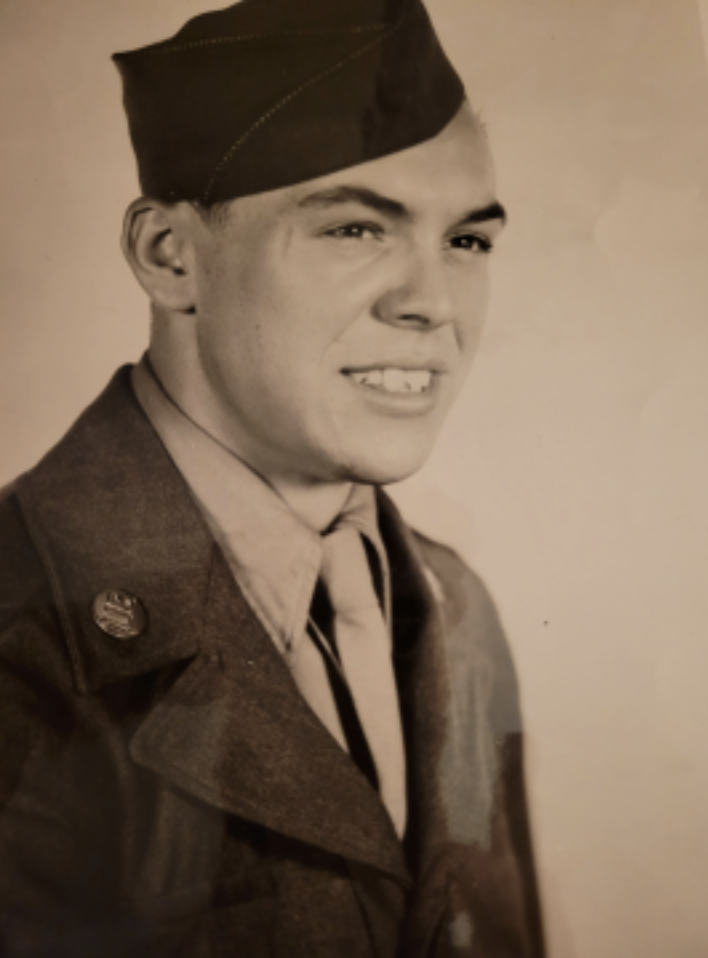
Tench Brower Aldrich was born to Ralph and Sarah Brower in Boy River, Minnesota, on September 19, 1924. He had four younger siblings: Stuart, Clifford, Charles, and Mary. He was affectionately nicknamed “Tenny” by his family.
At approximately 11 years old, Tench and his family moved to Ione, Oregon. Ione, a small rural farming community in eastern Oregon, specialized in grain, wool, sheep, and cattle production. The Oregon Railway and Navigation Company, operating from Arlington to Ione to Heppner, was a primary form of transportation for goods shipped to market, including lumber.
Tench worked as a farmhand for local farmer Foster Odem in Morgan, Oregon. This farm work likely included the production and harvesting of wheat. His father, Ralph, also worked for local wheat farmer Earle Heliker, about six miles west of Ione.
Three of the four sons and their father, Ralph, served in the military. Tench was drafted at the age of 18 on February 17, 1943. Stuart enlisted in December 1946, and Charles enlisted in December 1950.
Photo carousel gallery
Home Front
During the war, community members supported the effort in several ways, including rationing, increasing agricultural production, donating blood, and storing and transporting munitions. Morrow County, Oregon, was also home to the Arlington Military Bombing Range, a 27,000-acre restricted airspace used for military training and testing. Additionally, the U.S. Army Corps of Engineers constructed the Pendleton Army Air Base in August 1941 in anticipation of the potential need for increased air support.
Everyone Can Help “Our Boys”
These contributions exhibited the strength of small towns in Morrow County. The vast land in the area was well utilized for farming and military operations. On the home front, rationing was important for food, electricity, and petroleum products. Community members of Ione and the nearby towns of Lexington and Heppner were encouraged to help in any way possible. This also meant taking on jobs that servicemen left behind, working longer hours, and using wages to buy war bonds when possible.
Photo carousel gallery
Military Experience
Private First Class Tench Brower Aldrich served in the U.S. Army’s 188th Parachute Infantry Regiment, part of the 11th Airborne Division, during World War II. As part of the 11th Airborne Division, Tench trained at Camp Mackall, North Carolina. This division was activated in 1943 and participated in the campaigns in New Guinea, the Southern Philippines, Leyte, and Luzon during World War II. After the war, the 11th Airborne Division served on occupation duty in Japan until May 1949, when it returned to the United States.
Battle of Luzon
Private First Class Aldrich and his regiment were part of the campaign to retake the Philippines from Japanese control. His unit played a key role in the January 31, 1945, landing at Nasugbu, Luzon. The 11th Airborne Division spearheaded the 6th Army’s assault, securing a beachhead and pushing inland to establish control over key strategic locations.
Following the landing, the 188th Parachute Infantry Regiment was tasked with capturing high ground along Tagaytay Ridge, a crucial position overlooking Manila. The regiment encountered fierce enemy resistance, fighting through dense jungle and mountainous terrain. Their mission was to secure routes for advancing Allied forces, eliminate Japanese strongholds, and pave the way for the liberation of Manila. The regiment engaged in airborne drops and assaults, utilizing surprise and rapid maneuvering to destabilize Japanese defenses.
The battle for Manila was brutal. On February 6, 1945, they launched an assault on the southern part of Manila. On February 7, 1945, the 188th Parachute Infantry Regiment attacked the area around Nichols Field, while the 11th Airborne Division fought house to house and in the streets. The 188th Parachute Infantry Regiment was involved in heavy fighting near Nichols Field, a strategically important airstrip south of the city. Japanese forces were well-entrenched, and intense machine-gun fire pinned down Aldrich’s unit. By February 11, 1945, the Japanese firepower at Nichols Field remained unchanged. The 188th Parachute Infantry Regiment launched a full-scale attack. The regiment engaged in hand-to-hand combat, utilizing bayonets and knives. Over several days, the regiment launched repeated assaults to break enemy resistance. Fighting was often close-quarters, involving bayonets, grenades, and small arms fire.
Photo carousel gallery
Commemoration
On February 10, 1945, during an assault on Nichols Field, Private First Class Tench Aldrich was mortally wounded by shrapnel. His injuries were severe, and he succumbed to his wounds despite receiving medical treatment. His sacrifice was part of a larger effort that ultimately led to the liberation of Manila and the broader success of the Luzon campaign, significantly weakening Japanese control over the Philippines.
Aldrich was posthumously awarded the Purple Heart for his service and sacrifice. His legacy is honored in his hometown of Ione, Oregon, where a memorial field, dedicated in 1948, bears his name, along with those of other local World War II soldiers. His bravery and dedication remain a testament to the courage of the 11th Airborne Division and the soldiers who fought to reclaim the Pacific.
Tench Aldrich is buried in the Manila American Cemetery in the Philippines.
Photo carousel gallery
Primary Sources
Aldrich Family Photographs. Courtesy of Sandy Carr.
Gates, Arlynda. Interview with the author. March 27, 2025.
Gates Family Photographs. 1941. Courtesy of Arlynda Gates.
“Historic Photo of Ione, Oregon.” Small Town Oregon. Accessed April 18, 2025. https://www.smalltownoregon.com.
Minnesota. Cass County. 1930 U.S. Census. Digital images. http://ancestryclassroom.com.
“New B and C Card Grant 5 Gallons.” Heppner Gazette-Times [Heppner, OR], December 2, 1943. https://oregonnews.uoregon.edu/lccn/sn97071042/1943-12-02/ed-1/seq-1/.”
Pacific Power & Light Company Advertisement. Heppner Gazette-Times [Heppner, OR], December 2, 1943. https://oregonnews.uoregon.edu/lccn/sn97071042/1943-12-02/ed-1/seq-1/.
“Representative of Blood Bank Set Date for Meeting.” Heppner Gazette-Times [Heppner, OR], December 30, 1943. https://oregonnews.uoregon.edu/lccn/sn97071042/1943-12-30/ed-1/seq-1/.”
Tench Brower Aldrich. World War II Draft Cards Young Men, 1940-1947. Digital Images. https://ancestryclassroom.com.
Tench Brower Aldrich. Individual Deceased Personnel File. National Archives and Records Administration – St. Louis.
Workers at the Umatilla Ordnance Depot, 1943. Photograph. 1943. Oregon Historical Society (CN 005720). https://www.oregonhistoryproject.org/articles/historical-records/workers-at-the-umatilla-ordnance-depot-1943/.
Secondary Sources
“The 188th Glider Infantry Regiment.” The 11th Airborne Division. Accessed April 18, 2025. https://www.ww2-airborne.us/units/188/188.html.
“Boardman Bombing Range, Oregon.” The Center for Land Use Interpretation. Accessed January 29, 2025. https://clui.org/ludb/site/boardman-bombing-range.
“Campaigns in the Philippines.” Go for Broke National Education Center. Accessed April 18, 2025. https://goforbroke.org/campaigns-in-the-philippines/.
Doyle, Susan Badger. “Umatilla Army Depot.” Oregon History Project, the Oregon Historical Society. Accessed April 18, 2025. https://www.oregonencyclopedia.org/articles/umatilla_army_depot/.
Harris, Megan. “Battles of Leyte and Luzon, 1944-1945.” Library of Congress Blog. January 2, 2014. Accessed March 2, 2025. https://blogs.loc.gov/folklife/2014/01/the-battles-of-leyte-and-luzon-1944-1945/.
Morrow County Historical Societies. The History of Morrow County, Oregon. Taylor Publishing Company, 1983.
“Our History: The 11th Airborne Division and the Army in Alaska.” 11th Airborne Division. Accessed March 2, 2025. https://11thairbornedivision.army.mil/History/.
“Pendleton Field.” Oregon History Project, the Oregon Historical Society. Accessed January 29, 2025. https://www.oregonhistoryproject.org/articles/historical-records/pendleton-field/.
“PFC Tench Brower Aldrich.” Find a Grave. Updated August 8, 2010. Accessed November 30, 2024. https://www.findagrave.com/memorial/56786576/tench-brower-aldrich.
“Tench B. Aldrich.” American Battle Monuments Commission. Accessed November 30, 2024. https://www.abmc.gov/decedent-search/aldrich%3Dtench.
“The Battle of Leyte Gulf.” The National WWII Museum. Accessed March 2, 2025. https://www.nationalww2museum.org/war/articles/battle-leyte-gulf.
“US Forces Began Main Battle For Philippines 75 Years Ago.” U.S. Department of Defense. Accessed March 2, 2025. https://www.defense.gov/News/Feature-Stories/story/Article/2048611/us-forces-began-main-battle-for-philippines-75-years-ago/.
Vergun, David. “U.S. Forces Began Main Battle for the Philippines 75 Years Ago.” U.S. Department of Defense. https://www.defense.gov/News/Feature-Stories/story/Article/2048611/us-forces-began-main-battle-for-philippines-75-years-ago/.
Yesteryears of Morrow, A History of Morrow County, Oregon. Morrow County Courthouse, 1959.
This profile was researched and created through the Researching Silent Heroes program, sponsored by the American Battle Monuments Commission.
Contributor
Contributed by Mrs. Stefanie Spivey
Heppner Junior/Senior High School (Heppner, Oregon)
2024-2025
