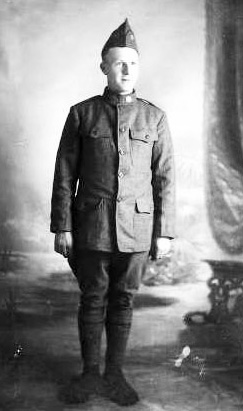
Private First Class William H. Bellows
Early Life
Rush for Gold to Gardening
In 1853, William H. Bellows, Jr.’s grandfather, James, sold his farm in Michigan and brought his wife Mary and their family to California, lured by the prospect of finding gold. The young family settled in Dutch Flat, right in the heart of Gold Rush country. However, by 1860, James Bellows had a mental breakdown, which was not uncommon during the Gold Rush era, and was committed to the State Asylum at Stockton. Mary eventually divorced James Bellows and married Walter Phillips, a gardener. Walter and Mary Phillips raised their son, William, and a daughter in their home in the center of town.
William grew up and married Louisa Hoos, and they had four children together, including William H. Bellows, Jr., born on November 18, 1889.
From the Hills to the City
According to his father, William H. Bellows, Jr., loved growing up in the hills that surrounded Dutch Flat. He attended Dutch Flat Grammar School and later moved to Sacramento, where he worked with contractors E.J. Carlow and W.P. Boyce to learn the plumbing trade. William worked hard to make his mark, and he made a name for himself as a plumber in the city. He worked on important buildings in the Sacramento area, including the California Fruit Exchange Building, once the tallest building west of the Mississippi River. He also installed the plumbing at the new Yolo County Courthouse.
William moved from Sacramento to the Woodland area in Yolo County around the time he was working on the courthouse. He lived across the street from the Chicago Cafe restaurant on Main Street. Still in operation in 2025, it is the oldest continuously operating Chinese restaurant in California, and some claim it is the oldest in the nation. At the time when Bellows may have eaten there, Chinese dishes, like orange chicken or chow mein, were not served to the general public. Rather, the restaurant served homestyle favorites of the day, such as Fried Chicken à la Maryland, cold roast lamb with potato salad, and a broad selection of homemade pies for dessert.
William was a respected, well-liked, and dedicated tradesman who was focused on developing his skills and living life. However, the Great War, later known as World War I, had begun in Europe, and its impact was inching closer to home.
Photo carousel gallery
Home Front
Following the Jobs
Gold mining was the dominant industry in Dutch Flat. Hydraulic mining was heavily used there, but was later banned due to its impact on surface water quality. William’s father and brothers intermittently tried their luck at mining, but census records show that they found more stable work in other industries. His father was a carpenter, and his brothers worked as merchants and laborers. Sacramento, the capital of California, developed into a political hub and a manufacturing, farming, and food production center. Manufacturing and transportation became even more critical industries in wartime for the Sacramento economy. The growing city needed skilled tradesmen and contractors to meet the demand for roads, buildings, and other infrastructure. Bellows’s choice to move from the hills of Placer County to learn a trade in the rapidly evolving city was timely.
Industry and Resources
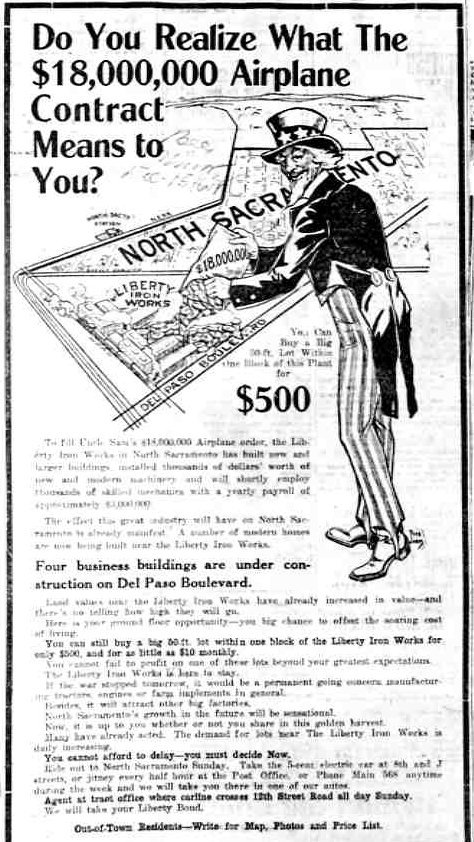
By the time the United States entered the Great War, there was high demand for airplanes and the pilots to fly them. Mather Army Airfield was swiftly constructed on the outskirts of Sacramento and served as a proving ground for airplane pilots. Sacramento encouraged industrial growth and investment in manufacturing companies such as Liberty Ironworks. It became an important industrial hub supporting the war effort and remained so through the end of the Cold War in the mid-twentieth century.
The War Question
In 1916, the U.S. was home to many European immigrants and their descendants, some of whom had close family ties to Germany and France. Because many European homelands were at odds with one another, Americans’ feelings about the Great War were complicated. This was one reason President Woodrow Wilson intended to stay out of the war. However, German attacks on civilian vessels, which resulted in the deaths of innocent people, including American citizens, inspired an explosion of anti-German propaganda. The German tactics against ordinary people generated fear and anger, which proponents of the war used to encourage support. On April 6, 1917, President Wilson declared war on Germany, and thus, the United States entered the Great War.
Photo carousel gallery
Military Experience
In the Army Now
William Bellows was 27 years old when he registered for the U.S. Army on June 5, 1917. This date was a common one for many who were called to fight in World War I, as it coincided with a requirement for all eligible men, under the recently passed Selective Service Act, to register on that date. Bellows was unmarried and had no children. He ultimately entered service on November 4, 1917, with the 161st Infantry, 41st Division, and was trained as a machine gunner. He shipped out of Hoboken, New Jersey, aboard the USS President Lincoln on December 13, 1917.
On the Front Lines
At some point after arriving in France, Bellows was moved to the 23rd Infantry Machine Gun Company, 2nd Division. Not much is known about the specifics of his time with the 23rd Infantry Machine Gun Company. The Woodland Mail reported in his obituary that he trained at Camp Lewis before heading overseas. Based on unit timelines, he trained through March 17, 1918, in the Verdun Sector, and engaged at the Aisne-Marne Defensive battle at Château-Thierry, near Belleau Wood in June. Military records confirm that he fought in the Aisne-Marne Offensive near Soissons in July.
Unexpected Tragedy
In the area of Soissons, Bellows and his fellow soldiers were awaiting a replacement unit to relieve them and provide a much-needed night of rest on July 20, when an enemy shell launched and exploded among them. Machine Gunner Private First Class William H. Bellows, Jr., was killed in action, along with 26 others, including his captain. He was 29 years old. Initially, Bellows and several others were buried in a shallow grave in the garden of Madame Gacagne near Vierzy. However, documents in Bellows’ military burial file suggest that the burial was not properly recorded, and the grave was not clearly marked.
Photo carousel gallery
Commemoration
A Family’s Anguish
At first, the Army reported Bellows as Missing in Action, as of July 20, 1918. In October, the family received a letter from First Lieutenant Richard P. Hildreth, who was nearby when Bellows was killed. He explained that the platoon was headed for a rest when an enemy shell exploded and instantly killed the captain and 26 others about a half mile outside Vierzy, near Soissons. Hildreth’s letter said, “The loss of your son is felt by all the men who knew him. Although he had been in the machine gun company of the Twenty-third Infantry only a short time, he was liked and admired by all.”
In November, the Nevada City News reported that Bellows had been killed in action near Soissons, France. However, 13 days later, another local newspaper, The Auburn Journal, reported that the War Department still listed Bellows as Missing in Action. The Auburn Journal report gave Bellows’s parents hope that their son was still alive. Nine months later, on July 4, 1919, the government confirmed the October 1918 report by Captain Richard P. Hildreth, who had since been promoted from First Lieutenant, that William Bellows had, indeed, been killed in action at Vierzy.
In his obituary, The Woodland Mail reported:
“William Bellows was one of the well-known and popular young men of Woodland. He entrained from here for Camp Lewis with a large contingent during the early part of November 1917, and after several months training at the northern cantonment, he was sent to France. He was a resident of this city for about two years and during that time was employed by the W. P. Boyce Company and was in charge of the plumbing work done on the new Yolo County Courthouse.”
Seeking Closure
The report on the circumstances of Bellows’s death troubled his parents. They embarked on a years-long query to find out when and where he was laid to rest, and they hoped to get a photograph of his grave. However, it took almost three more years to get final confirmation regarding the disposition of their son’s remains. Their first inquiry in 1919 was followed by two more years of back-and-forth correspondence by mail with the Graves Registration Bureau. His parents learned that there were no records about his burial and were assured in multiple communications that an investigation to find his remains was underway.
The Bellows continued to write letters to the Graves Registration Bureau and, at one point, they even telephoned the Bureau long-distance in Washington, D.C. In 1919, not many people had telephones, and making a call thousands of miles away could take about ten minutes to connect. Telephone calls were also very expensive, around $20 for a three-minute call, equivalent to approximately $375 in 2025.
At Peace
Finally, in 1921, the Graves Registration Bureau found Bellows’s remains. He had been buried under about a foot and a half of earth in a garden in Vierzy, France. He was then disinterred and properly re-interred at the Aisne-Marne Cemetery and Memorial in nearby Belleau Wood. At the time, the Graves Registration Bureau could not provide the Bellows with a photograph of their son’s grave. The American Red Cross had been responsible for photographing soldiers’ graves at the American cemeteries years earlier, but that service had been discontinued by the time Bellows was re-interred at Aisne-Marne American Cemetery.
Mrs. Bellows was offered an opportunity to visit her son’s grave in France through the Gold Star Mothers’ Pilgrimage Act, passed in 1929. However, by 1930, when the voyage was to take place, she was not well enough to go and declined the invitation. Mr. and Mrs. Bellows likely took comfort in knowing their son’s remains had been found, that he had a proper burial, and that the American Battle Monuments Commission would ensure it remained a place of peace and remembrance for generations to follow.
Local Legacy
Bellows’s parents were given an American flag in honor of their son’s sacrifice by the War Department in 1924. In Woodland, California, “W. H. Bellows” is memorialized on a plaque in front of the Yolo County Courthouse as one of many who died in combat and lived in Yolo County. In Sacramento, his name is inscribed, along with the names of other Sacramentans memorialized on the wall above the foyer of the Sacramento Memorial Auditorium, commemorating all who died in the Spanish-American War and World War I. Today, the Yolo County Courthouse and the Sacramento Memorial Auditorium are listed on the National Register of Historic Places. Private First Class William H. Bellows, Jr., indeed succeeded in making his mark.
Photo carousel gallery
Primary Sources
Aisne-Marne Cemetery and Memorial. Photograph. 1932. National Archives and Records Administration, Still Picture Branch. https://www.nps.gov/articles/000/aisne-marne-tour.htm.
“Bellows Officially Listed as Missing.” Auburn Journal [Auburn, CA], November 28, 1918.
“The California Fruit Exchange Building.” Photograph. c.1917. Comstock Publishing Company. https://www.comstocksmag.com/article/fresh-fruit.
California. Placer County. 1850 U.S. Census. Digital image. https://ancestry.com.
California. Placer County. 1860 U.S. Census. Digital image. https://ancestry.com.
California. Placer County. 1880 U.S. Census. Digital image. https://ancestry.com.
California. Placer County. 1900 U.S. Census. Digital image. https://ancestry.com.
California. Placer County. 1910 U.S. Census. Digital image. https://ancestry.com.
“Do You Realize What the $18,000,000 Airplane Contract Means to You?” The Sacramento Bee [Sacramento, CA], 1918. https://s3.amazonaws.com/pastperfectonline/images/museum_231/016/054_1983001sbpm00204.jpg.
“Interior of Liberty Ironworks.” Photograph. c.1917-1918. Sacramento Bee Collection, Center for Sacramento History. https://sacramento.pastperfectonline.com/photo/1A10F9D1-0C37-4F0A-BDA1-241115326052.
“Shades of Yolo – Yolo County Courthouse.” Shades of California Collection, California State Library. https://californiarevealed.org/do/570e591d-2832-47ec-81de-6dd543b1548c#page/1.
“W.H. Bellows Killed in Action.” Nevada City News [Nevada City, CA], November 15, 1918.
“William Bellows was Killed Near Soissons – Prominent Woodland Soldier Was Reported Missing in Action – Letter Is
Written to his Parents by Sergeant of Company.” The Woodland Mail [Woodland, CA], November 13, 1918. https://genealogytrails.com/cal/placer/military/ww1obits.html.
William H. Bellows. Burial Case File. National Archives and Records Administration – St. Louis.
William H. Bellows. World War I Burial Cards, 1915-1918. Digital Images. https://ancestry.com.
William H. Bellows. WWI U.S. Army Transport Service Passenger Lists, 1917-1919. https://www.fold3.com.
William H. Bellows, Jr. U.S. World War I Soldier Draft Registration Cards, 1917-1918. Digital images. https://ancestry.com.
William H. Bellows, Jr. World War I Soldier Service Cards and Photographs, 1917-1918. Digital images. https://ancestry.com.
World War I: Battles of the Meuse-Argonne. 1918, Photograph, U.S. Army Signal Corps. Encyclopedia Britannica. https://www.britannica.com/event/battles-of-the-Meuse-Argonne.
“Yolo Court House Contracts Are Awarded.” The Sacramento Bee [Sacramento, CA], August 22, 1916. Newspapers.com (616696320).
Secondary Sources
Beck, Elias. “Daily Routine in the Trenches of World War I.” History Crunch. Updated May 20, 2021. Accessed February 24, 2024. https://www.historycrunch.com/daily-routine-in-the-trenches-of-world-war-i.html#/.
DeWilde, Amanda G., and James C. Scott. World War I in the Sacramento Valley. The History Press, 2016.
Dunleavy, Brian. “Life in the Trenches of World War I.” HISTORY. Updated May 10, 2024. Accessed February 24, 2025. https://www.history.com/news/life-in-the-trenches-of-world-war-i.
Lehman, Gabe. “Exploring Dutch Flat, the Tahoe-Area Town That Helped Raise Gavin Newsom.” SF Gate, December 28, 2023. https://www.sfgate.com/renotahoe/article/dutch-flat-sierra-tahoe-gavin-newsom-18566414.php.
Maloney, Wendi. “WWI: The Battle of Belleau Wood.” TIMELESS: Stories from the Library of Congress Blog. June 6, 2018. https://blogs.loc.gov/loc/2018/06/world-war-i-the-battle-of-belleau-wood/.
Meyer, Carla. “Chicago Cafe: California’s Oldest Chinese Restaurant: Historical Research Project Reveals a Legacy of Resilience Despite Decades of Asian Exclusion.” Regents of the University of California, Davis. Updated January 22, 2024. Accessed March 24, 2025. https://www.ucdavis.edu/curiosity/news/chicago-cafe-is-oldest-chinese-restaurant-in-california.
“Pvt.1CL William H. Bellows Jr.” Find a Grave. Updated August 5, 2010. Accessed December 17, 2024. https://www.findagrave.com/memorial/55947547/william-h-bellows.
Schapiro, Larry. “Everyone, including Farmers, Contributed to World War I Effort in Yolo County.” The Woodland Daily Democrat [Woodland, CA], September 5, 2014. https://www.dailydemocrat.com/2014/09/05/everyone-including-farmers-contributed-to-world-war-i-effort-in-yolo-county/.
Simmons, Edwin H. “Leathernecks at Soissons.” Naval History 19 (no. 6), December 2005. https://www.usni.org/magazines/naval-history-magazine/2005/december/leathernecks-soissons.
“Twenty-Third Infantry Regiment” 2nd Division—Second to None. Accessed February 22, 2024. https://2nd-division.com/_div.units/23rd.inf/23rd.infantry.htm.
“William H. Bellows.” American Battle Monuments Commission. Accessed December 17, 2024. https://www.abmc.gov/decedent-search/bellows%3Dwilliam.
“William H. Bellows, Jr.” Honor States. Accessed February 22, 2025. https://www.honorstates.org/profiles/130562/.
“World War I Draft: Topics in Chronicling America: Timeline.” Accessed February 22, 2025. https://guides.loc.gov/chronicling-america-wwi-draft?loclr=blogser.
“World War I Obituaries: Bellows, William H., Jr.” Placer County, California Genealogy History Group. Accessed February 22, 2025. https://genealogytrails.com/cal/placer/military/ww1obits.html.
This profile was researched and created through the Researching Silent Heroes program, sponsored by the American Battle Monuments Commission.
Contributor
Contributed by Ms. Melissa Lawson
Cordova High School
2024-2025