


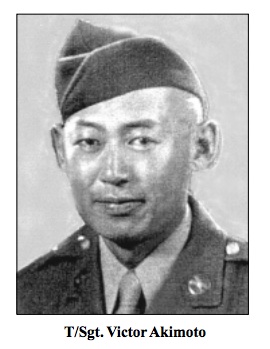
Private Victor Akimoto
Early Life
Victor Akimoto grew up as the fifth child in a large Japanese-American family of eight children during the 1920s and 1930s. Akimoto had three brothers and four sisters. His father, Masanori, managed the Utah-Idaho Sugar Company operations near Idaho Falls, Idaho. Akimoto’s mother, Mary “Miki” Shiratori Akimoto, was a homemaker. In 1928 the family moved to Los Angeles, California to get better healthcare to deal with Victor Akimoto’s sudden onset of alopecia, or hair loss. Masanori Akimoto went to work as a life insurance salesman.
Growing Up in Los Angeles
Akimoto attended 36th Street Elementary School, graduated from Foshay Junior High School, and then attended Jacob Riis High School. He excelled at sports including basketball, football, and boxing. Described by his brother Ted as the “leader of everything,” Akimoto worked at a variety of odd jobs including delivery driver, fruit stand attendant, and wholesale market worker.
Military Experience
Akimoto enlisted in the U.S. Army on January 27, 1942. He was initially assigned to Fort Warren, Wyoming for basic training where he learned how to drive military trucks. He quickly moved up through the enlisted ranks from Private, to Platoon Leader, and then to Private First Class. In January 1943, President Franklin D. Roosevelt authorized the formation of an all Japanese-American unit. Akimoto jumped at the opportunity. Before transferring to Camp Shelby, Mississippi to join the 100th Battalion from Hawaii and the 442nd Regimental Combat Team, Akimoto was promoted and earned his sergeant’s stripes. Brothers Johnny and Ted met Akimoto at Camp Shelby once they had enlisted in the U.S. Army.
Training at Camp Shelby
At Camp Shelby, Akimoto and his brother Ted were not on the list to go overseas, but their youngest brother, Johnny, had received his orders. Akimoto and Ted, as non-commissioned officers, were to remain behind to help train new recruits. Akimoto knew that the company chaplain could help persuade the regimental commander to let him go overseas. Akimoto requested to be demoted to private in order to join his brother. The Commanding Officer, impressed with Akimoto’s willingness to fight, gave him permission to go once Akimoto gave up his stripes. With the demotion, Private Akimoto joined his younger brother Johnny on their voyage to Europe.
Battlefields
Akimoto fought in a variety of battles in Italy including Anzio, Pian Marano, Hill 415, Belvedere, Sassetta, Cecina, Castellina, Pastina, Orciano, Livorno, Pisa, and Lucca. He also served in a number of battles in France including Bruyères, Belmont, and Biffontaine.
Near Biffontaine, the Germans had surrounded members of the 141st Infantry Regiment, a unit mostly from Texas, for nearly a week. Akimoto’s regiment made several attempts to help rescue this “Lost Battalion” before the regiment finally succeeded. This was one of the bloodiest battles undertaken by the 100th Battalion/442nd Regimental Combat Team. The Germans captured Akimoto on October 24, 1944, and he eventually died of his injuries at the Bad Ord Prisoner of War Camp Hospital in Germany on December 14, 1944.
Eulogy
Akimoto was awarded a Purple Heart, Combat Infantryman’s Badge, Bronze Star, Distinguished Unit Badge, three Presidential Unit Citations/Distinguished Unit Badge, Expert Marksman Badge, European-African Middle Eastern Campaign Medal, and a Victory Medal. Akimoto’s contributions helped the 100th Battalion/442nd Regimental Combat Team receive over 18,000 individual decorations making them the most decorated unit in U.S. military history. He is buried next to his brother, Johnny, in the Lorraine Cemetery in Saint-Avold. They are part of a section in which 26 brothers are buried next to each other. To learn more about the Akimoto family’s experiences during World War II, please download the book, When the Akimotos Went to War.
“7 Utahans Dead, 7 Wounded, 1 Safe, 1 Freed, 2 Lost.” The Salt Lake Tribune, May 3, 1945: Sec 2, 6.
“442nd Organizational Chart.” Sons and Daughters of the 442nd Regimental Combat Team. Accessed February 22, 2015. 442sd.org/category/442nd-organizational-chart/.
442nd Regimental Combat Team, World War II Operations Reports, 1941-1948; Records of the Adjutant General’s Office, 1917-, Record Group 407 (Box 17031); National Archives at College Park, College Park, MD.
442nd Regimental Combat Team, September 1944 – January 1945; World War II Operations Reports, 1941-1948, Records of the Adjutant General’s Office, 1917-, Record Group 407 (Box 17034); National Archives at College Park, College Park, MD.
“Akimoto and Yasuda will report to Denver April 6.” Granada Pioneer, March 31, 1943. cdmweb.lib.csufresno.edu/cdm/ref/collection/SVJAinWWII/id/1291.
Akimoto Family Photographs. 1890 – 2011. Courtesy of Sara Akimoto.
Akimoto, Ted. Various Photographs from Japan. Photographs. 1945. World War II Road Show, University of Massachusetts at Boston. www.massmemories.net/WWII.php?pageNum_Images=2.
Akimoto, Ted. “Memoirs of Theodore Akimoto.” Akimoto Family Collection. Boston, Massachusetts.
Akimoto, Theodore. “World War II Japan After the Surrender.” Photograph narration. Audio File, 8:32. WGBH Educational Foundation. streams.wgbh.org/online/specials/war/akimoto/index.html.
Akimoto, Theodore. Collection of military photographs, various locations in postwar Japan. Black and White Photographs. August 1945 to February 1946. Akimoto Family Collection.
“Americans in German Prisoner of War Camps.” Indiana Military Organization. Accessed February 22 2015. www.indianamilitary.org/German%20PW%20Camps/SoThinkMenu/GermanPW-START.htm.
“Anzio 1944.” U.S. Army Center for Military History. Last modified January 21, 2010. Accessed February 22 2015. www.history.army.mil/brochures/anzio/72-19.htm.
Asahina, Robert. Just Americans: How Japanese Americans Won a War at Home and Abroad. New York: Gotham, 2006.
“Asian American and Pacific Islander Heritage Month: Honoring Japanese-Americans from the 442nd.” American Battle Monuments Commission. Accessed February 22, 2015. www.abmc.gov/news-events/news/asian-american-and-pacific-islander-heritage-month-honoring-japanese-americans#.VOmqC7COHfa.
“Bruyeres and Biffontaine.” Go for Broke National Education Foundation. Accessed February 22, 2015. www.goforbroke.org/history/history_historical_campaigns_bruyeres.php.
Chakales, L. S. “Nisei Japanese on Our Side Make Crack Regiment of the War.” San Antonio Express, October 21, 1945: 6.
The Denver Post. “Amache Japanese-American Internment Camp.” The Archive. Last modified February 26, 2013. Accessed February 22, 2015. blogs.denverpost.com/library/2013/02/26/amache-japanese-internment-camp/6790/.
Dumas, Jerry. “He loved country, even when country didn’t love him.” GreenwichTime, February 2, 2011. www.greenwichtime.com/local/article/Dumas-He-loved-country-even-when-country-didn-t-992907.php.
Duss, Masayo. Unlikely Liberators: The Men of the 100th and 442nd. Honolulu: University of Hawaii, 1987.
“Executive Order No. 9066, February 19, 1942.” National Archives and Records Administration. Accessed August 4, 2015. www.ourdocuments.gov/doc.php?flash=true&doc=74.
Foster, Renita. “March to Freedom Filled with Danger.” Japanese American Veterans Association. Modified October 2007. Accessed December 15, 2014. www.javadc.org/March%20to%20Freedom%20Filled%20with%20Danger%20by%20Renita%20Foster.htm
Grapes, Bryan J. Japanese American Internment Camps. San Diego: Greenhaven, 2001.
“Horace (Stanley) Kango Sagara.” 100th Infantry Battalion Veterans. Accessed February 22, 2015. www.100thbattalion.org/archives/photos/n-s/horace-stanley-kango-sagara/.
Ikeda, Tom. “Sites.” Densho. Last modified February 20, 2015. Accessed February 21, 2015. www.densho.org/sitesofshame/facilities.xml.
“Jap-Americans Rescue Men of Lost Battalion.” Nevada State Journal, November 8, 1944: 4.
“John Akimoto.” American Battle Monuments Commission. Accessed February 22, 2015. www.abmc.gov/search-abmc-burials-and-memorializations/detail/WWII_40583#.VOmiA7COHfZ.
Kanaya, Jimmie. E-mail Correspondence. January 22, 2015.
Kanaya, Jimmie. “Out on patrol and being captured near the Lost Battalion.” National World War II Museum. Last modified 2013. Accessed February 22 2015. www.ww2online.org/view/jimmie-kanaya/segment-3/60151.
Japanese-American Internment. Evanston: Nextext — McDougal Littell, 2000.
Letters from Johnny Akimoto to Akimoto Family Members, 1942 – 1944. Courtesy of Gay Sato.
Letters from Victor Akimoto to Akimoto Family Members, 1942 – 1944. Courtesy of Gay Sato.
Lillquist, Karl. Imprisoned in the Desert: The Geography of World War II-Era, Japanese American Relocation Center in the Western United States. Ellensburg: Central Washington University, 2007. www.cwu.edu/geography/geography-japanese-american-relocation-centers.
Masuda, Minoru, Hana Masuda, and Dianne Bridgman. Letters from the 442nd: The World War II Correspondence of a Japanese American Medic. Seattle: University of Washington, 2008.
McIlwain, James. “Soldiers and the Camps.” Brown University. Accessed December 14, 2014. charlotte.neuro.brown.edu/~jamesmcilwain/SOLDIERS%20AND%20THE%20CAMPS.pdf.
Memorial Service for Japanese American Soldiers Who Died In World War II. Photograph. c. 1945.
Japanese American Archival Collection Imagebase, Sacramento State University digital.lib.csus.edu/cdm/ref/collection/jaac/id/632.
“Occupational Records for Akimoto, Masanori.” Japanese Immigrants to the United States, 1887-1924. Brigham Young University, Idaho. Accessed February 22, 2015. abish.byui.edu/specialCollections/fhc/Japan/occupations.asp?name_id=1806.
“Photo Gallery: Battalion Scrapbook.” The Honolulu Advertiser. Last modified June 17, 2007. Accessed February 22, 2015. the.honoluluadvertiser.com/article/2007/Jun/17/ln/scrapbook.html.
“Prisoners of War.” 100th Infantry Battalion Veterans. Accessed February 22, 2015. www.100thbattalion.org/history/veterans/prisoners-of-war/.
Records for Victor Akimoto; World War II Army Enlistment Records, 1938-1946 [Electronic File], Record Group 64; National Archives at College Park, College Park, MD [retrieved from the Access to Archival Databases at aad.archives.gov/aad/fielded-search.jsp?dt=466, December 1, 2014].
Records for Victor Akimoto; World War II Prisoners of War Data File, 12/7/1941-11/19/1946 [Electronic File], Records of the Office of the Provost Marshal General, Record Group 389; National Archives at College Park, College Park, MD [retrieved from the Access to Archival Databases at aad.archives.gov/aad/fielded-search.jsp?dt=466, February 22, 2015].
“Rome-Arno Campaign.” Go for Broke National Education Foundation. Accessed February 22, 2015.
www.goforbroke.org/history/history_historical_campaigns_rome.php.
Sara Akimoto to Matthew Elms Email Correspondence, 2015. Courtesy of Matthew Elms.
Steidl, Franz. Lost Battalions: Going for Broke in the Vosges, Autumn 1944. Novato: Presidio, 1997.
Summer Akimoto to Matthew Elms Email Correspondence, 2015. Courtesy of Matthew Elms.
“Through A Soldier’s Eyes.” November 7, 2014. PBS Video. video.tpt.org/video/2365361244/.
Teraoka, Moriso. Soldiers Preparing For a 25-Mile Training Hike. Photograph. March 1944. The Nisei Story: Americans of Japanese Ancestry During WWII, University of Hawaii. memory.hawaii.edu/object/io_1195876954171.html.
“To Wager Everything.” Army Live. Last modified May 20, 2014. Accessed March 24, 2015. armylive.dodlive.mil/index.php/2014/05/to-wager-everything/.
Trinh, Jean. “When Santa Anita Racetrack Was A Japanese Internment Camp Assembly Center.” LAist. Last modified December 8, 2014. Accessed February 22, 2015. laist.com/2014/12/08/when_santa_anita_racetrack_was_a_ja.php#photo-8.
U. S. Army Signal Corps. “POW Camp (Stalag IXB) near Bad Orb with American and Allied prisoners.” April 4, 1945. United States Holocaust Memorial Museum. collections.ushmm.org/search/catalog/fv5455
Various Still Photographs; Records of the War Relocation Authority, Record Group 210. National Archives at College Park, College Park, MD.
“Victor Akimoto.” American Battle Monuments Commission. Accessed February 22, 2015. www.abmc.gov/decedent-search/akimoto%3Dvictor.
Victor Akimoto, Official Military Personnel File, Department of the Army, RG 319, National Archives and Records Administration – St. Louis.
World War I Civilian Draft Registration, Bonneville County, Idaho – 1917-1918. US GenWeb Archives. Accessed February 22, 2015. files.usgwarchives.net/id/bonneville/military/ww1/wwibnvA.txt.
This profile was researched and created with the Understanding Sacrifice program, sponsored by the American Battle Monuments Commission.
Contributor
Contributed by Mr. Matthew Elms
Singapore American School
2014-2015
