


Private William Flowers
Early Life
William Flowers was born in Brundidge, Alabama, on June 26, 1890, to Lewis and Smitha Flowers. Brundidge is in Pike County, in the southeastern corner of Alabama. His paternal grandfather, Sunday Flowers, was born enslaved in North Carolina and sold “down the river” to Mississippi, where he married and had children. After emancipation, the Flowers family moved to Alabama, likely for work opportunities. Not much is known about his maternal grandparents, though it is likely that they were also enslaved and raised a family in Alabama after 1865.
Lewis and Smitha Flowers had 15 children. One child died in infancy, but the rest grew up in Pike County and were primarily sharecroppers. The promises of Reconstruction politics for African Americans were gone by the time Flowers was born. For most of the early twentieth century, sharecropping was a dominant labor system in Alabama. This system that replaced enslavement in the Deep South entrapped African Americans in insurmountable debt and nearly year-round farming to make ends meet. It meant that most African American children could not regularly attend school if they had access to it at all. However, census records show that William Flowers could read and write, suggesting he may have had some formal education or was taught by a family member.
By 1910, Flowers was sharecropping on a cotton farm likely in Dixon, Alabama, just a few miles from Brundidge.
Photo carousel gallery
Home Front
A New Crop
The Flowers family lived in multiple locations across Pike County. The county’s population boomed between 1850 and 1910, from roughly 15,000 to 30,000 people. Because of the legacy of slavery on cotton plantations, it had a large African American population. Cotton continued to be the dominant crop in the area until the turn of the century, when an uncontrollable boll weevil infestation destroyed crops and devastated the land throughout the South.
As a result, landowners and sharecroppers had to turn to new staple crops. While some cotton was still grown in Pike County, the most successful crop became peanuts. Dr. George Washington Carver advocated for peanut cultivation to restore soil fertility and provide new economic opportunities for farmers. Peanut oil became a valuable resource for the U.S. military because of its high glycerine content, which is essential for explosives. By 1918, over 95 million pounds of peanut oil were produced nationwide. At home, government pamphlets encouraged the consumption of peanuts during “meatless Mondays” as they were a protein-rich substitute.
The realities of sharecropping and living in the Jim Crow South were not avoidable for the Flowers or other African American families. African Americans in Alabama did not have the right to vote or equitable access to education, keeping them entrapped in a new kind of enslavement.
The Impact of the War
For some, enlistment or the draft allowed them to make more money than they ever had. But even overseas, African American units faced discrimination. In 1918, General John J. Pershing replied to an inquiry by Secretary of War Newton D. Baker to dispel rumors that segregated units were subject to more dangerous conditions and had a higher risk of illness. Pershing wrote, “The stories, probably invented by German agetns [sic], that colored soldiers in France are always placed in most dangerous positions and sacrificed to save White soldiers, that when wounded they are left on the ground to die without medical attendance, etc., are absolutely false.” In reality, their assignments did expose them to significant danger with minimal training, and in 1917, the death rate from disease for African American troops was 11.13 per thousand, compared to 4.92 per thousand for White troops. American newspapers also reported on rumors that German soldiers “feared” African American troops because they were ruthless in war.
The German military used the racial divide in America to target African American soldiers with propaganda. They disseminated leaflets entitled “To the Colored Soldiers of the American Army,” questioning why they would fight for a country that subjected them to racial discrimination.
At home, even wartime efforts were segregated. Governor Charles Henderson created the Alabama Council for Defense, which only supported White families, troops, and community efforts. Nonetheless, African Americans demonstrated strong support for both the homefront and the front lines. Community elders, typically middle-class business owners and professionals, led similar efforts. They sold war bonds, supported draft registration, rallied, and had their own Red Cross.
Photo carousel gallery
Military Experience
Flowers was inducted into the U.S. Army in Tennille, Alabama, on June 21, 1918. He received basic training with the 43rd Company, 2nd Training Battalion, 158th Depot Brigade until July 7, 1918. From July 7 to July 22, 1918, he received further training with Company 4 of the 802nd Infantry Regiment. Then, he was sent to Camp Sherman in Ohio until September 17, 1918, making preparations to be sent as part of the automatic replacement draft. These were groups of soldiers sent as reinforcements to units already in combat.
On August 22, 1918, Flowers left Hoboken, New Jersey, aboard the USS President Grant as part of Company E of the segregated 372nd Infantry Regiment. The 372nd Infantry Regiment was part of the U.S. Army’s 93rd Infantry Division, composed of four African American infantry regiments (the 369th, 370th, 371st, and 372nd), all of which saw significant combat. The 93rd Infantry Division did not fight as a full division; its regiments, including the 372nd Infantry Regiment, were attached to French commands. The 372nd Infantry Regiment was attached to the French 157th “Red Hand” Division, sometimes leading to it being nicknamed “The Bloody Hand” by association.
On The Front Lines
This unit served as a provisional unit for French forces, and for the first time, these men were treated as equals to their White counterparts. They were trained in trench warfare, including the use of grenades and machine guns, and fought with French-issued equipment on the front lines. They also received special commendations for their service.
On September 28, 1918, the 372nd Infantry Regiment joined the Allies’ final push of the war on the Meuse-Argonne (Champagne) Front. According to the National Archives, the Meuse-Argonne Offensive was “the largest operation of the American Expeditionary Forces (AEF) in World War I, with over a million American soldiers participating. It was also the deadliest campaign in American history, resulting in over 26,000 soldiers being killed in action (KIA) and over 120,000 total casualties.” This was the most important area for Germany, where all their communications and troops came via train. Flowers’ regiment stayed close to the enemy until October 7, 1918. During this period, the 372nd Infantry Regiment suffered substantial casualties—over 81 soldiers killed and 467 wounded, approximately one-third of its total force. In return, they captured over 100 German prisoners, 26 machine guns, and three artillery pieces.
The War At Home
African American troops, most of whom enlisted or quickly complied with draft requirements, returned stateside to a new war. Where White troops returned home to waves of fanfare and celebration, African Americans were targeted by the Ku Klux Klan and White Knights of the Camellia. The months following the Armistice became known as “The Red Summer,” as racially motivated riots and hundreds of lynchings went unprosecuted.
Many African American servicemen were targeted in this violence. This constant threat of violence, the replacement of sharecroppers with machines, and the need to earn a decent living led to the Great Migration, where thousands of African Americans moved north and west. Some of Private Flowers’s family members did seek opportunities in the North, finding jobs in Michigan and Ohio.
Photo carousel gallery
Commemoration
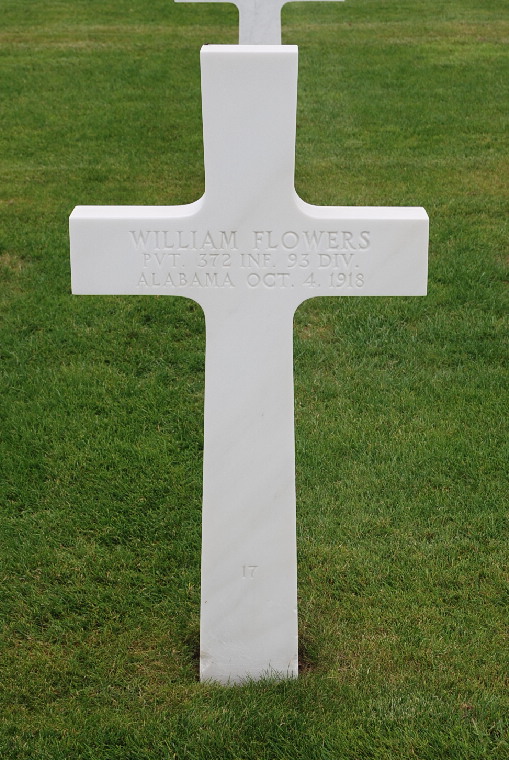
While the Meuse-Argonne Offensive raged, a second wave of influenza spread among the troops. William Flowers died from influenza on October 4, 1918, one month shy of the Armistice that ended the war.
Private Flowers’ family chose to leave his body in France to be buried in the Meuse-Argonne American Cemetery. At the end of the war, the entire 372nd Infantry Regiment received the Croix de Guerre with Palm for their dedicated service alongside French forces in the Meuse-Argonne Campaign.
Photo carousel gallery
Primary Sources
Alabama. Pike County. 1900 U.S. Census. Digital images. https://ancestry.com.
Alabama. Pike County. 1910 U.S. Census. Digital images. https://ancestry.com.
Alabama. Pike County. 1920 U.S. Census. Digital images. https://ancestry.com.
Alabama. Pike County. 1930 U.S. Census. Digital images. https://ancestry.com.
Alabama. Pike County. 1870 U.S. Census. Digital images. https://ancestry.com.
Will Flowers. Alabama, U.S., County Marriage Records, 1805-1967. Digital images. https://ancestry.com.
Du Bois, W. E. B. “Close Ranks.” The Crisis, July 1918. Smithsonian’s National Museum of African American History & Culture. https://nmaahc.si.edu/object/nmaahc_2012.84.7.
“Flowers, William.” World War I Service Record, Alabama Department of Archives and History. https://digital.archives.alabama.gov/digital/collection/p17217coll3/id/207290/rec/346.
French Pictorial Service. Colored Troops – American Colored Troops Camp in France. Machine gun instruction. Photograph. July 19, 1918. National Archives and Records Administration (NAID 26431498). https://catalog.archives.gov/id/26431498.
“Germans Afraid of U.S. Negroes.” The Troy Messenger [Troy, AL], September 11, 1918. Newspapers.com (320956383).
Mississippi. Hinds County. 1880 U.S. Census. Digital images. https://ancestry.com.
“Pershing Denys Giving Negro Troopers Dangerous Work Over That of Whites.” The Montgomery Advertiser [Montgomery, AL], June 22, 1918. Newspapers.com (412828330).
To the colored soldiers of the U.S. Army. Pamphlet. c.1917-1918. History Matters, George Mason University. Accessed April 13, 2025. https://historymatters.gmu.edu/d/6655/.
“Turn of the Century Share Cropping in Pike County. Interview with a ‘Merchant Farmer.’” Interview by Margaret Farmer. November 21, 1974. Troy State University Library. https://www.troy.edu/_assets/wiregrass-archives/_documents/183/_documents/farmer-sharecropping-pikeco-al.pdf.
William Flowers. Alabama, U.S., Military Card Files, 1917-1918. https://ancestry.com.
William Flowers. U.S., Army WWI Transport Service, Passenger Lists, 1918-1919. https://fold3.com.
Wolcott, Marion Post. Mr. Charlie McGuire (tenant purchase borrower) with his two mules and cultivator. Pike County, Alabama. Photograph. April, 1939. Library of Congress Prints (2017800940). https://www.loc.gov/item/2017800940/.
Secondary Sources
“93rd Division.” George S. Robb Center for the Study of the Great War, Park University. Accessed February 26, 2025. https://gsr.park.edu/collections/93rd-division/.
“The Battle of Lorraine.” Pritzker Military Museum and Library Blog. August 15, 2022. Accessed February 26, 2025. https://www.pritzkermilitary.org/resources/blog/battle-lorraine.
“Black History Month: Highlighting the 93rd Division in World War I.” National Guard. Accessed February 23, 2025. https://www.nationalguard.mil/News/Article/653966/black-history-month-highlighting-the-93rd-division-in-world-war-i/.
“Company E, 372nd Colored Infantry Regiment.” Black Fives. Accessed February 26, 2025. https://www.blackfives.org/company-e/.
Deuringer, Karl. The First Battle of the First World War: Alsace-Lorraine. The History Press, 2014.
“East Gulf Coastal Plain Physiographic Section.” Encyclopedia of Alabama. Accessed January 28, 2025. https://encyclopediaofalabama.org/article/east-gulf-coastal-plain-physiographic-section/.
“The Great War.” District of Columbia National Guard. Accessed April 7, 2025. https://dc.ng.mil/About-Us/Heritage/DC-National-Guard-Exhibition/Exhibits/The-Great-War.
“Hometown Boys from Alabama: Information and Statistics about WWI Service Members.” American Battle Monuments Commission. Accessed January 28, 2025. https://www.abmc.gov/news-events/news/hometown-boys-alabama-information-and-statistics-about-wwi-service-members/.
Lynching in America: Targeting Black Veterans. Equal Justice Institute, 2020.
Margis, Matthew J. “Safe for Democracy: Black National Guard Soldiers in the Great War.” Prologue, Winter 2017-2018. https://www.archives.gov/publications/prologue/2017/winter/safe-for-democracy.
“The Meuse-Argonne Offensive.” National Archives and Records Administration. Accessed February 22, 2025. https://www.archives.gov/research/military/ww1/meuse-argonne.
Oury, Marie. “African American Experience Overseas During WWI.” UCF & NCA: Veterans Legacy Program. Accessed April 7, 2025. https://vlp.cah.ucf.edu/wwi/aaexperiencesoverseas.html.
“Peanut Growers Meet War Demands.” Monthly Review Federal Reserve Bank of Atlanta. Volume 27 (no. 7), July 31, 1942. https://fraser.stlouisfed.org/files/docs/publications/frbatlreview/pages/63796_1940-1944.pdf.
“Pike County.” Encyclopedia of Alabama. Accessed January 28, 2025. https://encyclopediaofalabama.org/article/pike-county/.
“Pvt. William Flowers.” Find a Grave. Updated August 5, 2010. Accessed January 2, 2024. https://www.findagrave.com/memorial/55958067/william-flowers.
Scott, Emmett J. The American Negro in the World War. Homewood Press, 1919.
“Smitha Missey ‘Smithey’ Griffin Flowers.” Find A Grave. Updated July 3, 2017. Accessed December 31, 2024. https://www.findagrave.com/memorial/180974359/smitha-missey-flowers.
This Day in History, September 26, 1918: The Meuse-Argonne Campaign Begins. Video, [2:52]. American Battle Monuments Commission. Accessed February 17, 2025. https://www.abmc.gov/video/this-day-in-history-september-26-1918-the-meuse-argonne-campaign-begins/.
“Troy, AL.” Lockheed Martin. Accessed January 28, 2025. https://www.lockheedmartin.com/en-us/who-we-are/business-areas/missiles-and-fire-control/troy.htm.
Wheeling, Kate. “A Brief History of Peanut Butter.” Smithsonian Magazine, January 2021. https://www.smithsonianmag.com/innovation/brief-history-peanut-butter-180976525.
“William Flowers.” American Battle Monuments Commission. Accessed January 2, 2024. https://weremember.abmc.gov/#!/details?id=49208.
“World War I and Alabama.” Encyclopedia of Alabama. Accessed January 28, 2025. https://encyclopediaofalabama.org/article/world-war-i-and-alabama/.
This profile was researched and created through the Researching Silent Heroes program, sponsored by the American Battle Monuments Commission.
