


Sergeant Eugene William Wear
Early Life
Eugene William Wear was born on February 8, 1896, in Beaver Meadows, Pennsylvania. Beaver Meadows is just outside of Hazleton, in the state’s northeastern corner. Wear was the youngest of five children born to William and Angeline “Angie” Wear. The family lived on Vine Street, and the children attended the Vine Street School.
Wear’s father worked as a collier in the local coal mines, and his older siblings worked in retail stores. After he left school, Wear worked at Bethlehem Steel Corporation. He also listed himself as a silk weaver on his Canadian enlistment paperwork.
Photo carousel gallery
Home Front
Hazleton was chartered as a city only five years before Wear’s birth. The coal industry was the leading cause of its growth, with the population almost doubling between 1900 and 1910. Over 30 languages were spoken in the community. Hazleton, Pennsylvania, along with many resource-rich manufacturing towns, was known for its coal production.
Hazleton is part of the Pocono Plateau region of eastern Pennsylvania, known for its anthracite coal production. Pennsylvania produced 277 million tons of coal in 1918, worth $705 million.
Like many manufacturing towns in the early twentieth century, there was conflict between laborers and industry, including a 163-day strike in 1902. This strike was settled due to the fear of a coal shortage in the coming winter.
Hazleton, surprisingly to some, also became known for its silken goods production. It was the location of the French-based Duplan Silk Company. The industry provided more stable employment opportunities. The city collected donations and incentivized the company to build a plant in Hazelton. The Duplan Silk Mill employed thousands of residents in its 600,000 square foot mill until it closed in 1953. Much of the company’s workforce consisted of young women. As the war began, the Duplan Silk Company began making gunpowder and other munitions bags needed by the military.
Photo carousel gallery
Military Experience
Early Years and Enlistment
After working with a man from Britain at Bethlehem Steel and hearing of the war from their perspective, Wear snuck out of Hazleton and enlisted in the British forces through Montreal, Canada, on June 8, 1915. He joined the unit known as the Black Watch and was on his way to Europe when his parents found out what had happened. His parents petitioned the State Department of the United States to help return Wear to the U.S. since he was still considered a minor at the time. It was reported that as many as 500 American youths were also sent home from the British army in 1915 due to lying about their age at the time they enlisted. He returned in 1915.
Transition to the U.S. Military
On April 6, 1917, the United States officially went to war with Germany, and Wear enlisted in Port Royal, South Carolina, that day, at age 21. His initial training took place at Parris Island, South Carolina. He served with the 49th Company, 5th Marines, 2nd Division.
Wear and his fellow soldiers left Philadelphia on June 8, 1917, aboard the USS DeKalb and landed in France soon after. Wear rose quickly through the ranks and was appointed sergeant on September 8, 1917.
Action in France
Detailed records do not exist regarding Wear’s service from his arrival in France until he officially joined the 49th Company in early June 1918. As a member of the American Expeditionary Forces, he would have trained as a replacement for troops sent to the front.
In June 1918, Wear was transferred to a replacement battalion and soon moved to the front. On June 6, 1918, his actions were awarded the Distinguished Service Cross. The act of valor is described in his files as: “On the 6th of June 1918, in the vicinity of Chateau-Thierry, France. With a private, Corporal Wear went into an open field under heavy shell and machine-gun fire and succeeded in bandaging and carrying back to our lines a wounded comrade.”
Wear’s time on the front involved him in other pivotal battles, such as the battle at Bois de Belleau; Argonne Forest between Moselle and Forest of Argonne near Blanc Mont and Champagne; and Foret Domeniale de Retz, Chaudon, and Vaux Castille. These final pushes were meant to assure victory as the Germans were pushed back after indications of their forces weakening.
Legacy and Death
Wear was wounded two times before ultimately succumbing to complications of his final injury. In early October 1918, he was taken out of action due to a gunshot wound to the cheek. He spent the next few weeks in the hospital. The timing of his next injury has conflicting information. According to his local newspaper, he sent his mother a letter that said he returned to duty on October 31 and was sent over the top of the trenches on November 1, to take a machine gun nest. It was during this time that he was shot in the chest. Wear’s service files, though, indicate it occurred on October 20. Other parts of his record suggest that he never left the hospital after the first injury.
Wear died of complications from a gunshot wound, including septicemia and emphysema, in U.S. Base Hospital #19 in Vichy, France. Official records indicate December 26, 1918, as his death date, but other records list December 25.
Photo carousel gallery
Commemoration
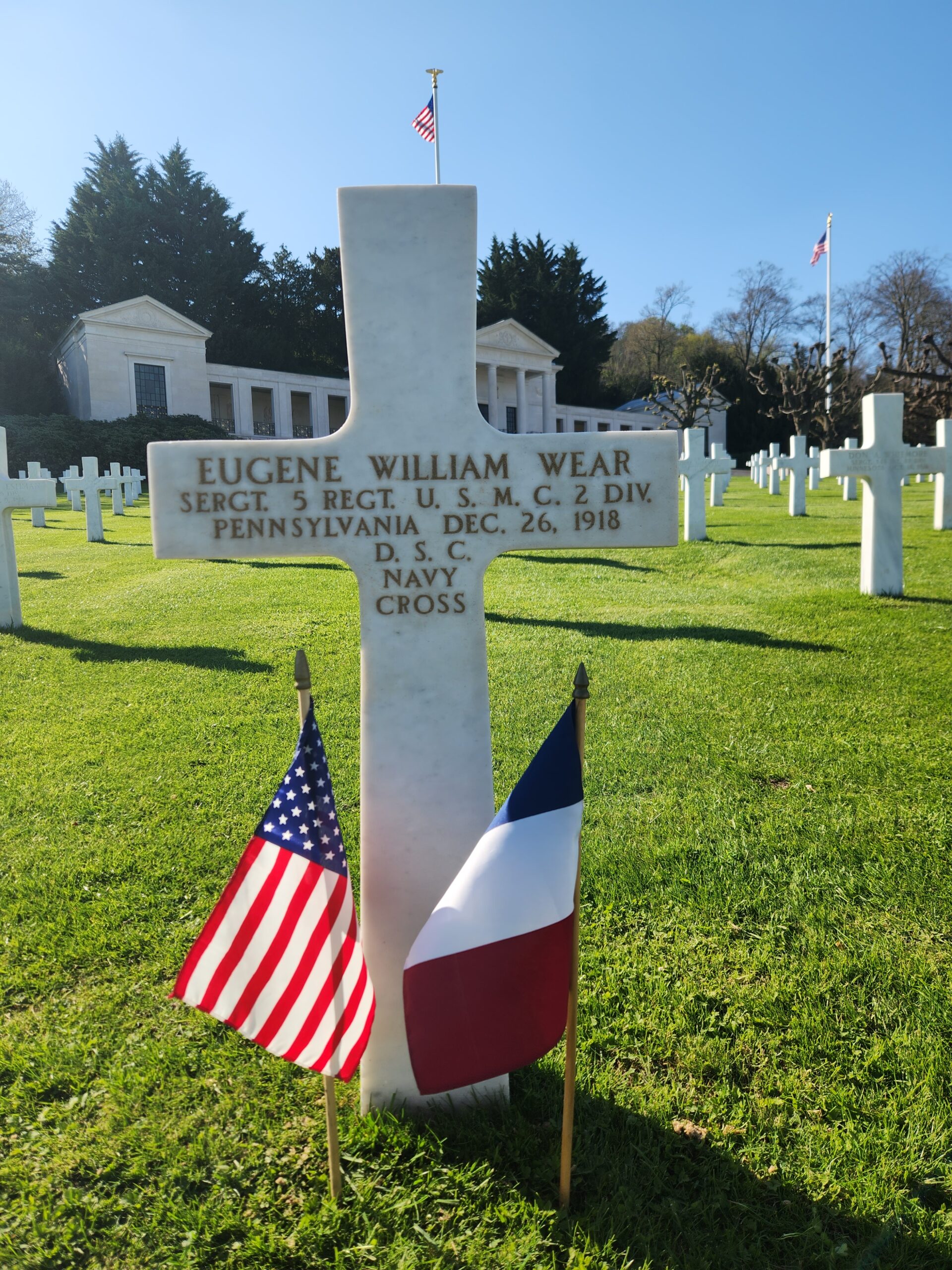
Sergeant Eugene William Wear received many commendations for his service. He received the World War I Victory Medal, the Marine Corps Distinguished Service Medal, the Navy Cross, the Purple Heart, the Marine Corps Expeditionary Medal, the Bronze Star, the Silver Star, and the Fourragère (a French military honor awarded to certain units for exceptional performance and bravery in battle).
His hometown also recognized his service and that of fellow hometown soldier Frederick L. Drake by naming a local Veterans of Foreign Wars (V.F.W. ) Post after the pair.
Wear was also mentioned in a 2018 speech given by President Donald Trump at a ceremony commemorating the one hundredth anniversary of the World War I Armistice. He was held up as an example of the bravery of all those who were lost.
Today, Wear is buried next to Frederick L. Drake in the Suresnes American Cemetery in France at the request of their parents.
Photo carousel gallery
Primary Sources
“American Boy Returned From War.” Mauch Chunk Times-News [Mauch Chunk, PA], Sept. 23, 1915. Newspapers.com (296893116).
Eugene Wear. Headstone and Interment Records for U.S. Military Cemeteries on Foreign Soil, 1942-1949. Digital images. https://ancestryclassroom.com.
Eugene Wear. Pennsylvania, U.S., World War I Veterans Service and Compensation Files, 1917-1919, 1934-1948. Digital images. https://ancestryclassroom.com.
Eugene William Wear. Burial Case File, Department of the Navy. National Archives and Records Administration – St. Louis.
Eugene William Wear. Deceased Veterans Claims (XC) File. National Archives and Records Administration – St. Louis.
Eugene William Wear. Official Military Personnel File, Department of the Navy. National Archives and Records Administration – St. Louis.
Death Certificate for Wear, Angeline. Filed Jan. 31, 1940, File number 7790, Registered No. 53. Luzerne County, Pennsylvania.
“Hazleton, PA June 25.” The Times-Tribune [Scranton, PA], June 25, 1915. Newspapers.com (534508320).
Miner’s children and houses near Hazleton, Pa., U.S.A. Photograph. June 19, 1905. Library of Congress (2015646639). https://www.loc.gov/item/2015646639/.
“News Briefs.” The Wilkes Barre Times Leader [Wilkes Barre, PA], June 15, 1915. Newspapers.com (135807406).
Pennsylvania. Carbon County. 1880 U.S. Census. Digital images. https://ancestryclassroom.com.
Pennsylvania. Luzerne County. 1900 U.S. Census. Digital images. https://ancestryclassroom.com.
Pennsylvania. Luzerne County. 1910 U.S. Census. Digital images. https://ancestryclassroom.com.
“The Spirit Lives On: WWI Memorial Plaque Rediscovered by HASD Employee.” The Standard Speaker [Hazleton, PA], July 24, 2010. https://www.standardspeaker.com/2010/07/24/the-spirit-lives-on-wwi-memorial-plaque-rediscovered-by-hasd-employee/.
USS DeKalb. Photograph. 1917. U.S. Naval History and Heritage Command (NH 54644). https://www.history.navy.mil/content/history/nhhc/our-collections/photography/numerical-list-of-images/nhhc-series/nh-series/NH-54000/NH-54655.html.
“Veterans Open New Quarters.” Standard-Speaker [Hazleton, PA], July 6, 1921. Newspapers.com (500360463).
View of Hazleton, PA From Silk Mills. Photograph. Lattimer Archeology Project, University of Maryland. https://lattimerarchaeology.wordpress.com/2014/02/21/other-dimensions-of-patchtown-life-part-4-the-textile-industry/.
Wear, Eugene. Canada, WWI, CEF Attestation Papers, 1914-1918. https://fold3.com.
Secondary Sources
Bettez, David J. “Heroic Deeds, Heroic Men.” MCU Press, 2020.
“City of Hazleton, Area Information.” Hazleton City. Accessed February 2, 2025. https://hazletoncity.org/hazleton-information.
Coffman, Edward M. The War to End All Wars: The American Military Experience in World War I. The University Press of Kentucky, 1998.
“The Duplan.” Hazleton History—The Wayback Machine. Accessed February 2, 2025. http://www.hazletonhistory.8m.com/duplan.htm.
“Eugene W. Wear.” American Battle Monuments Commission. Accessed November 30, 2024. https://www.abmc.gov/decedent-search/wear%3Deugene.
“Eugene William Wear.” Find a Grave. Updated September 28, 2020. Accessed February 22, 2025. https://www.findagrave.com/memorial/55954447/eugene-william-wear.
“Eugene William Wear.” Honor States. Accessed February 25, 2025. https://www.honorstates.org/profiles/155810/.
“Facts About Pennsylvania in the First World War.” World War I Centennial. Accessed February 2, 2025. https://www.worldwar1centennial.org/index.php/pennsylvania-in-ww1-articles.html.
“The Final Efforts: St. Mihiel and the Meuse-Argonne.” The United States World War One Centennial Commission. Accessed February 22, 2025. https://www.worldwar1centennial.org/index.php/edu-home/edu-topics/592-on-to-victory-the-hundred-days/5020-the-final-efforts-st-mihiel-and-the-meuse-argonne.html
Goldenberg, Colonel Richard. “National Guard’s 42nd Division goes on attack in WWI at Chateau Thierry.” U.S. Army. Accessed March 26, 2025. https://www.army.mil/article/208939/national_guards_42nd_division_goes_on_attack_in_wwi_at_chateau_thierry.
“Life and Death of Soldiers.” International Encyclopedia of the First World War. Accessed February 25, 2025. https://encyclopedia.1914-1918-online.net/article/life-and-death-of-soldiers/.
“Life at the Front in 14 Objects.” Imperial War Museum. Accessed February 25, 2025. https://www.iwm.org.uk/history/life-at-the-front-in-14-objects.
“Other Dimensions of Patchtown Life- Part 4.” Lattimer Archeology Project/University of Maryland. Accessed February 2, 2025. https://lattimerarchaeology.wordpress.com/2014/02/21/other-dimensions-of-patchtown-life-part-4-the-textile-industry/.
“Sgt. Eugene W. Wear.” Find a Grave. Accessed November 30, 2024. https://www.findagrave.com/memorial/55954447/eugene-william-wear.
Shaw, Madeline. “Post-World War I tales: A silk surplus, armistice fashion, and a philanthropic innovator.” Smithsonian’s National Museum of American History. Updated October 11, 2016. Accessed February 2, 2025. https://www.americanhistory.si.edu/explore/stories/post-world-war-i-tales-silk-surplus-armistice-fashion-and-philanthropic-innovator.
“What Sets Us Apart.” Atlantic Carbon. Accessed February 2, 2025. https://atlanticcarbon.com/.
“USS Hazleton.” Naval History and Heritage Command. Accessed February 2, 2025. https://www.history.navy.mil/content/history/nhhc/research/histories/ship-histories/danfs/h/hazleton.html.
Yingling, Major James M. A Brief History of the 5th Marines. U.S. Marine Corps, 1968.
This profile was researched and created through the Researching Silent Heroes program, sponsored by the American Battle Monuments Commission.
Contributor
Contributed by Mr. Shawn Lucas
Neshannock Jr/Sr High School (New Castle, Pennsylvania)
2024-2025
