


Sergeant First Class Robert Francis Scherdin
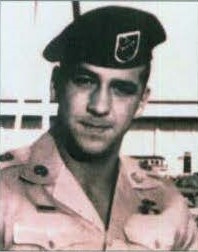
Early Life
Robert Francis Scherdin was born into a family committed to military service.
His father, Donald Scherdin, served in World War II as a corporal in Company C, 602nd Tank Destroyer Battalion, Third Army. For his efforts he received the French Croix de Guerre. After the war Donald did not return to his old life as a farm hand in Iowa. He proposed to a young New Jersey woman named Katherine DeMott in January 1945, and the two wed in 1946.
Donald and Katherine settled in veterans’ housing in Neshanic, New Jersey. One year later, on February 14, 1947, they welcomed their first child, a son they named Robert Francis Scherdin. By 1950 the family moved in with Katherine’s parents, in a cozy home in Somerville, New Jersey. Donald got a job at Vanum Cleaners, and later at Suburban Propane Gas Company. In 1949, Katherine gave birth to another boy, Donald. Within a few years, the Scherdins moved into their own home a mile east, on North Clark Avenue. Robert and his brother Donald grew up in this quiet neighborhood.
Growing Up in Somerville
As a young boy, Scherdin led his friends in enthusiastic games of “Army” as part of their very own “East End Militia,” where they battled imaginary enemies and made pretend grenades out of dirt. Scherdin’s friend Jim Langenbach recalled the time Scherdin convinced his friends to answer John F. Kennedy’s call to fitness by walking the 45 miles from Somerville to Jim’s aunt’s house in Long Branch. The pack of friends completed the hike!
Activities at the Catholic Church of the Immaculate Conception shaped much of the Scherdins’ family life. Scherdin’s grandmother served as the chapter president of the Catholic Daughters of America. Robert’s mother, Katherine, and her sisters Anne, Eleanor, and Josephine participated in this group since childhood. His aunt Eleanor worked as the parish secretary for Monsignor Eugene Kelly for 29 years.
Monsignor Kelly served in World War II as a chaplain in the Pacific Theater, saying Mass for Marines on the beach at Okinawa. Scherdin received his sacraments of Baptism, Communion, and Confirmation from Monsignor Kelly in the old brick church in the middle of town.
High School Years
Robert Scherdin was very active at Somerville High School. He served as a homeroom captain and participated in the Firemen, a safety group at school. He ran track with his younger brother, Don, played football, and sang in multiple choruses. Continuing his interest in the military, he participated in the Rifle Club. Outside of school, Robert, his brother Don, and his cousin John hiked two parts of the Appalachian Trail.
During high school, Scherdin broke his leg, but his participation in school activities remained strong. On a school trip to the Metropolitan Opera in New York, Scherdin got his cast signed by one of the opera singers.
Scherdin, nicknamed “Worms” in the school yearbook, entered The Citadel after his graduation on June 16, 1965, to continue his education at the military school. Sadly, his father, Donald, passed away from a brain tumor on August 25, 1965, only two months after Scherdin’s high school graduation.
Photo carousel gallery
Home Front
Somerville, New Jersey, bustled with growth and activity in the 1940s and 1950s. Located in “the heart of central Jersey,” southwest of the Watchung Mountains and slightly northeast of the rolling farmlands of Hunterdon County, near the Raritan River, the suburban town was located in a prime location. Several highways converged near Somerville, some of these roads dating back to colonial times. Somerville’s location along the train line to New York City made it an especially desirable community after World War II.
The Somerset County courthouse anchored one end of Main Street, and a variety of shops and businesses lined the busy road. Woolworths, Kugler’s Bike Shop, and a number of bakeries served the growing population. By 1960, more than a dozen houses of worship from all different denominations dotted the town. The Scherdin’s church, Immaculate Conception, stood a block off Main Street, a few minutes from their home. A hospital built in 1925 continued to expand only a few blocks from North Clark Street, where the Scherdins lived.
Somerville’s charm reached a wider audience every May. In 1940, cyclists and enthusiasts from all over the world converged on Somerville for its inaugural elite 50-mile cycling race, the Tour of Somerville. Renamed in 1947, the Kugler-Anderson Memorial Bike Race commemorated the first two winners of the tour, who were both killed in World War II. Furman Kugler (the first winner), the son of the race founder, won the inaugural race, and Carl Anderson won the second 50-mile tour. The race continues every Memorial Day weekend.
World War II
During World War II, factories in the area provided enormous quantities of war materiel for the Allied effort, specifically chemical products from the American Cyanamid factory in Bridgewater. The military honored the company for its efforts after the war. Just down the road in Manville stood the massive headquarters of the Johns Mansville company, which produced asbestos products. Both companies employed many area residents.
By the late 1960s, the water pollution created by American Cyanamid drew strong backlash from residents. With the later closure of the John Mansville plant, area employment suffered a significant blow. The environmental and health impacts of these companies challenged area residents for decades.
The Post-War Population Boom
Somerville’s population grew by about ten percent a decade from the 1950s to the 1970s. Veterans and their families moved into “Victory Homes,” built on the east side of town, while developers constructed large garden apartment communities. One such community added 642 units in 1948. The western side of town boasted stately Victorian homes that reminded residents of Somerville’s past as a thriving commercial center. By the time Scherdin prepared to enter high school in 1961, 12,458 people called Somerville home.
Race Relations
While Somerville was a predominantly White community in 1960, its high school was integrated early in the twentieth century. Somerville High boasted Paul Robeson, class of 1915, as its most famous graduate. African Americans in town were actively involved in all areas of civic life. In 1960, the Somerville Negro Civic Council held a “Freedom Rally” to support the sit-ins of the South. Somerville residents kept informed of national efforts to promote Civil Rights. Monsignor Kelly of Immaculate Conception Church stopped the practice of blackface in church theater productions out of respect for the Civil Rights Movement. As the town grew, its diversity increased.
By the late 1960s, the unrest that struck the nearby cities of Newark and Plainfield found echoes in Somerville. A few incidents of smashed store windows made the news, and residents complained of “tokenism” on the primarily White police force. Protesters held a march against police brutality. Still, Somerville’s citizens tended to get along, and Monsignor Kelly noted the town’s “warm moral character.”
Growth and Urban Renewal
By the 1960s, many larger businesses in the downtown area moved to the nearby Somerville Circle, a convergence of two major roadways. This move meant that a significant amount of traffic bypassed Somerville’s Main Street and its businesses. Somerville’s town council expressed concern and unveiled a variety of plans to tap into federal funds for urban renewal. Debates over new road configurations and moderate-income housing went on for years.
At the county level, debates over a proposed jetport worried residents. Ultimately, the County Freeholders deemed the area unsuitable for a jetport and focused on roads as the key infrastructure needed for Somerset County to grow and thrive.
Responses to the War in Vietnam
Residents had mixed reactions to the war in Vietnam, but consistently showed strong support for the troops.
As American involvement in Vietnam grew, rallies for peace also occurred in town. By 1966, three young men from the Scherdins’ parish had died in the war. A fourth died early in 1968. Calls for peace grew. By 1969, the national War Moratorium Day saw candlelight vigils, discussions in schools, film viewings, and petitions in towns across Somerset County. Later, on November 14, 1969, three young local Veterans of the Vietnam War held a rally for peace in Somerville, about five minutes from Scherdin’s home. By 1970, calls for peace spread across the area.
Photo carousel gallery
Military Experience
After Scherdin’s second year at The Citadel, he worried about the burden his tuition put on his widowed mother. He put his education on hold and enlisted in the U.S. Army. The Scherdin family had a long legacy of service to their country, and Scherdin followed in those footsteps. In addition to his father, his father’s sister served in the WAVES during World War II. Later, Scherdin’s uncle, Hubert, died as a Prisoner of War during the Korean War.
In keeping with his adventurous past, Scherdin pursued the rigorous training course required to join the Army Special Forces. At Fort Bragg, North Carolina, Scherdin learned survival skills and how to improvise in the field under pressure. After intense training, he earned his Green Beret. The “Green Berets” were trained to deploy in very small mission groups in austere environments, skills Scherdin would need in Vietnam. Additionally, in March 1968, Scherdin received his Parachutist Badge at Fort Benning, Georgia.
Military Assistance Command, Vietnam–Studies and Observations Group
At some point in 1968, Scherdin was deployed to Vietnam with the 5th Army Special Forces, landing in Nha Trang, Vietnam, before being deployed throughout the country. Scherdin volunteered for the most elite of the Special Forces, the top-secret, all-volunteer Military Assistance Command, Vietnam – Studies and Observations Group (MACV-SOG). Accepted volunteers represented the best of the best in the U.S. Armed Forces. Scherdin made his way to Command and Control North at Da Nang and started his work in this secret group.
Founded on January 24, 1964, MACV-SOG units operated outside the sphere of regular Army operations. Soldiers signed ten-year Non-Disclosure Agreements as a prerequisite to joining MACV-SOG, as the secrecy of operations remained paramount. Small groups of two to three American soldiers and eight Indigenous soldiers formed Reconnaissance Teams (RTs) that carried out covert reconnaissance of the Ho Chi Minh Trail in Laos and Cambodia. Sometimes they took Viet Cong prisoners, tapped enemy communications, or committed acts of sabotage. Some covert missions focused on the rescue of American Prisoners of War behind enemy lines.
Helicopter pilots inserted MACV-SOG units into remote and hazardous areas, targeting “boxes” of six-kilometer-square areas of mountainous jungle terrain. Often, the soldiers climbed metal ladders to and from the helicopters to the ground when no clear landing zone could be found, or were extracted by attaching to long chains hanging from the helicopters. They customized their weapons and wore unmarked uniforms suitable for their top-secret work. MACV-SOG soldiers prepared to improvise and survive in the most difficult conditions. While they aimed to avoid enemy contact, MACV-SOG soldiers trained to fight their way out of difficult situations.
Eventually, Scherdin ended up at Command and Control Central in Kontum, not far from the borders of Cambodia and Laos. In the tight-knit group of MACV-SOG, Scherdin prepared for missions and found time to joke around with his friends. The Americans and their counterparts—Montagnard, Chinese, Vietnamese, and Cambodian soldiers—forged a brotherhood on the front. In the field, their lives depended on cooperation.
The RTs of MACV-SOG were unaware of the details of other teams’ missions. Even within the unit, missions remained secretive, labelled “Long Distance Reconnaissance Patrols” to maintain operational security. Within the unit, RTs had nicknames—often states, poisonous snakes, or weather effects. RTs maintained autonomy while on mission, and soldiers determined what weapons and supplies they should bring to carry out their assigned task. Missions lasted from a few hours to a few days. Soldiers back at base waited for the return of the helicopters and their friends.
Scherdin’s Final Mission
On December 29, 1968, Robert Scherdin, Gerald Apperson, and eight Montagnard soldiers embarked on a reconnaissance mission, crossing four miles over the border into Cambodia. As the Assistant Team Leader (the “One-Two”) of RT Vermont, Scherdin carried two radios and led four of the Montagnard soldiers.
Apperson and the lead element moved ahead through the tall grass, bamboo, and trees near the landing zone, while Scherdin led the rear group of Montagnards. As Scherdin’s element moved to join Apperson, they came under heavy fire from the rear, and Scherdin went down, severely wounded. The closest Montagnard, Nguyen Van Vinh, tried to help Scherdin up, but the young soldier simply groaned and could not move. Nguyen realized he, too, had been shot and that the rest of the element had moved on ahead. The wounded Nguyen had no choice but to leave Robert Scherdin behind.
When the enemy barrage started, Apperson called for emergency air support. He explained that the RT had come under heavy fire and that he had been separated from his rear element. Despite repeated attempts to contact Scherdin by radio, Apperson received no reply.
Shortly after, a helicopter extracted Apperson and the first four Montagnards. The rear element used a signalling panel to alert the helicopter to their location 30 minutes later, about 600 yards from where Apperson and the first element had been extracted. Scherdin remained lost somewhere on the hill behind them.
Photo carousel gallery
Commemoration
The Search
After bringing the Reconnaissance Team back to Kontum, the helicopter quickly refueled. Within 45 minutes, the same helicopter that extracted both the forward team and the Montagnard members of the rear team circled back to search for Scherdin from the air. Darkness fell, forcing the pilots to call off the search.
The rescue crew continued to call for Scherdin over the radio every three minutes, but he never responded. The February 1969 report after the incident stated that “no contact was made with PFC Scherdin after 1230 hours 29 December 1968 by sight or radio.”
At least one of the Montagnard soldiers thought Scherdin died almost immediately after being wounded, but this was never confirmed.
The next day, December 29, a 40-man MACV-SOG “Bright Light” recovery team assembled to find Scherdin. This unit also came under heavy attack during their rescue mission and suffered terrible losses. One of the leaders of this group, First Lieutenant James R. Jerson was killed, along with half his team. Sergeant First Class Robert Howard was awarded the Medal of Honor for his actions under fire that day. Still, there was no sign of Scherdin.
The “Wake”
The day after the Bright Light team lost so many men, the soldiers remaining at the base gathered in the club to remember Scherdin and Jerson. They toasted both soldiers, told stories about their fallen friends, and sang an old folk song about a dog called “Hey Blue,” a tradition in MACV-SOG. The men added the names of their fallen friends into the song as a way to honor their memories.
More Loss
One week later, on January 8, 1969, Scherdin’s team leader, Sergeant First Class Gerald Apperson, Specialist Fourth Class Bill Williams, and a four-man Montagnard crew, returned to the area of their mission. After four days of searching, the team was extracted, but the helicopter they were traveling in crashed. The men in the chase chopper were unable to save anyone aboard, due to exploding ordnance. Once the crash site cooled, recovery teams found no evidence of Scherdin in the wreckage.
The date of Scherdin’s loss, December 29, 1968, also marks the date the U.S. Congress passed the Cooper-Church Amendment, which prohibited U.S. participation in actions in Laos and Cambodia.
The Family’s Struggle for Information
Katherine DeMott Scherdin learned that her son was missing in January 1969, but the Army officers who came to her door told her she must never speak of Scherdin’s loss. The secrecy of MACV-SOG work, especially in Cambodia, meant that even Scherdin’s mother did not have any real information on what happened to her son, or even where he had been lost, until 1978.
While some believed Scherdin died shortly after being wounded, proof remained elusive. Mrs. Scherdin periodically received visits from Army officers who showed her pictures of POWs to see if any resembled her son. By 1978, Mrs. Scherdin believed her son would never return home. The Army formally declared Robert Scherdin deceased in 1978, ten years after that mission in Cambodia.
The search for Scherdin continued, and reports from 1993 and 2019 describe the challenging terrain and the difficulties faced by the elderly Vietnamese veterans interviewed. No remains have been found, but some of the Veteran reports suggest that they found a mortally wounded soldier with a radio in roughly the same time as Scherdin’s mission.
Remembrance
Today, Robert Scherdin’s name is engraved on the Honolulu Memorial at National Memorial Cemetery of the Pacific in Honolulu, Hawaiʻi, and on the Vietnam Memorial in Washington, D.C. In the late 1970s, his family placed a memorial marker for him in the local cemetery in Somerville.
Robert Scherdin’s younger brother, Don, later served stateside in the U.S. Navy, and his cousin, John Brower, served as a medic in the 173rd Airborne Brigade in Vietnam from 1970 to 1971.
Scherdin’s alma mater, Somerville High School, honors him with a display that includes his Army jacket and a photograph. Somerville has honored Scherdin’s memory many times over the years, with Memorial Day ceremonies, remembrances by the Elks, and newspaper articles. The Citadel includes him on their list of graduates lost in Vietnam, a testament to the fact that he planned to return to finish his education. A minor league ballpark in New Jersey’s Skyland region has a “Chair of Honor” commemorating Scherdin’s sacrifice and the plight of all POWs.
Fifty years after his loss, Scherdin’s memory lives on. Posts on POW pages from people who have worn his POW bracelet for decades testify to the fact that this adventurous 21-year-old, who loved his country so much, will live on in the memory of a grateful nation.
Photo carousel gallery
Primary Sources
“3 New Highways Proposed in Somerset County Study.” The Courier-News [Bridgewater, NJ], December 1, 1965. Newspapers.com (218946609).
“354 Get Diplomas at Somerville High.” The Courier-News [Bridgewater, NJ], June 17, 1965. Newspapers.com (218845892).
Additional information report 19-XVN-08 possibly correlating with Cambodia Refno 1351 . . . Socialist Republic of Vietnam. Manuscript/Mixed Material. 2019. Library of Congress. https://www.loc.gov/item/powmia/s147-172/.
“Both Sides Yell Foul at Water Hearing.” The Central New Jersey Home News [New Brunswick, NJ], December 9, 1964. Newspapers.com (315773482).
Clampitt, Maggie. “Non-Profit Housing Examined: Opinions Vary on Fiscal Impact.” The Courier-News [Bridgewater, NJ], October 27, 1969. Newspapers.com (221925826).
“DeMott-Scherdin.” The Courier-News [Bridgewater, New Jersey], Friday, January 5, 1945. Newspapers.com (221443401).
“DeMott-Scherdin.” The Courier-News [Bridgewater, NJ], Friday, January 5, 1945. Newspapers.com (221443414).
Detailed report of investigation of Laos Refno Conducted during joint field activity 19-2VN JFA in the Socialist Republic of Vietnam. Manuscript/Mixed Material. 2019. Library of Congress. https://www.loc.gov/item/powmia/s148-086/.
“Donald F. Scherdin.” Central Jersey Home News [New Brunswick, New Jersey], August 25, 1965. Newspapers.com (315906812).
Donald F. Scherdin. Iowa, U.S., State Census Collection, 1836-1925. https://ancestryclassroom.com.
Donald Scherdin. U.S., World War II Army Enlistment Records, 1938-1946. https://ancestryclassroom.com.
“Eleanor F. DeMott.” Cusick Funeral Home. Updated January 23, 2013. Accessed December 28, 2024. https://www.cusickfuneralhome.com/obituaries/Eleanor-F-DeMott?obId=24007670.
“Ex-Mayor Attacks Agencies for Failure to Clean Up River.” The Central New Jersey Home News [New Brunswick, NJ], September 4, 1966. Newspapers.com (315581247).
“Freeholder Blasts Solberg.” Echoes-Sentinel [Warren Township, NJ], March 6, 1969. Newspapers.com (95530220).
Genovese, Peter. “War Takes Toll on Somerville Woman, Mother of an MIA.” The Central New Jersey Home News [New Brunswick, NJ], August 23, 1978. Newspapers.com (317043284)
“Jersey Students Enjoy Opera at Met.” The Star Ledger [Newark, NJ], April 5, 1964. Newspapers.com (1108792311).
JTFFA SITREP Messages/Daily Sitrep for JFA 94-C for 13 Nov. 93. Manuscript/Mixed Material. 1993. Library of Congress. https://www.loc.gov/item/powmia/pwmaster_110214/.
“Katherine DeMott Wed to Donald Scherdin.” The Courier-News [Bridgewater, NJ], February 8, 1946. Newspapers.com (221267085).
“Katherine Scherdin.” The Courier-News [Bridgewater, NJ], November 21, 2008. Newspapers.com (225253487).
“Men and Women in Uniform: Servicemen’s News From Around the World.” The Daily Home News [New Brunswick, NJ], March 27, 1968. Newspapers.com (315699109).
Missing Persons in Sea. Manuscript/Mixed Material. 1976. Library of Congress. https://www.loc.gov/item/powmia/pwmaster_125030/.
“Mrs. Roscoe DeMott Heads CD of A in Somerville.” The Courier-News [Bridgewater, NJ], May 6, 1942. Newspapers.com (218902293).
“Negro Policemen Called Examples of Tokenism.” The Courier-News [Bridgewater, NJ], September 12, 1968. Newspapers.com (221941781).
New Jersey. Somerset County. 1950 U.S. Census. Digital images. https://ancestryclassroom.com.
New Jersey. Somerset County. 1950 U.S. Census. Digital images. https://www.familysearch.org/.
“Rally to Help Raise Funds.” The Central New Jersey Home News [New Brunswick, NJ], June 2, 1960. Newspapers.com (315231449).
Results of photo comparison R.D. Scherdin/Robert F. Scherdin. Manuscript/Mixed Material. 1971. Library of Congress. https://www.loc.gov/item/powmia/pwmaster_88294/.
Robert F. Scherdin. U.S., Headstone Applications for Military Veterans, 1861-1985. https://ancestryclassroom.com.
“Scores March in Somerville Protest Against Police.” The Central New Jersey Home News [New Brunswick, NJ], August 30, 1968. Newspapers.com (315864419).
“Simes Bests Bell in Stretch Duel to Win Tour of Somerville.” The Central New Jersey Home News [New Brunswick, NJ], May 31, 1967. Newspapers.com (315906650).
“Somerville Given Extension to Implement Urban Renewal.” The Courier-News [Bridgewater, NJ], June 22, 1966. Newspapers.com (221838711).
“Somerville Urban Renewal Ready.” The Central New Jersey Home News [New Brunswick, NJ], June 28, 1973.
“Stars to Vie in Somerville Race.” The Courier-News [Bridgewater, NJ], May 25, 1967. Newspapers.com (222340521).
“State MIA Families Feel Abandoned.” The Star-Ledger [Newark, New Jersey], January 26, 1975. Newspapers.com (221857691).
“Store Fronts are Smashed in Somerville.” The Central New Jersey Home News [New Brunswick, NJ], July 17, 1967. Newspapers.com (315706433).
“Three in Somerville.” The Courier News [Bridgewater, New Jersey], February 15, 1947. Newspapers.com (221430003).
“Urban Renewal.” The Central New Jersey Home News [New Brunswick, NJ], January 21, 1968. Newspapers.com (315802169).
“Vets to Lead Viet Service.” The Courier-News [Bridgewater, NJ], November 14, 1969. Newspapers.com (221964730).
“Viet War Protest Generates Mixed Reaction, Varied Plans.” The Courier-News [Bridgewater, NJ], October 4, 1969. Newspapers.com (221981452).
“War Protests Planned in Central Jersey.” The Courier-News [Bridgewater, NJ], November 12, 1969. Newspapers.com (221964492).
“War Takes Toll on Somerville Woman, Mother of an MIA.” The Central Jersey Home News. [New Brunswick, NJ], August 23, 1978. Newspapers.com (317043284).
Secondary Sources
“1968.” MACV-SOG. Accessed February 9, 2025. https://www.macvsog.cc/1968.htm.
Barth, Linda J., Robert H. Barth, and James L. Sommerville III. Somerville Through Time. Fonthill Media LLC, 2015.
Brooks, Steven B. “Legionnaire and former Green Beret shares story of ‘best-kept secret’ of Vietnam War.” American Legion. Updated August 30, 2023. Accessed February 15, 2025. https://www.legion.org/information-center/news/convention/2023/august/legionnaire-and-former-green-beret-shares-story-of-best-kept-secret-of-vietnam-war.
Brower, John. Email interview with author. April 2, 2025.
“Citadel History-War Deaths.” The Citadel. Accessed December 16, 2024. https://www.citadel.edu/citadel-history/war-deaths/.
Crowley-Hughes, Andrea. “Somerville Delays Talks on Rezoning of Brookside Gardens Apartments.” TapInto Somerville, December 7, 2021. https://www.tapinto.net/towns/somerville/sections/government/articles/somerville-delays-talks-on-rezoning-of-brookside-gardens-apartments-dd8b0931-0b52-4144-800f-229ac67adcba.
Doorly, Bruce. “Welcome to Raritan Online.” Raritan Online. Accessed January 26, 2025. http://raritan-online.com/.
“Fifth Special Forces Group (Airborne) History.” United States Army Special Forces Command. Accessed February 23, 2025. https://www.soc.mil/USASFC/Groups/5th/5thSFGHistory.html.
Ganz, Carl Jr. The History of Immaculate Conception Parish, Somerville, NJ 1883-2008. Immaculate Conception Press, 2008.
General Population Characteristics: New Jersey. U.S. Census Bureau. https://usa.ipums.org/usa/resources/voliii/pubdocs/1960/Population/Vol1/21260894v1p32ch3.pdf
Hatala, Greg. “Glimpse of History The ‘60s in Somerville.” NJ.com. Accessed March 28, 2025. https://www.nj.com/somerset/2012/10/glimpse_of_history_the_60s_in.html .
Hirsch, Rod. “Somerville High School Pays Tribute to its Fallen Hero 50 Years Later.” TAPinto Hillsborough, June 2, 2018.
“Historical Timeline.” Johns Manville. Accessed January 19, 2025. https://www.jm.com/en/our-company/HistoryandHeritage/company-history/.
“History of the Paris.” Church of the Immaculate Conception. Accessed December 28, 2024. https://immaculateconception.org/history-of-the-parish.
“Military Assistance Command, Vietnam-Studies and Observations Group (MACV-SOG).” History of MACV-SOG. Accessed February 9, 2025. https://sogsite.com/.
How Somerville Grew: Mapping Out the History of Our Regional Center. Somerville Historic Advisory Committee, 2001.
“Hubert C. Scherdin.” American Battle Monuments Commission. Accessed December 29, 2024. https://www.abmc.gov/decedent-search/scherdin%3Dhubert.
New Jersey Population Trends 1790-2000. New Jersey State Data Center. August 2001. https://www.nj.gov/labor/labormarketinformation/assets/PDFs/census/2kpub/njsdcp3.pdf.
Parner, Joe, and Robert Dumont. SOG Kontum Top Secret Missions in Vietnam, Laos, and Cambodia 1968-1969.Casemate Publishers, 2022.
Plaster, John L. Secret Commandos: Behind Enemy Lines with the Elite Warriors of SOG. NAL Caliber, 2004.
Plaster, John L. SOG A Photo History of the Secret Wars. Casemate Publishers, 2022.
“Robert Francis Scherdin.” American Battle Monuments Commission. Accessed December 28, 2024. https://www.abmc.gov/decedent-search/scherdin%3Drobert.
Scherdin, Robert F. Combat Area Casualties Current File. National Archives and Records Administration. https://aad.archives.gov/aad/record-detail.jsp?dt=197&mtch=1&cat=all&tf=F&q=robert+francis+scherdin&bc=&rpp=10&pg=1&rid=38137.
“Scherdin, Robert F.” P.O.W. Network. Accessed February 9, 2025. https://www.pownetwork.org/bios/s/s005.htm.
Scruton, Bruce A. “Skylands Stadium dedicates ‘Chair of Honor’ to POW/MIA.” NJ Herald, August 8, 2019. https://www.njherald.com/story/news/2019/08/08/skylands-stadium-dedicates-8216-chair/4320778007/ .
Seals, Robert. “MACV-SOG History.” U.S. Army. Accessed February 15, 2025. https://www.army.mil/article/216498/macv_sog_history.
“SFC Robert Francis Scherdin.” Defense Personnel POW/MIA Accounting Agency. Accessed November 10, 2024. https://dpaa-mil.sites.crmforce.mil/dpaaProfile?id=a0Jt00000001UIWEA2.
“SSgt. Robert Francis Scherdin.” Find a Grave. Updated June 11, 2021. Accessed April 18, 2025. https://www.findagrave.com/memorial/228380725/robert-francis-scherdin.
“SSgt. Robert Francis Scherdin.” Find a Grave. Updated December 22, 2012. Accessed December 16, 2024.https://www.findagrave.com/memorial/102464179/robert-francis-scherdin.
“Tour of Somerville Event History.” Tour of Somerville. Accessed December 31, 2024. https://tourofsomerville.com/spectator-information/history/.
“U.S. Military Fatal Casualties of the Vietnam War for Home-State-of-Record: South Dakota.” National Archives. Accessed February 15, 2025. https://www.archives.gov/files/research/military/vietnam-war/casualty-lists/sd-alpha.pdf?_ga=2.252537161.1742119186.1739559945-898485522.1730740150.
Young, Colleen. Email interview with author. January 7, 2025.
Contributor
Contributed by Mrs. Kristin Camiolo
Immaculata High School (Somerville, New Jersey)
2024-2025
