


Sergeant Norman J. Stewart
Early Life
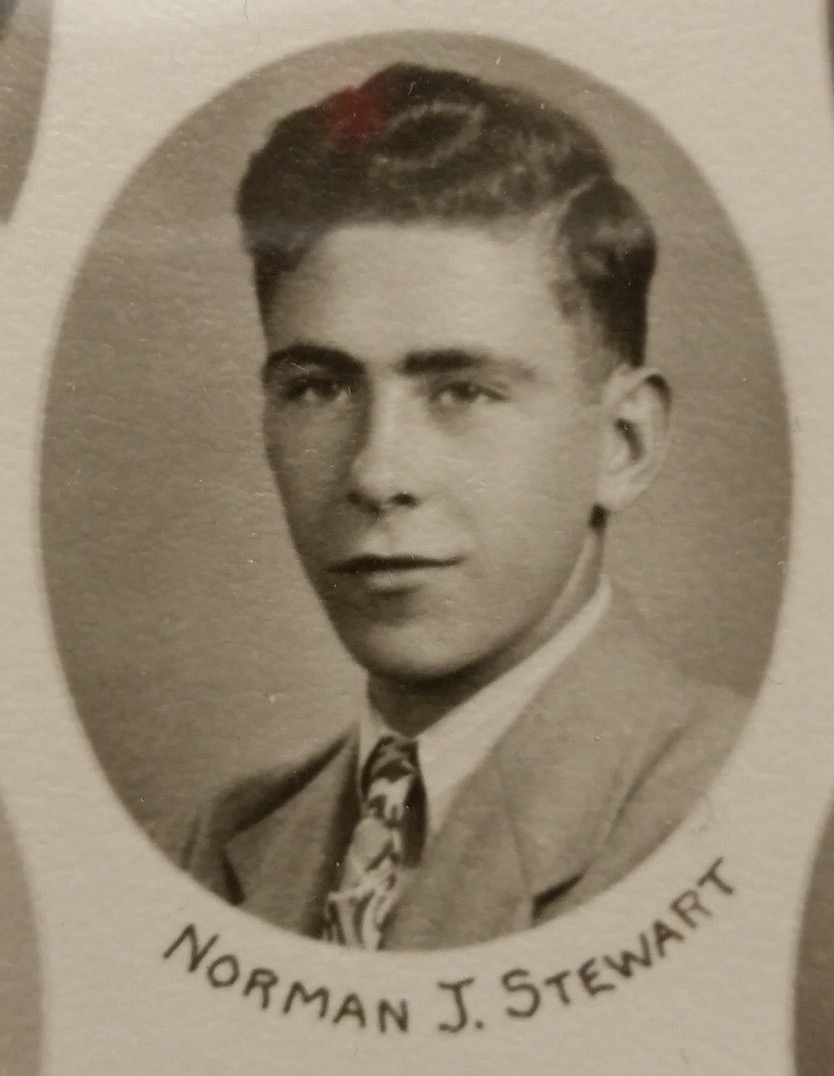
Norman J. Stewart grew up in Farmington, Michigan. During the Great Depression, his family moved from Dearborn to Detroit before settling in a neighborhood near Farmington High School. His little brother, Gerald, was four years his junior. His father, Foster, was a postman and mother, Harriet, a housewife. Growing up, Stewart attended Farmington First United Methodist Church.
In June 1943, after graduating from Farmington High School, Stewart enlisted in the U.S. Army Air Forces. Just two weeks after Norman left for basic training in Miami Beach, Florida, Norman’s father moved the rest of the family to California to deliver mail in Montecito.
A childhood friend of Stewart was Edward A. Dick. After graduating from Cooley High School in Detroit, the U.S. Army drafted Edward into the 114th Infantry Regiment, 44th Division. He fought in France. Like the Stewart family, the Dick family moved to California after Edward entered the service. The two families remained friends throughout the war.
Military Experience
Following basic training, Stewart earned his gunner’s wings at Tyndall Field, Florida, and transferred to Westover Field, Massachusetts, for combat training. The Army Air Forces sent Stewart overseas on July 1, 1944, to serve with the 8th Army Air Force, 445th Bomber Group, 701st Squadron at Tibenham, England. On his nineteenth birthday, the U.S. Army Air Forces promoted Stewart to sergeant. He served as the tailgunner on Ole Baldy, a B-24 built in Henry Ford’s Willow Run bomber plant.
The Willow Run bomber plant was just miles from where Stewart attended school. Farmington locals contributed to the war effort by working in the many factories that produced war materials in the Detroit area. In fact, a year before Stewart enlisted, his former junior high school principal resigned to take a position at the Willow Run bomber plant.
The 445th Bombardment Group
The 445th Bomber Group was made up of four bomber squadrons. B-24 bombers were assigned to each squadron for use on bombing missions made on strategic Axis targets in France, Germany, and Romania. The B-24 was one of two types of heavy bombers used as part of the strategic bombing campaign in Europe during World War II. Stewart participated in multiple bombing missions with the 445th Bomber Group. On August 31, 1944, he earned the Air Medal Decoration for “coolness and skill in the performance of his duties.”
The Kassel Mission
On September 27, 1944, the 445th Bomber Group participated in a bombing mission over Kassel, Germany, to attack armored vehicle and tank factories. The 445th Bomber Group was scheduled to meet the 389th and 453rd Bomber Groups and form the 2nd Combat Wing. Altogether, 283 American planes were involved in the attack.
Captain John Chilton led the four squadrons of the 445th Bomber Group. The pilots were trained to fly close together and follow the lead plane. Due to limited recent engagements, commanders ordered the removal of the ball turrets and gunners who flew underneath the planes. By removing the ball turret, the planes could carry more bombs.
Thick clouds engulfed the 35 planes that made up the 445th Bomber Group as it began its journey over France. For unknown reasons, the 445th Bomber Group began to veer off course. Chilton, flying the lead plane, was informed of the error. He replied with the message: “Keep in tight-keep it together.” The rest of the 2nd Combat Wing continued on to Kassel without them.
Because of the navigational error, the 445th Bomber Group missed the intended target of Kassel and bombed the farmland around the town of Göttingen, Germany. The change of course put Stewart and the 445th Bomber Group about 100 miles behind the rest of the 2nd Combat Wing for the journey back to England. Fighter squadrons assigned to protect the 445th Bomber Group could not locate the group. Stewart and his comrades had to fend for themselves.
The German Luftwaffe, the name for the German air force, spotted the planes returning from the Kassel bombing mission and quickly made preparations to attack straggling Allied aircraft that might use the same flight path back to England.
German fighters began attacking the unprotected bellies of the B-24s. Without the bottom turret gunners for protection, the attack tore through the 445th Bomber Group formation. As some B-24s crashed, the German fighters circled around the remaining B-24s to strike again from the front. When the assault ended, only four B-24s returned to England.
20mm cannon fire from a German plane hit Ole Baldy during the first attack. The German gunfire smashed Stewart’s tail turret. Although dazed and confused, Stewart appeared unhurt. The side gunners, Sergeant Robert Bagley and Sergeant Edward Feltus, pulled Stewart from the collapsed tail turret.
The attack by the German airplanes badly damaged Ole Baldy. The number three engine that operated the landing gear no longer worked. Two of the remaining three engines were soon damaged. With only one engine functioning, the pilot, Lieutenant William Golden, tried to give the order to bail, but the interphone was destroyed. Someone rang the warning bell to let those in the rear of the plane know it was time to abandon the plane.
Stewart stood confused by the camera hatch in the back of the plane as the warning bell went off. While still at approximately 22,000 feet, Sergeant Bagley knew everyone needed to bail quickly. In the Casualty Questionnaire he filled out after the war Bagley said, “I forced the tail gunner out the back hatch. He seemed dazed and was reluctant to jump. He was apparently uninjured so to expedite the abandoning of ship I pushed him out with the help of Edward H. Feltus, the other tail gunner.”
Feltus quickly followed Stewart out of the hatch. Bagley jumped as he heard the second warning bell chime. The remaining crew also jumped.
Lieutenant Golden alone remained on Ole Baldy. As the crew bailed he attempted to keep the plane steady. Before jumping, Lieutenant Boomhower saw Golden put the autopilot on and assumed the pilot would bail as soon as the rest of the crew escaped from the plane. As Boomhower fell to Earth he saw Ole Baldy disappear over a hill near the town of Hersfeld. Golden’s parachute never appeared.
Seven crew members made it safely to the ground but became prisoners of war. Stewart’s parachute never opened. A German farmer found Stewart laying in a field.
It is unclear why Stewart’s parachute did not open. Some crew members speculated Stewart suffered from shell shock or a concussion, leaving him unable to pull the cord. The parachute may have malfunctioned. Stewart may have suffered from a lack of oxygen, causing him to become disoriented or unconscious, and unable to operate his parachute.
Eulogy
Two days after the battle, a German farmer placed Stewart’s body in a wooden coffin and buried him in a community cemetery in Rautenhausen, Germany. After the war in Europe ended, the U.S. military moved Stewart’s body to a temporary cemetery. Stewart’s father, Foster, requested Stewart be buried at the Epinal American Cemetery next to his boyhood friend, Private First Class Edward Dick, who was killed February 15, 1945 in action in France.
Sergeant Norman J. Stewart was buried in Plot A, Row 44, Grave 16 at the Epinal American Cemetery in Lorraine, France, next to his childhood friend Edward. After years of working odd jobs and receiving a generous gift from patrons along Foster’s mail route, the Stewart family visited his final resting place in 1953.
445th Bomb Group; Records of the Army Air Forces, World War II Combat Report, 1941-1946; Record Group 18 (Box 2246); National Archives at College Park, College Park, MD.
445th Bomb Group; Records of the Army Air Forces, World War II Combat Report, 1941-1946; Record Group 18 (Box 2262); National Archives at College Park, College Park, MD.
Birsic, Rudolph J., The History of the 445th Bombardment Group (H) (unofficial). World War Regimental Histories. Book 98, 1947. digicom.bpl.lib.me.us/ww_reg_his/98.
Bowman, Martin W., and Truett Lee Woodall, Hellton’s Hellcats: A Pictorial History of the 493rd Bomber Group. Paducah: Turner Publishing, 1998.
Collar, George. “Kassel Mission Overview.” The Kassel Mission Historical Society. Accessed April 1, 2016. kasselmission.com/overview.html.
Edward A. Dick. Cooley High School, 1943. Digital Images. Ancestry.com. ancestry.com.
Erickson, Jack. A War Time Log by TSgt. Jack Erickson. Erickson Family Collection.
The Farmington Enterprise. “Jr. High Principal Leaves for Willow Run.” May 28, 1942. history.farmlib.org/localhist/npageturn.cgi?papername=Farmington+Observer+et+al&id=4823.
The Farmington Enterprise. “September Meeting of the Book Club of the First Methodist Church.” September 30, 1943. history.farmlib.org/localhist/npageturn.cgi?papername=Farmington+Observer+et+al&id=48944.
The Farmington Enterprise. “Service Honors Norman Stewart.” March 15, 1945. history.farmlib.org/localhist/pdfcache/np-4970-1.pdf.
Fenelon, Holly S., That Knock on the Door: The History of Gold Star Mothers in America. Bloomington: iUniverse, Inc. 2012.
The Golden Crew. Digital Image. The Kassel Mission Historical Society. kasselmission.com/galleryKMCrews.html#golden.
Michigan. Wayne County. 1940 U.S. Census. Digital Images. ancestry.com.
Michigan. Wayne County. 1930 U.S. Census. Digital Images. ancestry.com.
“Norman J. Stewart.” American Battle Monuments Commission. Accessed April 1, 2016. www.abmc.gov/node/537278#.VwG9VM8UV7c.
Norman J. Stewart Enlistment File. Military Personnel Records Center, National Archives and Records Administration, St. Louis.
Norman J. Stewart. Farmington High School, 1943. Photograph. Courtesy of Sue Brodzinsky.
Norman J. Stewart, Individual Deceased Personnel File, Department of the Army.
Norman J. Stewart, Official Military Personnel File, Department of the Army, RG 319, National Archives and Records Administration – St. Louis.
Ole Baldy. Digital Image. Roger Freeman Collection. American Air Museum in Britain. www.americanairmuseum.com/media/4024.
Preperato, Chris. Norman J. Stewart and Edward A. Dick’s graves at Epinal American Cemetery. Photographs. July 19, 2016.
Records of Luftgaukommandos: Downed Allied Aircraft Report, 1943-1945; Department of Defense, Department of the Army, Adjutant General’s Office / Administrative Services Division, Departmental Records Branch, Captured Records Session, Record Group 0242 (Box 288); National Archives at College Park, College Park, MD.
Records for Norman J. Stewart; World War II Army Enlistment Records, 1938-1946 [Electronic File], Record Group 64; National Archives at College Park, College Park, MD [retrieved from the Access to Archival Databases at, aad.archives.gov/aad/print-record-detail.jsp?dt=929&mtch=, February 5, 2016].
This profile was researched and created with the Understanding Sacrifice program, sponsored by the American Battle Monuments Commission.
Contributor
Contributed by Michele Anderson
John Glenn High School
2015-2016
