


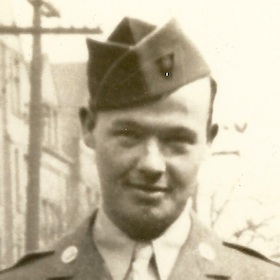
Sergeant Paul Theophane Boyle
Early Life
Paul Theophane Boyle was born in New Castle, Pennsylvania, just a month before the end of the Great War. His father, Thomas Boyle, was a builder in New Castle, just north of Pittsburgh. The Great Depression cost the family their business, their home, and their father’s health. Throughout the early 1930s, the family traveled the country looking for a better life. After a few years on the road, they came back east and sunk roots in Cleveland.
Boyle graduated from James Ford Rhodes High School in 1937 and later went to work at White Motors, a truck manufacturing company in Cleveland. With this experience, Boyle hoped that if he was drafted, he would be a mechanic. But on October 28, 1942, when he reported for duty, Boyle was assigned to the infantry and ordered to report to Camp Atterbury, Indiana.
Military Experience
Basic Training
Camp Atterbury was described in a regimental history as a “clay red scar on the green, hilly Indiana countryside.” The post was hastily constructed in about eight months, transforming a wild forest to a 40,000-soldier facility.
The men went through an abbreviated basic training throughout November and December and spent the cold Midwest winter in “Combined Training,” to prepare them for combat. In the summer of 1943, they traveled to Tennessee to participate in maneuvers under the sweltering summer sun. After maneuvers, they went to Camp Breckinridge, Kentucky for some final training before deployment.
The training was barely tolerable, but Boyle put a brave face on it. “Don’t worry about me having it bad because the Irish can take almost anything,” he wrote to his mother.
Entering the War
In April 1944, the men of the 331st Regiment boarded a troop ship bound for England. It was a trip of “two weeks that seemed like two months,” a regimental history reported. The men trained in Wales and waited for their orders to head to the continent.
There they remained past the initial invasion, until June 16, when they were moved aboard troop ships. The voyage across the English Channel should have been a few hours, but a massive storm swept up in the Channel that evening. The Liberty ships were stuck at sea; they could not risk going back to port, and they could not approach the Mulberry harbors, which were damaged in the storm. For four days, the ships remained at sea as the men ate their landing rations and fought off seasickness.
It was a stroke of bad luck that foreshadowed the misfortunes the 83rd Division would suffer in its time in combat.
The invasion force was stalling out a few miles inland from the beaches, and Boyle’s unit was ordered to move toward the hedgerow country south of Carentan, France. It was terrain for which neither the men nor their officers were prepared.
The Hedgerows
The hedgerows were centuries-old natural fences of earth and prickly, tangled bushes enclosing pastures and fields. Generally four to six feet wide at the base, and between five and fifteen feet in height, the hedgerows followed centuries-old property lines. They created thousands of small, irregularly shaped barriers for miles. The fact that these hedgerows were virtually impossible to cut through by tanks or trucks made it critical for the Allied forces to control the few highways that cut through the area.
The 83rd Infantry Division was part of a plan to dislodge German forces. The operation, launched on July 4, 1944, was an Independence Day the men would never forget – to the point that 70 years later, many of the veterans would still never attend a fireworks ceremony in their communities.
This sort of fighting was nothing like that for which they had trained. Sergeant Jack M Straus, in the division history, wrote:
We had never imagined battle like this. We never expected to be walled-in with the enemy in constant deathlock struggles which lasted through the days and nights, as we moved from one slit trench to another, through one hedgerow to another. We were never sure where the enemy was – to the left of us, to the right of us or even behind us.
Throughout the next three weeks, the 83rd Infantry Division would take monstrous casualties as they pushed through the hedgerows; their casualty rate was the highest of any unit in Normandy at that point. By mid-July, nearly half of Boyle’s C Company was made of replacement soldiers. Boyle leapt in rank from Private First Class to Sergeant, by virtue of having survived.
The tone of Boyle’s last letter to his mother, dated July 22, had a more desperate tone than previous messages.
I have received a few letters from you but I haven’t had time to answer them. But I want you to know that I am alright and getting along OK… I know I would give anything to be home now. There isn’t much I can say but I do hope this war ends soon. I will close now and hope to hear from you often. I can’t write as often as I would like so don’t worry about me. Good bye and God bless you.
Final Battle
The 331st took its place for Operation Cobra – a massive offensive to break free of the hedgerows – before dawn on July 26. Their first objective was believed to be a thinly-defended line that would wilt under direct attack. This assessment would prove fatally optimistic.
Around 5 a.m., a Sherman tank rumbled to the front. Boyle’s squad moved into position, hoping to quietly set up their machine gun position. Suddenly, an American tank opened fire – eliminating the element of surprise. Left in the line of German fire were the men of C Company.
Boyle was most likely killed in the initial moments of the assault toward Le Village des Saints. Boyle’s brother, Bill, traveled to Indiana in 1946 to meet an injured soldier who had served with Boyle. The young man could not look Bill Boyle in the face.
He was sitting on the roof. His mom said he wouldn’t talk to me. The kid said ‘I want you to follow me to the orchard. I’ll sit on a stump and face the other way. I’ll tell you. It was a machine gun outfit. They were putting guns around the hedgerow. Boyle gave the orders, a sniper shot him through the shoulder. He got on his hands and knees said ‘don’t retreat!’ crawled back, and the sniper shot him again.’
Eulogy
Even after the family was notified of his death in mid-August, his mother sought answers. Mary Boyle wrote frequently to the Army seeking information. Eventually, she had to decide where her son’s body should be buried.
For Mary Boyle, it was a decision not made lightly. On October 20, 1947, she wrote back to the Army with her decision to allow Boyle to remain on the soil he helped to free. “Believe me, this has been hard to accept, and only trust that the supreme sacrifice that he + all the others have made, will only mean something toward a peace in this world soon.”
On February 14, 1949 – St. Valentine’s Day – Sergeant Paul T. Boyle at last was laid to rest in peace among his comrades at Normandy American Cemetery.
83rd Infantry Division After Action Against Enemy Reports; World War II Action and Operational Reports, United States Army, Record Group 407 (Box 10477); National Archives at College Park, College Park, MD.
331st Infantry HQ Action Against Enemy Reports to the Adjutant General, July 21, 1944; World War II Action and Operational Reports, United States Army, Record Group 407 (Box 10477); National Archives at College Park, College Park, MD.
331st Infantry HQ Action Against Enemy Reports to the Adjutant General, August 8, 1944; World War II Action and Operational Reports, United States Army, Record Group 407 (Box 10477); National Archives at College Park, College Park, MD.
Andy Kozlowski to Mary Boyle. 7 May 1945. Courtesy of Joseph Boyle.
Blumenson, Martin. U.S. Army in World War II: Breakout and Pursuit. Washington, D.C.: Center of Military History, 1960.
Boyle, Bill. Interview with author by telephone. January 20, 1998.
Boyle, John F. Interview with author by telephone. January 20, 1998.
Boyle, Joseph P. Interview with author by telephone. January 20, 1998.
Calnan, William. “The Operations of the 3d Platoon, Company C, 308th Engineer Combat Battalion (83d Infantry Division) As Part Of The 331st Infantry Regimental Combat Team In The Attack To And Crossings Of The Taute River 10-27 July 1944: Personal Experience of a Combat Engineer Platoon Leader.” Written for Advanced Infantry Officers Course, Fort Benning, Georgia, 1949. Accessed March 30, 2012. 83rdinfdivdocs.org/documents/308th_Capt_Calnan_Taute_river.pdf
Doubler, Michael. Busting the Bocage: American Combined Arms Operations in France, 1944. Ft. Leavenworth: Combat Studies Institute Press, 1984.
George Boyle to Paul Boyle. 29 July 1944. Courtesy of Joseph Boyle.
Guiliano, W. A., J. J. O’Neill, C. R. Withey, C.R. & D. A. Beran. “1st Battalion 331st Infantry.” Self-published. 1945.
Hayhow, Ernie. The Thunderbolt Across Europe. Munich: F. Bruckemann, 1945.
Mary Boyle to Paul Boyle. August 1, 1944. Courtesy of Joseph Boyle.
Mary Boyle to Paul Boyle. August 7, 1944. Courtesy of Joseph Boyle.
Neilson, Henry. “Narrative of Action of 1st Bn., 331st Infantry, 83rd Infantry Division in France.” 1945. Accessed April 23, 2015. 83rdinfdivdocs.org/accounts/Account_331st_June_24-July_5_1944_LtCol_Neilson.pdf.
Paul Boyle to Mary Boyle. October 29, 1942. Courtesy of Joseph Boyle.
Paul Boyle to Mary Boyle. October 30, 1942. Courtesy of Joseph Boyle.
Paul Boyle to Mary Boyle. November 5, 1942. Courtesy of Joseph Boyle.
Paul Boyle to Mary Boyle. November 14, 1942. Courtesy of Joseph Boyle.
Paul Boyle to Mary Boyle. December 28, 1942. Courtesy of Joseph Boyle.
Paul Boyle to Mary Boyle. January 14, 1943. Courtesy of Joseph Boyle.
Paul Boyle to Mary Boyle. January 28, 1943. Courtesy of Joseph Boyle.
Paul Boyle to Mary Boyle. February 14, 1943. Courtesy of Joseph Boyle.
Paul Boyle to Mary Boyle. April 24, 1943. Courtesy of Joseph Boyle.
Paul Boyle to Mary Boyle. May 9, 1943. Courtesy of Joseph Boyle.
Paul Boyle to Mary Boyle. June 15, 1943. Courtesy of Joseph Boyle.
Paul Boyle to Mary Boyle. August 18, 1943. Courtesy of Joseph Boyle.
Paul Boyle to Mary Boyle. November 9, 1943. Courtesy of Joseph Boyle.
Paul Boyle to Mary Boyle. November 20, 1943. Courtesy of Joseph Boyle.
Paul Boyle to Mary Boyle. December 1, 1943. Courtesy of Joseph Boyle.
Paul Boyle to Mary Boyle. December 5, 1943. Courtesy of Joseph Boyle.
Paul Boyle to Mary Boyle. July 2, 1944. Courtesy of Joseph Boyle.
Paul Boyle to Mary Boyle. July 22, 1944. Courtesy of Joseph Boyle.
“Paul T. Boyle.” American Battle Monuments Commission. Accessed November 1, 2014. www.abmc.gov/search-abmc-burials-and-memorializations/detail/WWII_61126#.VcnvYvlViko.
Paul T. Boyle, Individual Deceased Personnel File, Department of the Army.
Strauss, Jack. We Saw It Through: History of the Three Thirty First Combat Team. Munich: F. Bruckemann, 1945.
Tennessee Department of State. “Tennessee in World War II: A Guide to Collections at TSLA.” Accessed January 5, 2015. www.tennessee.gov/tsla/history/guides/guide11.htm.
Tryon, Jimmy. 1945. “To Paul.” Courtesy of Joseph Boyle.
United States Army. Sicily: The U.S. Army Campaigns of World War II. Accessed April 23, 2015. www.history.army.mil/brochures/72-16/72-16.htm.
United States Department of Selective Service. “Notice of Classification.” October 23, 1942. Courtesy of Joseph Boyle.
Waters, William. “A Year Ago Today.” Self-published. 1945.
This profile was researched and created with the Understanding Sacrifice program, sponsored by the American Battle Monuments Commission.
Contributor
Contributed by Mr. Joe Boyle
Morrison R. Waite High School
2014-2015
