


Sergeant Teofilo Yldefonzo
Early Life
Setting
The Philippines is an archipelago composed of 7,100 islands. Located in the Pacific, it was colonized by the Spanish in 1521. In 1898, the Spanish-American War brought Americans to its shores.
Fallen Hero
Teofilo Yldefonzo was born in 1902 in the agricultural town of Piddig, Ilocos Norte, on Luzon Island in the Philippines. He was the middle child of three boys: Vicente, Teofilo, and Teodoro. Their father, Felipe, was believed to have been a member of the Katipunan, the peasant revolutionary movement that rose up in arms to overthrow the Spanish government in 1898. Following the Spanish-American War and the Philippine-American War, the Philippines became an American territory.
Their mother, Aniceta, died after giving birth to Teodoro. Their father also died when the brothers were young, thus placing the responsibility of rearing the youngest on the older brothers. Growing up near a river, the brothers taught themselves how to swim, with Teofilo showing special skill and interest that would manifest later in his life.
To improve his prospects, Teofilo moved from the province to Manila, the urban capital, where he joined the Philippine Scouts in 1922. The move created new opportunities for him. In 1923, he began swimming competitively. He participated in many international and regional events and represented the Philippines in the Olympic Summer Games of 1928, 1932, and 1936. He was the first Filipino athlete to win an Olympic medal, winning back-to-back bronze medals in the 200-meter breaststroke in the 1928 Amsterdam and 1932 Los Angeles Olympic Games.
Through a fellow soldier, Yldefonzo met Manuela Ella. Three years later, they married on May 7, 1925. They raised six children: Porfirio, Emilio, Felipe, Norma, Herminia, and Carmelito. The youngest was born in 1941, just before the United States entered World War II. They made their home in Makati, near the Philippine Scouts’ training camp in Fort McKinley, a few miles east of Manila.
Military Experience
By 1941, the Philippine Scouts were a highly trained military unit and would prove to be the most courageous soldiers during the Battle of Bataan. Known for their discipline, loyalty, and love of soldiering, the Philippine Scouts fought in the first major ground battle in the Pacific.
Yldefonzo, who enlisted in 1922, served in the 57th Infantry Regiment (PS). A fellow Philippine Scout, Private First Class Ramon Regalado, also of the 57th Infantry Regiment (PS), remembered Yldefonzo as part of an elite group of riflemen and as a strict instructor who taught new recruits swimming and water safety. These younger soldiers regarded Yldefonzo’s years of service in the Philippine Scouts highly and spoke of him respectfully as an “old-timer.” In December 1941, Yldefonzo, age 39, was one of the older soldiers in the field. By this time, he had served for 19 years.
The Battle of Bataan
“Make way, make way, the Scouts are moving in!” First Lieutenant Henry G. Lee, an American officer, wrote snippets of poetry in his foxhole during the Battle of Bataan, praising the bravery and courage of the Philippine Scouts.
Immediately after the December 7, 1941, bombing of Pearl Harbor, the Japanese attacked the Philippines. Overwhelmed by superior air and naval invasion forces, General Douglas MacArthur ordered his combined Filipino and American forces to withdraw to the Bataan Peninsula to stage a delaying strategy.
By January 7, 1942, the stage was set for the Battle of Bataan. Yldefonzo’s 57th Infantry Regiment (PS) was assigned to the most critical point of the main battle position of the Abucay-Mauban line. This is where the enemy was first expected to breach the Filipino-American forces’ defensive positions.
The 57th Infantry Regiment (PS) was one of the first units to come under heavy artillery fire. The Scouts also faced a ferocious attack by Japanese banzai soldiers hurling themselves against the barbed wire fences. However, the Scouts continued to repulse the Japanese onslaught, engaging the enemy in hand-to-hand combat. The Scouts formed sniper groups consisting of riflemen to pick off the infiltrating Japanese. As an expert rifleman, Yldefonzo may have been part of this sniper group.
The 57th Infantry Regiment (PS) also saw action in a three-week long critical battle along with other Philippine Scout units, when they wiped out an entire Japanese battalion. Despite their gallant efforts, the exhausted Filipino-American troops fell back against the continuous attack of the Japanese forces. Without reinforcements and weakened by starvation and disease due to lack of food and medical supplies, the Scouts continued to retreat, their ranks slowly collapsing. On April 9, 1942, the Commander of the Bataan forces, General Edward P. King, Jr., decided to surrender the command to prevent any more casualties.
Prisoner of War
Following the surrender, the captured Filipino and American troops were forced to march 65 miles from Mariveles, Bataan, to the San Fernando train station. There they were loaded into train cars for the final leg to the prison camps in Capas, Tarlac. During the march, the soldiers suffered extreme brutality from their captors. The numbers are not exactly known, but it is estimated that thousands died during what is now known as the Bataan Death March. The vast majority of those who died were Filipino. Yldefonzo survived the ordeal and was interned at Camp O’Donnell, a Prisoner of War camp in Capas, Tarlac.
The maltreatment of the prisoners continued in the prison camps. They were deprived of food, water, and medical treatment. Malaria, dysentery, typhus, and other illnesses abounded from the extremely dire conditions in the camp.
Confusion remains regarding Yldefonzo’s death. Official records state that Yldefonso died from dysentery and septicemia. However, narratives from his family state that Yldefonzo was wounded by shrapnel and developed gangrene. He was denied medical treatment by the Japanese because he was a prisoner of war. Without medicine, even his younger brother, Teodoro, an enlisted soldier of the 12th Medical Regiment (PS) who located him, could do nothing.
According to family narratives, Yldefonzo’s Japanese Olympic rival, Yoshiyuki Tsuruta, who won back-to-back gold medals in the 1928 and 1932 Olympics, learned of Yldefonzo’s capture. Tsuruta was then serving as a lieutenant in the Japanese Imperial Army. He immediately requested the release of Yldefonzo, but it was too late. Yldefonzo’s family indicated that he died in the arms of his younger brother, Teodoro.
Eulogy
Yldefonzo died on June 19, 1942. Every year on this date, his wife Manuela held a special family celebration to commemorate her husband. Yldefonzo’s body was buried in a mass grave with hundreds of other Filipino and American soldiers who died in the prison camp. His remains were never recovered.
Teofilo Yldefonzo is memorialized on the Walls of the Missing at the Manila American Cemetery.
Amsterdam Olympic Games of 1928. Swimming, men: The Filipino Teofilo Yldefonzo photographed after he won third place in the 200m breaststroke. Photograph. National Archives of the Netherlands (ELSEVI 081). www.gahetna.nl/en/collectie/afbeeldingen/fotocollectie/zoeken/weergave/detail/start/0/tstart/0/q/zoekterm/Teofilo%20Yldefonzo/q/commentaar/1.
Buencamino, Felipe III. “Diary of Felipe Buencamino III.” Philippine Diary Project. Last modified September 2013. Accessed March 22, 2017. philippinediaryproject.com/category/diary-of-felipe-buencamino-iii/page/5/.
Morelock, Jerry D. “U.S. Army’s Philippine Scouts, 1901-48.” History Net. Last modified February 28, 2017. Accessed March 19, 2017. www.historynet.com/u-s-armys-philippine-scouts-1901-48.htm.
Morton, Louis. The Fall of the Philippines. Washington, D.C.: Center of Military History, 1993.
Olsen, John E. “Interview with Colonel John E. Olsen March 15, 1998.” Oral History Collection. National Museum of the Pacific War, Fredericksburg, TX. digitalarchive.pacificwarmuseum.org/cdm/compoundobject/collection/p16769coll1/id/4906/rec/2.
Olsen, John E. “Philippine Scouts.” Defenders of the Philippines. Accessed March 15, 2017. philippine-defenders.lib.wv.us/pdf/scouts/Philippine_Scouts_Olsen.pdf.
Payo, Jasmine. “Yldefonso father of modern breastroke.” Philippine Daily Inquirer, May 10, 2010. www.pressreader.com/philippines/philippine-daily-inquirer/20100510/283308928699992.
POWs at Camp O’Donnell. Photograph. National Museum of the U.S. Air Force. www.nationalmuseum.af.mil/Upcoming/Photos/igphoto/2000510465/.
Records for Teofilo Yldefonzo; World War II Army Enlistment Records, 1938-1946 [Electronic File], Record Group 64; National Archives at College Park, College Park, MD [retrieved from the Access to Archival Databases at aad.archives.gov/aad/fielded-search.jsp?dt=466, November 21, 2016].
Regalado, Ramon. Personal interview with the author. March 13, 2017.
“Roster of the 12th Medical Regiment (PS).” Philippine Scouts Heritage Society. Last modified January 26, 2016. Accessed March 20, 2017. www.philippine-scouts.org/the-scouts/ps-rosters-of-1941-2/12th-medical-regt-ps.html.
Ruiz, Paul. “Philippine Scout Memories.” Philippine Scouts Heritage Society. Last modified January 26, 2016. Accessed March 20, 2017. www.philippine-scouts.org/Newsletters/PSHS-Fall_2007.pdf.
Shoulder Sleeve Insignia of the Philippine Division / 12th Infantry Division The head of the water buffalo symbolizes the Philippines. The colors red and gold represent the islands’ Spanish colonial roots. Photograph. commons.wikimedia.org/wiki/File:12th_Infantry_Division_SSI.svg.
“Teofilo Yldefonzo.” American Battle Monuments Commission. Accessed November 7, 2016. www.abmc.gov/node/371918#.WSj0XOsrLIU.
“Teofio Yldefonso (PHI) 1903-1942 2010 Honor Pioneer Swimmer.” International Swimming Hall of Fame. Last modified May 7, 2017. Accessed February 14, 2017. www.ishof.org/teofio-yldefonso-(phi).html.
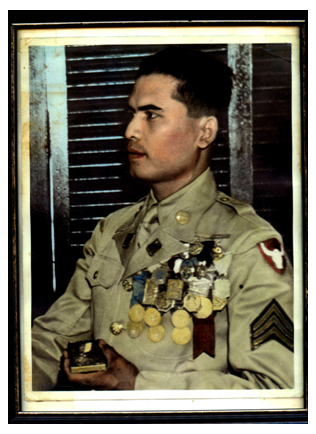
Teofilo Yldefonzo in uniform. Photograph. Courtesy of the Yldefonzo Family.
Teofilo Yldefonzo, Individual Deceased Personnel File, Department of the Army.
Teofilo Yldefonzo, Official Military Personnel File, Department of the Army, RG 319, National Archives and Records Administration – St. Louis.
“The U.S. Army’s Philippine Scouts.” U.S. Army. Last modified May 26, 2010. Accessed March 15, 2017. www.army.mil/article/39797.
The Winners. Yldefonzo, Philippines. Third; Tsuruta, Japan, First; Koike, Japan, Second. 200m breaststroke, 1932 Olympics. Photograph. 1932. LA84 Foundation. library.la84.org/6oic/OfficialReports/1932/1932spart4.pdf
Yldefonzo-Arganda, Arthur. Personal interview with the author. April 20, 2017.
Yldefonzo-Arganda, Irene. Telephone interview with the author. March 29, 2017.
Young, Donald J. “The Bataan Poet.” World War II Magazine. April 2004, 18-24. philippine-defenders.lib.wv.us/pdf/bios/lee_henry_article_wwii_magazine.pdf.
Young, Donald J. The Battle of Bataan A Complete History. Jefferson: McFarland & Company Inc., 2009.
This profile was researched and created with the Understanding Sacrifice program, sponsored by the American Battle Monuments Commission.
Contributor
Contributed by Mr. Jose Cumagun
Deer Valley High School
2016-2017

