


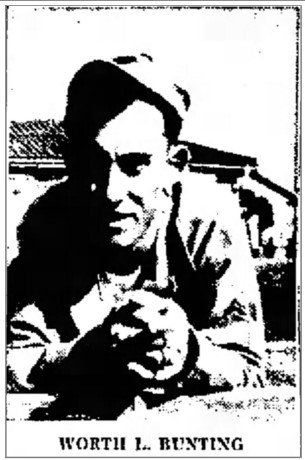
Sergeant Worth Lamar Bunting
Early Life
Born May 26, 1928, in Graham, North Carolina, Worth Lamar Bunting was the fourth of seven children of Joseph Clyde Bunting, Jr. and Stacey Bunting. The family lived modestly on the outskirts of Burlington, an industrial textile town in Alamance County, part of North Carolina’s largely rural Piedmont region. Joseph Clyde worked as a farm operator and later ran a grocery store and filling station with his wife, Stacey.
Burlington’s textile industry provided economic opportunities for many working-class families, including the Buntings. Like much of the South during this time, the town was shaped by the realities of racial segregation. Schools, public facilities, and job opportunities were divided along racial lines. As a child growing up in this environment, Bunting would have witnessed these divisions in daily life, from segregated schools to businesses that catered to different racial communities.
Education and Early Work
Bunting’s childhood and early life are largely undocumented. He likely attended Graham High School from 1942 to 1946, but there is no available confirmation of his attendance or graduation. At age 18, Bunting found employment as a knitter at the Russell-Watkins Hosiery Mill in Burlington. This was a typical job in the region’s textile industry, suggesting he might have completed his secondary education.
Photo carousel gallery
Home Front
By the early 1950s, Burlington had become a key player in the growing textile industry, especially in hosiery production. The city, along with the rest of North Carolina, led the nation in hosiery manufacturing. This industrial development was fueled by the post-World War II boom, which propelled growth across the region. As a result, Burlington’s population grew.
Textile Mill Workforce in the 1950s
The textile mills, including the Russell-Watkins Hosiery Mill where Bunting worked, were the backbone of Burlington’s economy. By the early 1950s, 32 mills operated in the city, employing nearly 6,000 people. Companies like Burlington Industries and Baker-Cammack Hosiery Mills grew quickly, benefiting from both rising consumer demand and government contracts.
Wartime Contributions
The growth of Burlington’s textile industry was closely tied to wartime production. During World War II, local mills, including Burlington Industries, played a key role in manufacturing military goods, including nylon parachute cloth. Their expertise in synthetic textiles positioned Burlington as an industry leader. In 1948, Bunting’s work as a knitter contributed to this effort. As the Korean War escalated, the mills fulfilled defense contracts, while companies like Western Electric shifted toward military production. Even today, Burlington remains a significant supplier of defense textiles.
Photo carousel gallery
Military Experience
Enlistment
Bunting enlisted in the United States Army in February 1948. He trained at Fort Jackson, South Carolina, where he served as an infantry instructor. In late 1949, he deployed from Camp Stoneman, California, to Japan, where he was assigned to the 24th Infantry Division, 21st Infantry Regiment, 3rd Battalion, Company L, at Camp Wood, near Kumamoto. At Camp Wood, he trained and performed occupation duty.
Deployment to Korea and the Battle of Osan
In late June 1950, tensions in Korea escalated when North Korea, backed by the Soviet Union and China, invaded South Korea. Corporal Bunting and his unit were subsequently deployed to the Korean Peninsula, landing in Pusan on July 1, 1950.
Bunting’s unit joined Task Force Smith, the first United States ground forces to engage the North Korean army at Osan on July 6. Lacking combat experience, Task Force Smith suffered heavy casualties, losing over a third of their men. Bunting survived, though his exact actions are undocumented. The poorly equipped troops, facing superior enemy forces and weaponry, retreated. This initial encounter led Company L into the Battle of Chochiwon a few days later.
Battle of Chochiwon
In the early morning of July 11, near Chochiwon, soldiers described the scene as so foggy that it was difficult to distinguish their units from enemy forces. The dense mist provided cover for the advancing North Korean forces, who soon overran the American lines. Communications were disrupted by the bombing of the American headquarters. With no means to call for resupply, report enemy positions, or receive orders, the American troops were left disorganized and vulnerable, forcing them to retreat.
Company L, as a rear holding unit, provided cover for the retreating companies. Amid the chaos, an order came for each man to fend for himself. During the retreat, Bunting attempted to secure more ammunition when he encountered a wounded comrade, Corporal Charles Kinard, who had been shot in the shoulder. They planned to meet at railroad tracks on the opposite side of a road, crossing at different times to avoid detection. Bunting never made it to the meeting point.
Missing in Action
Sergeant First Class Bobby McCormack, the supply sergeant for Company L, reported that only 25 (of approximately 200) men survived the North Korean attack at Chochiwon. Corporal Bunting was not among the survivors, but it was later confirmed that he had been taken as a Prisoner of War (POW).
The Tiger Death March
In August 1950, Bunting was moved in conditions ill-suited for human passage from Seoul to Pyongyang, then on to Manpo-Jin, arriving on September 11, 1950. On October 9, he began the brutal Tiger Death March, where starving soldiers and civilians endured relentless exposure to the elements, limited access to water, and abuse. The march ended on November 9 at Chung-Gang-jin, with survivors reporting that 256 of the original 726 soldiers perished during the march. This number is based on survivor accounts. The exact death toll may never be known.
Final Captivity and Death
On November 16, Bunting was transferred from Chung-Gang-jin to the Chungung Camp, part of the remote Apex Prison network in the North Korean mountains. Weakened by malnutrition and exposure, he likely died between December 1950 and January 1951. The only record of Bunting’s death date comes from a fellow prisoner, Private First Class Wayne Johnson’s Tiger Survivors List, which Johnson kept hidden in a toothpaste tube throughout his captivity. Johnson reported Bunting’s death as January 8, 1951. Fellow prisoners, Private First Class James Moore and Corporal G.W. Jenkins, later confirmed that Bunting succumbed to malnutrition, exposure, and dysentery.
Due to the frozen ground and the weakened state of those burying the dead, survivor accounts suggest that Bunting’s remains were likely placed in a shallow grave on a hill near the camp. His remains have not been recovered.
Photo carousel gallery
Commemoration
Corporal Worth Lamar Bunting’s name is inscribed on the Honolulu Memorial at the National Memorial Cemetery of the Pacific, Honolulu, Hawaiʻi.
Posthumous Honors and Recognition
After his death, Bunting was posthumously promoted to sergeant and awarded the Korean Presidential Unit Citation, Combat Infantryman Badge, Prisoner of War Medal, United Nations Service Medal, Korean Service Medal, Republic of Korea War Service Medal, and National Defense Service Medal in recognition of his bravery and sacrifice.
Ongoing Efforts for Identification and Recovery
Bunting was declared “non-recoverable” in 1952, though hope remains that he may one day be found and identified. Recovery efforts in North Korea have been limited, with the last occurring shortly after the 1953 armistice and the most recent repatriation on June 25, 2023. The Defense POW/MIA Accounting Agency’s (DPAA) Korean War Unknowns Phased Disinterment Project, launched in 2019, aims to identify 652 sets of remains of U.S. service members killed or missing in action in Korea. Now in its fifth phase of seven, these ongoing efforts, alongside international cooperation, continue to offer hope for locating lost service members, including Bunting.
Sergeant Worth Lamar Bunting’s legacy reflects his courage and the ongoing hope for recovery. Though his remains have not been recovered, his story, shared through fellow prisoners’ accounts, serves as a reminder of the sacrifices made during the Korean War.
Bunting’s legacy continues through the efforts to recover and honor those still missing from the Korean War, such as the Defense POW/MIA Accounting Agency’s (DPAA) Korean War Unknowns Phased Disinterment Project. His story symbolizes hope that all who served will one day be accounted for and their sacrifices remembered.
Photo carousel gallery
Primary Sources
“Bees Idled By Rain; Caps In Double Header Here Tomorrow.” The Daily Times-News [Burlington, NC], July 17, 1950. https://www.newspaperarchives.com/.
“Bible Verse of the Day.” The Daily Times-News [Burlington, NC], July 10, 1951. https://www.newspaperarchives.com/.
“The Boys Come Home.” LIFE, May 11, 1953. 24th Infantry Division Association. Accessed February 27, 2025. https://24thida.com/stories/images02/LIFE%20MAGAZINE_The_Boys_Come_Home.pdf.
“Burlington Economic Development Leads Trade Mission, Sister-Cities Visit to South Korea.” City of Burlington, North Carolina. Accessed January 31, 2025. https://www.burlingtonnc.gov/DocumentCenter/View/17988/Blog-Post—Korea.
“Capehart Recommends That Government Consider Freezing Prices and Wages at Present Levels.” The Daily Times-News [Burlington, NC], December 6, 1950. https://www.newspaperarchives.com/.
“Cpl. Worth L. Bunting Of Graham Reported Missing In Korean Action.” The Daily Times-News [Burlington, NC], August 15, 1950. Newspapers.com (52638955).
“Direct Appeal to Red China Attacked.” The Daily Times-News [Burlington, NC], December 6, 1950. https://www.newspaperarchives.com/.
“Economy Champ! Dodge Advertisement.” The Daily Times-News [Burlington, NC], July 17, 1950. https://www.newspaperarchives.com/.
“Eighth Army Digs In Against Chinese Reds.” The Daily Times-News [Burlington, NC], December 6, 1950. https://www.newspaperarchives.com/.
“End Not Yet.” The Daily Times-News [Burlington, NC], November 27, 1950. https://www.newspaperarchives.com/.
“End State of War.” The Daily Times-News [Burlington, NC], September 20, 1950. https://www.newspaperarchives.com/.
“Familiar Team Of Western Electric . . . World War II Equipment.” The Amplifier, August 1951. North Carolina Digital Heritage Center. https://lib.digitalnc.org/nanna/api/multimedia/image/v2/recid:100548-AlamanceCountyPL_1953BurlingtonMissileScrapbook_0151.jpg/full/759,1000/0/default.jpg.
Gruber, Edward. Conversion. Hosiery factory . . . Van Raalte Company. Photograph. February 1942. Library of Congress (2017690699). https://www.loc.gov/item/2017690699/.
Gusler, Richard Noel. Growing Up in Burlington, NC. Oral history. July 24, 2012. North Carolina State University Libraries. https://d.lib.ncsu.edu/student-leaders/videos/growing-up-in-burlington-nc-gusler.
Henry A. Wallace Encounters a Protester in Burlington, NC, 1948. Photograph. August 30, 1948. Library of Congress (2004672507). https://www.loc.gov/item/2004672507.
Korean War Prisoner of War Camp. Photograph. C.1950–1953. Defense POW/MIA Accounting Agency. Accessed March 28, 2025.
“Korean War Unknowns Phased Disinterment Project.” Defense POW/MIA Accounting Agency. Accessed February 22, 2025. https://dpaa-mil.sites.crmforce.mil/KoreanWar/DisintermentProject.
Lucy Florence Hunt Bunton. North Carolina, Death Certificates, 1909-1976. https://ancestrylibrary.com.
“Location of New Line Is Kept Secret.” The Daily Times-News [Burlington, NC], December 6, 1950. https://www.newspaperarchives.com/.
Main Street, Burlington, NC, 1929. Photograph. 1929. Alamance County Public Libraries. https://lib.digitalnc.org/record/107814?ln=en&v=uv#?xywh=-541%2C-229%2C5115%2C2648.
Missile Guidance Equipment Assembly, Western Electric Tarheel Army Missile Plant, Burlington, NC, 1953. Photograph. 1953. Alamance County Public Libraries. https://lib.digitalnc.org/record/100510?ln=en&v=uv#?xywh=-1689%2C-1%2C9337%2C4835.
Rural Alamance County Book Truck. Photograph. c.1936-1939. Rockingham County Public Library. https://lib.digitalnc.org/record/4866?ln=en&v=uv#?xywh=-278%2C0%2C3935%2C2037.
“Sgt. Worth Lamar Bunting.” The Korean War Project. Accessed February 27, 2025.https://www.koreanwar.org/html/3816/korean-war-project-north-carolina-ra14249782-sgt-worth-lamar-bunting/.
Western Electric Tarheel Army Missile Plant, Burlington, NC, 1953. Photograph. 1953. Alamance County Public Libraries. https://lib.digitalnc.org/record/100544?ln=en&v=uv#?xywh=-2004%2C-310%2C10299%2C5333.
Worth Lamar Bunting. Individual Deceased Personnel File. National Archives and Records Administration – St. Louis.
Worth L. Bunting. Korean Conflict Casualty File, National Archives and Records Administration. https://aad.archives.gov/aad/record-detail.jsp?dt=194&mtch=1&cat=all&tf=F&q=worth+bunting&bc=&rpp=10&pg=1&rid=3163.
Secondary Sources
“1-24 Infantry Battalion History.” U.S. Army. Last modified October 14, 2016. Accessed February 27, 2025. https://www.army.mil/article/166701/1_24_infantry_battalion_history.
“21st Infantry Regiment.” U.S. Army Center of Military History. Accessed February 26, 2025. https://armyhistory.org/21st-infantry-regiment/.
“Alamance County, North Carolina Korean War Veterans.” American History & Genealogy Project. Accessed January 4, 2025. https://ahgp.org/nc/Alamance/Military/Korea/index.html.
“Corporal Chester Albert Wright.” Defense POW/MIA Accounting Agency (DPAA). Accessed February 27, 2025. https://dpaa-mil.sites.crmforce.mil/dpaaProfile?id=a0Jt0000009CEvfEAG.
“Corporal: Stepping into the World of NCOs.” U.S. Army. Accessed February 26, 2025. https://www.army.mil/article/18109/corporal_stepping_into_the_world_of_ncos.
Ecker, Richard E. “Battles of the Korean War: A Chronology, with Unit-by-Unit United States Casualty Figures & Medal of Honor Citations.” McFarland & Company, 2004.
Embracing the Legacy – Graham High School. Alamance County Public Libraries, 2015. Accessed December 30, 2024. https://lib.digitalnc.org/record/105247?v=uv#?xywh=-1923%2C-186%2C6393%2C3708.
Estabrook, Shorty. “The Tiger Survivors Story—Capture and Beyond.” 24th Infantry Division Association. Accessed February 27, 2025. https://24thida.com/stories/estabrook_tiger_survivors.html.
Fitzgerald, Claire. “24th Infantry Division Bazooka Team Taking On the Enemy During the Battle of Osan. War History Online. Accessed April 5, 2025. https://www.warhistoryonline.com/korean-war/battle-of-osan.html.
Frederickson, Kari. The Dixiecrat Revolt and the End of the Solid South, 1932-1968. UNC Press, 2001.
“Gold Star Veterans: North Carolina: Prisoners of War – Korean War.” Honor States. Accessed January 4, 2025. https://www.honorstates.org/pow/NC/Korea/.
“Helm Chonui Chochiwon Massacre.” 24th Infantry Division Association. Accessed February 27, 2025. https://24thida.com/stories/images03/Lake,%20Charles%20via%20Helm%20CHONUI%20CHOCHIWON%20MASSACRE.pdf.
Historic Preservation Commission Agenda. January 11, 2022. City of Burlington, North Carolina. Accessed January 31, 2025. https://burlingtonnc.gov/DocumentCenter/View/21782/January-Binder.
“Joseph Clyde Bunton Sr.” Find a Grave. Updated March 26, 2013. Accessed December 30, 2024. https://www.findagrave.com/memorial/107328814/joseph_clyde_bunting.
“Korean War Chronology.” U.S. Army Center of Military History. Last modified July 10, 2019. Accessed February 27, 2025. https://history.army.mil/Research/Reference-Topics/Army-Campaigns/Brief-Summaries/Korean-War.
“Korean War Maps.” Defense POW/MIA Accounting Agency (DPAA). Accessed February 27, 2025. https://www.dpaa.mil/Our-Missing/Korean-War/Maps/.
“Sgt. Worth Lamar Bunting.” Defense Personnel POW/MIA Accounting Agency. Accessed April 5, 2025. https://dpaa-mil.sites.crmforce.mil/dpaaProfile?id=a0Jt0000007kTPTEA2.
“Sgt. Worth Lamar Bunting.” Find a Grave. Updated December 1, 2012. Accessed December 30, 2024. https://www.findagrave.com/memorial/101567981/worth-lamar-bunting.
“A Soldier in Kyushu.” United States Army. Last modified October 23, 2006. Accessed February 27, 2025. https://www.army.mil/article/4604/a_soldier_in_kyushu.
“Stacey Bunton.” Find a Grave. Updated March 26, 2013. Accessed December 30, 2024. https://www.findagrave.com/memorial/107328815/stacey-l-bunting.
“Worth L. Bunting.” American Battle Monuments Commission. Accessed December 30, 2024. https://api.abmc.gov/decedent-search/bunting%3Dworth.
Contributor
Contributed by Ms. Whitney Ann Cooper
Valley Springs Middle School
2024-2025

