


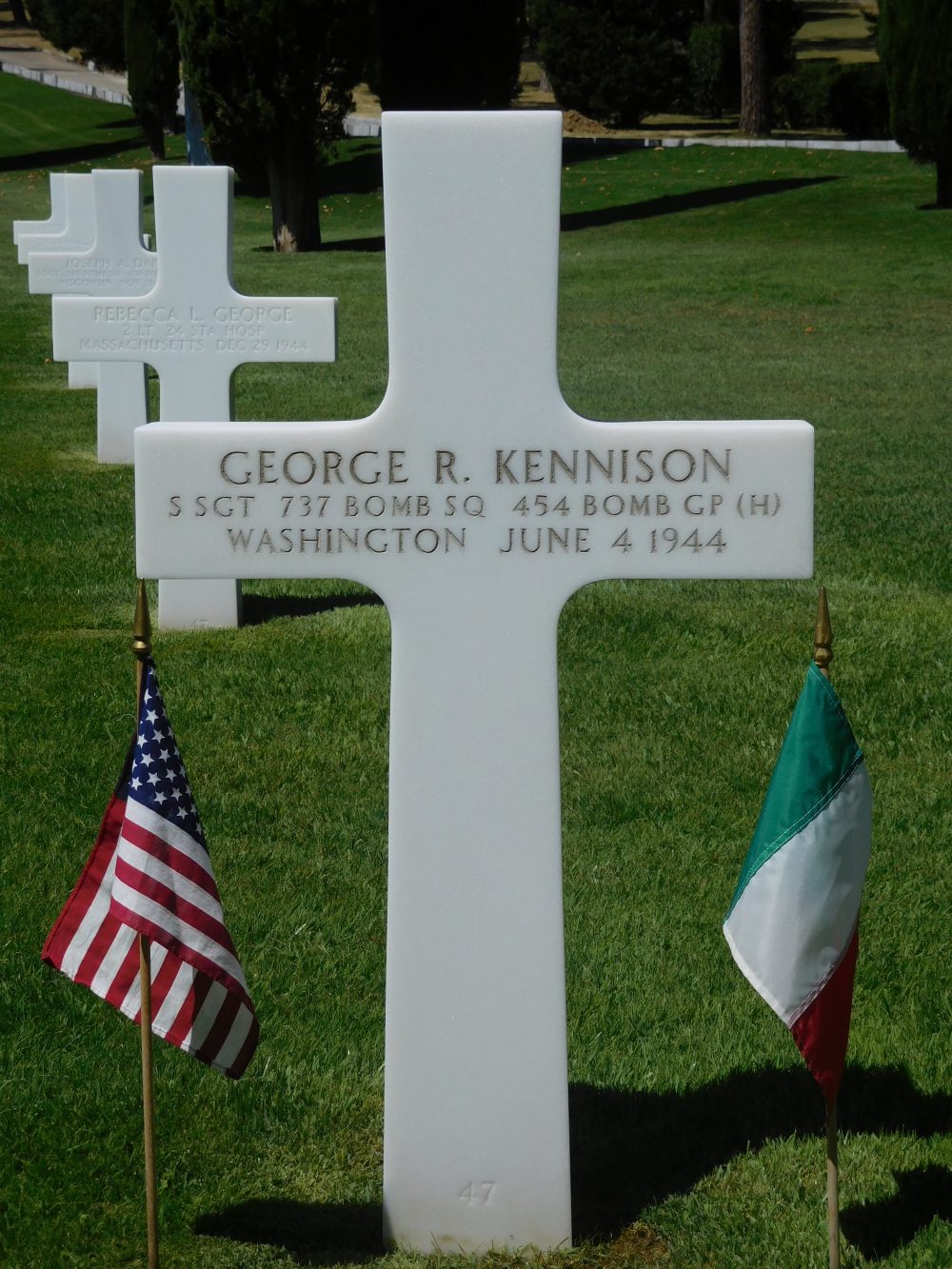
Staff Sergeant George R. Kennison
Early Life
George Richard Kennison was born on April 12, 1915, to William and Emma Kennison in rural Oregon. The family moved to the Pacific Northwest from the Midwest in the early 1900s, stopping in Colorado, Idaho, and Oregon, before moving to Washington state. As they moved across the region, William and Emma had seven children: Edith, Harold, Ruby, Alma, Elmer, George, and Helen.
The boom years of the Alaskan Gold Rush and World War I led to rapid population growth in the Pacific Northwest. Little information is known about the activities of the Kennison family once they moved to the region.
In the early 1940s, George Kennison lived in Spokane, Washington, with his parents and extended family. Kennison’s brothers lived in the same neighborhood with their families. According to a Spokane city directory, Kennison and his brothers, Harold and Elmer, worked as electricians while William worked as a steamfitter.
Military Experience
Training
Upon entering the U.S. Army Air Forces, Kennison reported for duty at Fort Douglas, Utah. After completing his training, Kennison joined the 454th Bomber Group, 737th Bomber Squadron in Charleston, South Carolina, where he trained as a gunner. Shortly after Kennison’s arrival, the 454th Bomber Group was deployed to the air base at San Giovanni, Italy.
Operation Strangle
The Fifteenth Air Force and the 454th Bomber Group participated in Operation Strangle, an unsuccessful effort to drive the Germans from Italy using air power alone. The Allies launched Operation Strangle to deny the Germans essential war material such as food, fuel, and munitions by bombing railways, troop gathering yards, and communication networks. Italy was considered an ideal target for bombing given the terrain, the stretched German supply lines, and the many vulnerable bridges and tunnels the Germans needed for transportation and communications. Ultimately, this operation played a crucial role in Operation Diadem – a combined air and ground effort by American and British forces to drive the Germans out of Italy.
Genoa Harbor
On June 4, 1944, the B-24 Liberator Victoria Vixen, piloted by Captain William McKee, took off from San Giovanni along with more than 550 B-17s and B-24s in support of Operation Strangle. In addition to the seven other crew members, Kennison was a gunner on the Vixen that day. The Vixen’s mission was to disrupt enemy communications and attack facilities around the harbor in Genoa, Italy. As the 737th Bomber Squadron reached the harbor, they encountered heavy resistance from German flak cannons. Fire from a German flak cannon hit the Vixen, downing the plane and killing all aboard.
On June 5, 1944, Second Lieutenant Arthur S. Pitts gave a statement describing the fate of the Vixen. Pitts described seeing the Vixen navigating the clouds of flak on its way to the target over the harbor in Genoa. He watched the plane get hit by flak and someone struggle to keep the plane in the air. Pitts did not report seeing anyone parachute out of the plane. He described the Vixen’s tail as having been shot off and the fuselage in the area around the bomb bay as having been badly damaged.
After the Vixen crashed, American forces were not immediately able to recover the wreckage or the bodies of the crew. The military classified Kennison and the rest of the crew as Missing in Action (MIA). Soon after the crash, the Germans recovered the bodies of Kennison and the rest of the Vixen’s crew and turned the bodies over to the International Red Cross. The Swiss consulate in Genoa informed the U.S. military, and Kennison was promptly buried in a military cemetery in Genoa.
On June 16, 1944, the military notified Kennison’s family by telegram that he was missing in action. In a report dated October 14, 1944, the War Department updated Kennison’s status to Killed in Action on September 5, 1944.
Eulogy
As the war progressed, Allies sent recovery teams to locate downed aircraft and their crews. In a letter to the Kennison family dated September 26, 1946, the U.S. Army informed the family that in May, a team had recovered the crew and that the Quartermaster General in Washington, D.C., would be in touch with more information regarding George’s reburial in an American military cemetery.
On October 16, 1947, Kennison’s sister, Mrs. Edith Bordwell, wrote the Army Air Forces on behalf of her father to inquire about George’s interment in Italy. In a response to William Kennison dated November 13, 1947, Lieutenant Colonel R.M. Bauknight of the Quartermaster General’s Office, Memorial Division, said that an investigation was being conducted to prove that the remains the Army had recovered belonged to Kennison and not another of the Vixen’s crew.
The Army conducted the investigation to ensure that the remains in question belonged to George Kennison and not Russell Lindsay, another Vixen crew member. Records indicated that the two men were very similar in appearance and shared many of the same features. The U.S. Army eventually used dental and medical records to determine that the remains buried in the U.S. military cemetery in Follonioca, Italy, did indeed belong to George Kennison.
The investigation took almost two years to complete. Lieutenant Colonel W. E. Campbell sent the Kennison family a letter confirming that the remains buried in Follonioca did belong to George Kennison. The letter contained paperwork for the family to determine George’s final resting place. William Kennison returned the forms, deciding to bury his son in a permanent overseas American military cemetery. On December 5, 1949, Quartermaster H. Feldman informed the family by letter that George had been interred at the Florence American Cemetery and had been given a funeral service.
Atkinson, Rick. “‘Put the Fear of God into Them.’” In The Day of Battle: The War in Sicily and Italy, 1943-1944. New York: Henry Holt, 2007.
Barker, John S. The Flight of the Liberators; the Story of the Four Hundred and Fifty-Fourth Bombardment Group. Rochester: Du Bois Press, 1946. Accessed November 5, 2015. www.454thbombgroup.it/Flight%20of%20the%20Liberators%201946.pdf.
Chalker, Stephen, Erik Goldstein, and Mario Capocefalo. “Home 454th BG.” Home 454th BG. Accessed December 1, 2015. www.454thbombgroup.it/index.htm.
“George R. Kennison.” American Battle Monuments Commission. Accessed November 5, 2015. www.abmc.gov/node/529983#.VwGtxhIrKi4.
George R. Kennison, Individual Deceased Personnel File, Department of the Army.
George Kennison, Official Military Personnel File, Department of the Army, RG 319, National Archives and Records Administration – St. Louis.
George Kennison, Selective Service Record, National Archives and Records Administration – St. Louis.
Lambert, Dale A. “Early 20th Century Historical Events to World War II.” In The Pacific Northwest: Past, Present, and Future. East Wenatchee, WA: DMI, 1998.
Maurer, Maurer. Air Force Combat Units of World War II. Washington, D.C.: Office of Air Force History, 1983.
McKillop, Jack. “USAAF Chronology.” USAAF Chronology. Accessed March 31, 2016. paul.rutgers.edu/~mcgrew/wwii/usaf/html/Jun.44.html.
Missing Air Crew Report; Records of the Army Air Forces, World War II (5478); National Archives at College Park, College Park, MD.
Norris, Joe L., Capt. The Combined Bomber Offensive: 1 January to 6 June 1944. Report no. AAFRH-22. Headquarters, Army Air Forces: AAF Historical Office, 1947.
Oregon. Marion County. 1940 U.S. Census. Digital Images. ancestry.com.
Overy, Richard. “Italy: The War of Bombs and Words.” In The Bombers and the Bombed: Allied Air War over Europe, 1940-1945. New York: Penguin Books, 2015.
Photograph No. ETO-HQ-44-15265; “Dutch civilians show members of the 101st Airborne Division, who landed behind German lines in Holland, the lay of the land,” Department of the Army, U.S. Army Signal Corps, Record Group 11-SC; National Archives at College Park, College Park, MD.
Polk’s Spokane (Washington) City Directory 1943. Vol. LII. Spokane: R.L. Polk &, 1942. 411.
Records for George R. Kennison; World War II Army Enlistment Records, 1938-1946 [Electronic File], Record Group 64; National Archives at College Park, College Park, MD [retrieved from the Access to Archival Databases at aad.archives.gov/aad/record-detail.jsp?dt=893&mtch=1&cat=GP23&tf=F&q=George+R.+Kennison&bc=sl&rpp=10&pg=1&rid=7907892., November 10, 2015].
Sallager, F. M. Operation “STRANGLE” (Italy, Spring 1944): A Case Study of Tactical Air Interdiction. Report no. R-851-PR. Santa Monica: Rand Corporation, 1972. Accessed April 2, 2016. www.rand.org/content/dam/rand/pubs/reports/2006/R851.pdf.
Washington. Walla Walla County. 1920 U.S. Census. Digital Images. ancestry.com.
Washington. Benton County. 1930 U.S. Census. Digital Images. ancestry.com.
Washington. Yakima County. 1940 U.S. Census. Digital Images. ancestry.com.
This profile was researched and created with the Understanding Sacrifice program, sponsored by the American Battle Monuments Commission.
Contributor
Contributed by Mr. Bradley Liebrecht
West Valley Junior High School
2015-2016
