


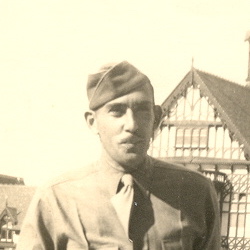
Technician Fifth Class Salvador M. Ybor
Early Life
Salvador M. Ybor, Jr., known as Salvin to his family, was born to Salvador Martinez Ybor and Consuelo Pou in 1910. Salvin grew up with his brother, Ignacio, four years his junior, surrounded by family in Ybor City, Florida. The town was founded by Salvin’s grandfather, Vicente Martinez Ybor, in 1885, as a cigar manufacturing center. Ybor City was known for fairness, opportunity, tolerance, cooperation, and diversity.
In addition to opening the first cigar factory, Vicente also created the Florida Brewing Company, later led by his son, Salvador, Sr. In addition to working in the family businesses, Salvador, Sr., was also very involved in civic organizations and served as the president of El Circulo Cubano, a prominent and influential mutual aid and cultural organization in Ybor City.
Cuba
Despite being part of one of Ybor City’s most prominent families, Salvin and his family left Ybor City following his father’s legal problems during Prohibition, with the subsequent closing of the Florida Brewing Company around 1929. They moved to live close to family in Cuba, a place the family had frequently visited. They quickly acclimated to society due to family connections, and Salvador, Sr., served in a Cuban government position.
In 1940, Salvin’s brother, Ignacio, and his wife baptized their first child as Ignacio, Jr., and Salvin’s nephew was named as his godson. Despite the draw of family and community in Cuba, as World War II began, the call of country and honor became stronger.
Return to Florida
Salvin returned to Tampa, Florida in 1942. He stayed with his uncle while he considered his options for joining a branch of service. When Salvin ultimately enlisted, he listed his uncle as his next of kin. During this time, Salvin was fortunate to spend time with the many family members still living in the Tampa area, including his cousin, Rafael, Jr., who remembers him with love and respect.
Salvador M. Ybor, Jr., enlisted at age 32 on March 28, 1942. He served in the General Officers branch of the U.S. Army. At the time of enlistment, Salvin stood 5’6” tall, weighed 112 pounds, and had completed two years of high school. He was a single man, without his own dependents, but he knew he wanted to forge a bond with his nephew and godson, Ignacio, Jr. Throughout his time in the service, he sent letters and packages home to his nephew. These often included things that a boy might treasure, such as exotic-looking seashells and a sabre taken from a Japanese officer. They were prized possessions that, unfortunately, had to be left behind when the family later fled the Castro-led Cuban revolution.
Military Experience
43rd Infantry Division
In 1942, Ybor enlisted and joined the 43rd Infantry Division, stationed at Camp Blanding, located between Jacksonville and Gainesville, Florida. The 43rd Infantry Division later trained at Camp Shelby, Mississippi and Fort Ord, California.
Solomon Islands
After some delays, the 43rd Infantry Division arrived in the South Pacific in November 1942, then deployed to Guadalcanal in the Solomon Islands in February 1943. Later, the division moved to the Russell Islands, also in the Solomon Islands. Because the Russells were unoccupied by the Japanese, additional jungle and combat training took place here.
In June and July 1943, the 43rd Infantry Division landed on Rendova and New Georgia Islands (Solomon Islands) in order to take the Munda Airfield, which the Japanese had begun building. Together with the 37th and 25th Infantry Divisions, the airstrip was secured in early August 1943.
New Zealand and New Guinea
From December 1943 through January 1944, the 43rd Infantry Division traveled to New Zealand for a period of rest, relaxation, and training with the New Zealanders. Replacement soldiers were absorbed into the division, and “vigorous and intensive training” lasted until July 1944. Next, the 43rd Infantry Division fought to drive the Japanese out of New Guinea, which led to preparation for the invasion of the Philippine Islands.
Return to the Philippines
The Japanese considered the Philippines strategically important to defeating the U.S. and had taken control of some of the islands, including Luzon, earlier in the war. The Allies created a coordinated plan of attack to include soldiers and sailors from the U.S., Australia, and the Philippines.
On January 6, 1945, the Battle of Luzon started with the U.S. Navy and the Royal Australian Navy bombing the Japanese for three days. On January 9, 1945, troops began to land from ships while being attacked by Japanese kamikaze planes. The 43rd Infantry Division participated in the amphibious landing in the San Fabian area at Lingayen Gulf, Luzon.
Ybor was fatally wounded during the landing when hit in the back with shrapnel. However, “Under enemy fire, the Division secured the beachhead.”
Eulogy
Salvador M. Ybor, Jr., was buried at sea at latitude 16 degrees 12.5 North, longitude 120 degrees 17.5 East (approximately 15 kilometers off the coast near San Fabian). He was awarded a Purple Heart and is memorialized on the Walls of the Missing at the Manila American Cemetery. That Purple Heart was carried out of Cuba during the revolution and is one of the few treasured personal items of his uncle’s that his nephew, Ignacio Martinez Ybor, Jr., still has today.
The 43rd Infantry Division became one of the first to occupy Japan. The 43rd Infantry Division was the only division to serve in four theaters of the Pacific Campaign: South Pacific, Southwest Pacific, Philippines and Japan.
As a child, Ignacio Ybor, Jr. (Salvin’s nephew and godson), spent time with his grandmother, Salvin’s mother. She told her grandson over and over again about when they would go to meet Salvin’s airplane when he would return home. She told him that at first, it would look like a tiny speck in the sky, and that speck would get bigger and bigger, until it was close enough to look like a plane. And then it would land, the plane would open up, and Salvin would come home to them. This never came true. Upon hearing of her son’s death, Consuelo Ybor, wore black for the rest of her life. She never recovered from the loss of her firstborn son.
43rd Infantry Division; Records of the Adjutant General’s Office, World War II Combat Operations Reports 1940-1948, Record Group 407 (Box 9150); National Archives at College Park, College Park, MD.
43rd Infantry Division; Records of the Adjutant General’s Office, World War II Combat Operations Reports 1940-1948, Record Group 407 (Box 9151); National Archives at College Park, College Park, MD.
43rd Infantry Division; Records of the Adjutant General’s Office, World War II Combat Operations Reports 1940-1948, Record Group 407 (Box 9152); National Archives at College Park, College Park, MD.
43rd Infantry Division; Records of the Adjutant General’s Office, World War II Combat Operations Reports 1940-1948, Record Group 407 (Box 9155); National Archives at College Park, College Park, MD.
43rd Infantry Division; Records of the Adjutant General’s Office, World War II Combat Operations Reports 1940-1948, Record Group 407 (Box 9176); National Archives at College Park, College Park, MD.
43rd Infantry Division “Winged Victory Division” Veterans Association. Accessed January 6, 2017. www.winged-victory.org/.
Florida. Hillboro County. 1910 U.S. Census. Digital Images. ancestry.com.
Martinez Ybor, Vincente. New Jersey, Wills and Probate Records, 1739-1991 for Vincent M Ybor. Electronic. Digital Images. ancestry.com.
Raines, Robert. First assault waves troops of the (43rd Infantry Division) take cover behind their alligator 300 yards inland from (White Beach #9) and return enemy fire. Photograph, January 9, 1945. National Archives and Records Administration (SC 20019). Image.
Records for Salvador M. Ybor, Jr.; World War II Army Enlistment Records, 1938-1946 [Electronic File], Record Group 64; National Archives at College Park, College Park, MD [retrieved from the Access to Archival Databases at aad.archives.gov/aad/series-description.jsp?s=3360&cat=WR26&bc=,sl, December 1, 2016].
Rogers, Hubert F. Honoring officers and men of the (43rd Winged Infantry Div) who were killed during the (Luzon Campaign). Three men of the firing squad firing volley after volley in the (US Cemetery No. 2 Manila, P.I.). Photograph. June 24, 1945. National Archives and Records Administration (SC 209502). Image.
“Salvador M. Ybor, Jr.” American Battle Monuments Commission. Accessed February 22, 2015. www.abmc.gov/node/371897#.WO0snYgrLIU.
Salvador M. Ybor, Jr., Official Military Personnel File, Department of the Army, RG 319, National Archives and Records Administration – St. Louis.
Winged Victory of Foot: 43rd Infantry Division. Film. 1949. National Archives and Records Administration (4522933).
Ybor, Jr., Ignacio Martinez. Telephone interview by the author. July 12, 2017.
Ybor, Jr., Raphael Martinez. Telephone interview by the author. May 18, 2017.
This profile was researched and created with the Understanding Sacrifice program, sponsored by the American Battle Monuments Commission.
Contributor
Contributed by Ms. Ellen Davis
Ramblewood Middle School
2016-2017
