


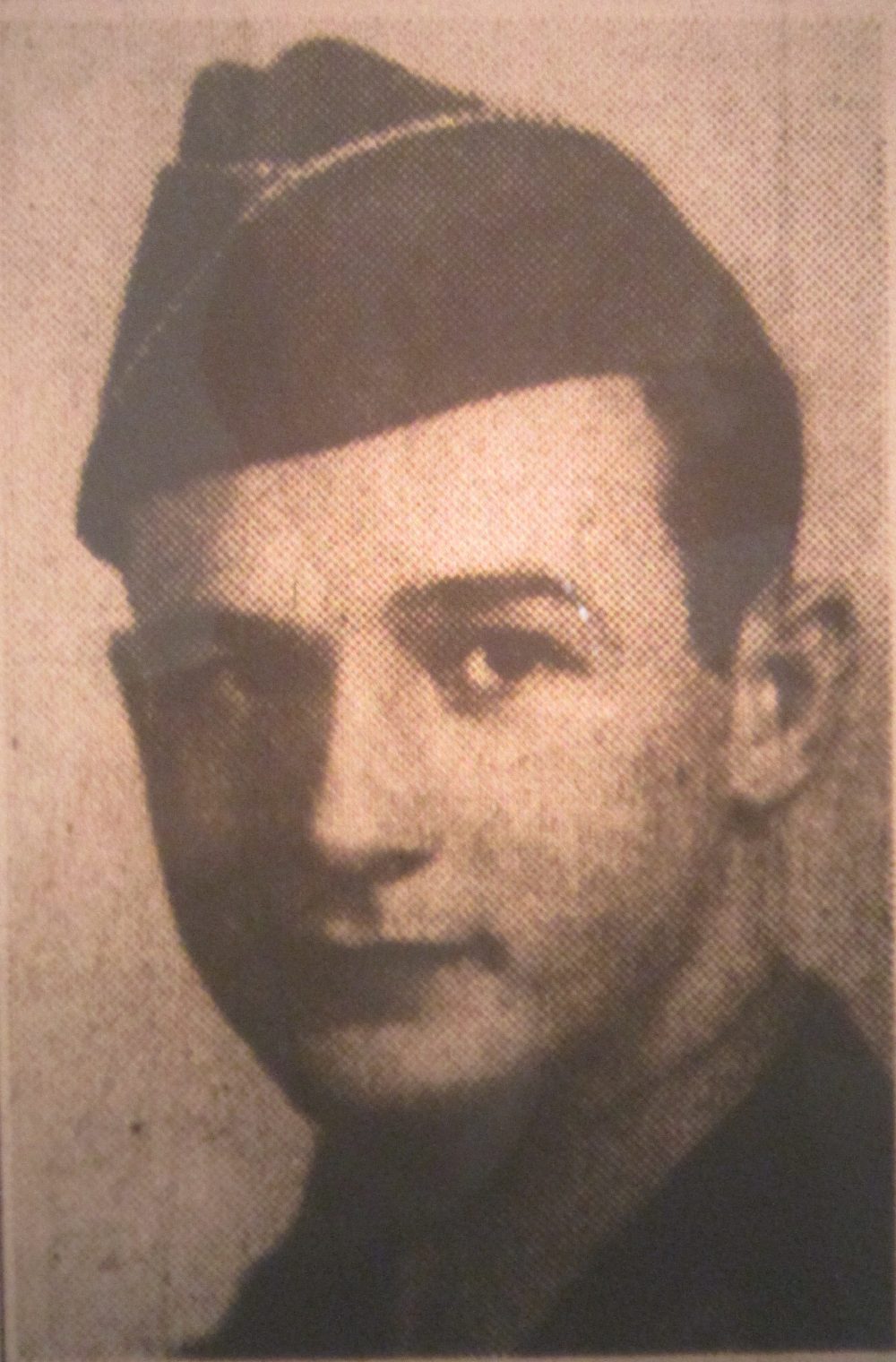
Technician Fourth Class Raymond S. Wittbrodt
Early Life
Raymond Wittbrodt grew up as the third son of five children in a Catholic home in Flint, Michigan. Born in 1920 to an autoworker, he attended St. Michael High School in Flint and graduated in 1939.
He worked for the Flint Journal and Flint News Advertiser circulation department from June 1937 until September 1940. He also worked for the Buick Motor Company.
Wittbrodt’s two older brothers served the United States during the war. His oldest brother, Andrew, served in U.S. Navy. The other, Anthony, served in the U.S. Army. Both siblings came home after the war.
In August 1942, Wittbrodt enlisted in the U.S. Army. In December, he requested a transfer to the paratrooper division. At about this time, he became engaged to Mary West.
Military Experience
In December 1942, Wittbrodt learned that he was in training for the 1st Special Service Force (FSSF). This elite American-Canadian commando unit fought behind enemy lines. The unit accepted single men who volunteered with at least three years of high school. They arrived at an unknown training camp; the train windows had been painted.
Three regiments of 385 men each comprised the FSSF. A demanding training schedule forced them to learn parachuting, weapons, demolition, unit tactics, problem solving, skiing, rock climbing, and how to fight in a cold climate. Wittbrodt also went on long training hikes, including a 60-mile course.
The FSSF became known for their spearhead shoulder insignia which connected a horizontal USA and vertical CANADA. One could only separate the Americans from the Canadians by the color of the disc on their uniform. The two armies bonded together through their dedication and training.
Aleutian Islands, 1943
In July 1943, the FSSF first saw action as the invasion force for the Aleutian Islands in Alaska to fight the Japanese. However, during the invasion, they discovered that the Japanese had retreated.
Italy, 1943
Wittbrodt sailed with the FSSF to Morocco in November 1943 and later arrived in Naples, Italy. The unit served on the front lines with the 36th Infantry Division. The FSSF had two objectives: take the German positions on the mountains Monte la Difensa and Monte la Remetanea. Both of these locations were key points on Hitler’s Gustav Line, which protected the city of Rome.
The well-defended line held commanding views of the roads and valleys below. To take Monte la Difensa, the FSSF had to scale the steep mountain. The Germans believed no one would try to climb the high cliffs. Wittbrodt’s regiment supplied the assault and was held in reserve.
By December 4, 1943, the assault succeeded after several hours, and FSSF took Monte la Difensa. The FSSF took Monte la Remetanea (Hill 907) on December 9 at a great cost. The FSSF suffered 511 total casualties, which comprised 77% of the force.
Anzio Beachhead, 1944
One month later, the FSSF moved from the mountains to help with the invasion of Anzio (Operation Shingle). At the Anzio beachhead, the Allies faced 70,000 Germans and Italians. The FSSF held the right side of the beachhead along the Mussolini Canal and Pontine Marshes. Wittbrodt’s regiment held two-thirds of the line in that area.
The FSSF patrolled and conducted covert invasions across the German lines. At Anzio, the Germans first referred to the FSSF as “The Black Devils” because they smeared their faces with black shoe polish and because after attacks they left trademark stickers that read “Das dicke Ende kommt noch” (“The Worst is Yet to Come”).
During the invasion, Wittbrodt was hospitalized for jaundice. In February, Wittbrodt transferred to a hospital in Naples where he spent almost two months recovering. On May 23, 1944, he sent his last letter home. After returning to the lines, he participated in the breakout from Anzio and was killed in action near Rome on May 29, 1944.
Eulogy
Wittbrodt’s parents officially learned of his death on June 27. A letter from a wounded member of his regiment arrived soon afterward. St. John Vianney Church in Flint held a memorial mass for him. Today he rests in the Sicily-Rome American Cemetery in Nettuno, Italy.
Adleman, Robert H., and Colonel George Walton. The Devil’s Brigade. Annapolis: Naval Institute Press, 1966.
Burnhans, Lt. Col. Robert D. The First Special Service Force: A War History of the North Americans, 1942-1944. Washington: Infantry Journal Press, 1947.
“Flint Ski Paratrooper and Marine Corporal Die: Sgt. Raymond Wittbrodt is Victim Near Rome May 29.” The Flint Journal, June 29, 1944.
Hicks, Anne. The Last Fighting General: The Biography of Robert Tryon Frederick. Atglen: Schieffer Military History, 2006.
Horn, Bernd and Michel Wyczyski. Of Courage and Determination: The First Special Force, “The Devil’s Brigade,” 1942-1944. Toronto: Dundurn, 2013.
Michigan. Genesee County. 1930 U.S. Census. Digital Images. ancestry.com.
Nadler, John. A Perfect Hell: The True Story of the Black Devils, The Forefathers of the Special Forces. New York: Ballantine Books, 2006.
“Raymond Wittbrodt.” American Battle Monuments Commission. Accessed November 5, 2015. www.abmc.gov/node/428441.#.V2UgrBVRH58.
Ross, Robert Todd. The Supercommandos: First Special Service Force: 1942-1944, An Illustrated History. Atglen: Schieffer Military History, 2000.
Sheehan, Mary. Telephone interview by the author. December 22, 2015.
Special Services; World War II Operations Reports, 1941-1948, Records of the Adjutant General’s Office, 1917-, Record Group 407 (Box 18484); National Archives at College Park, College Park, MD.
Special Services; World War II Operations Reports, 1941-1948, Records of the Adjutant General’s Office, 1917-, Record Group 407 (Box 18486); National Archives at College Park, College Park, MD.
Special Services; World War II Operations Reports, 1941-1948, Records of the Adjutant General’s Office, 1917-, Record Group 407 (Box 18487); National Archives at College Park, College Park, MD.
Special Services; World War II Operations Reports, 1941-1948, Records of the Adjutant General’s Office, 1917-, Record Group 407 (Box 18489); National Archives at College Park, College Park, MD.
Springer, Joseph A. The Black Devil Brigade: The True Story of the First Special Service Force in World War II. Pacifica, California: Pacifica Military History, 2001.
Werner, Bret. First Special Service Force 1942-1944 (Elite). Long Island City, New York: Osprey Publishing, 2006.
Ibid. Storming Monte La Difensa: The First Special Service Force at the Winter Line, Italy 1943. New York: Osprey Publishing, 2015.
Wittbrodt Family Photographs. 1943-1945. Courtesy of Mary Sheehan and Family.
This profile was researched and created with the Understanding Sacrifice program, sponsored by the American Battle Monuments Commission.
Contributor
Contributed by Mr. Jim Goodspeed
Fulton High School
2015-2016
