


The Paul Cret Collection
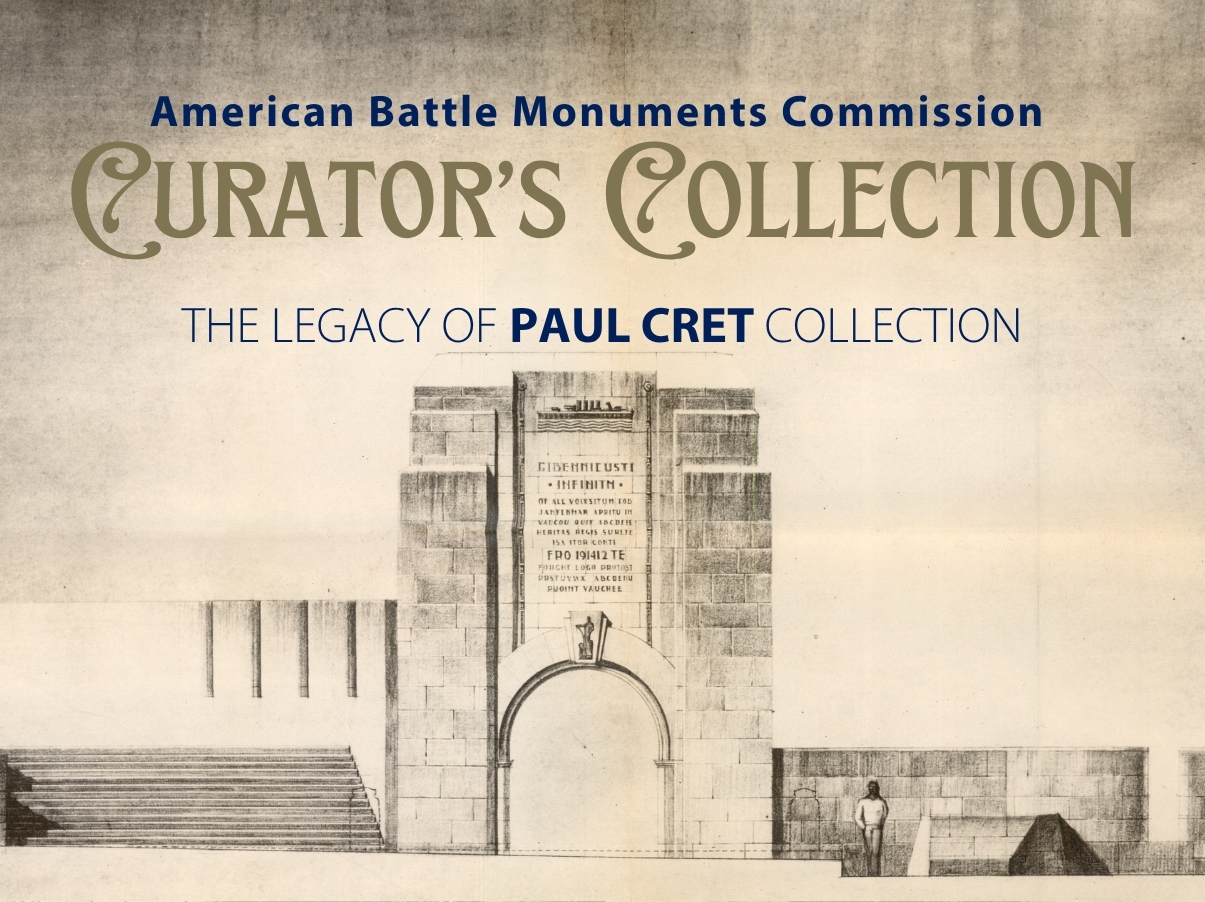
This Curator’s Collection highlights Dr. Paul Philippe Cret, the French-born architect who became ABMC’s first consulting architect in 1925. Born in Lyon, France, Cret came to the United States in 1903 to teach at the University of Pennsylvania and built a distinguished career designing government buildings, hospitals, monuments, bridges, dams, and military installations.
Before his work with ABMC, Cret designed the National Memorial Arch at Valley Forge, built between 1914 and 1917, to commemorate Gen. George Washington and the Continental Army’s arrival and sacrifice during the winter encampment of the Revolutionary War. His use of classical forms connected America’s founding-era memory with a broader tradition of national tribute.
Cret’s life and work also intersected directly with World War I. He served in the French Army’s Chasseurs Alpins and later as an interpreter attached to the American Expeditionary Forces. After the war, his architectural vision helped ABMC commemorate the American fallen in France through monuments that balanced dignity, classical design, and deep historical meaning.
These portraits introduce Dr. Paul Philippe Cret, ABMC’s first consulting architect. A French-born architect who established his career in the United States, Cret brought both European classical training and firsthand wartime experience to his commemorative work.
Designed by Cret and built between 1914 and 1917, the National Memorial Arch commemorates the arrival and sacrifices of Gen. George Washington and the Continental Army at Valley Forge. The monument connects Cret’s work to America’s Revolutionary War legacy and the ideals later reflected in ABMC’s America 250 programming.
Cret’s experience in World War I shaped his later commemorative designs. After serving with the French Army and the American Expeditionary Forces, he was asked to design memorials that reflected sacrifice, service, and the shared wartime memory of France and the United States.
As ABMC’s consulting architect, Cret helped establish the visual language of America’s overseas commemorative sites after World War I. His designs emphasized permanence, restraint, and reverence while honoring the American service members who never returned home.
These molds are part of a multi-part high-relief plaster sculpture depicting two female figures, symbols of France and the United States, holding hands. The piece includes upper sections with busts and heads, lower body sections, and joined hands, with pointing nails and graphite inscriptions identifying “Woman symbol of US (Château-Thierry)” and “Woman symbol of France (Château-Thierry).”
