An official website of the United States government. Here's how you know.


 Countdown to





This World War I Battlefield Tour includes Google Maps links at each stop. Travel along virtually or map the full route and take a drive along this historic battlefield route in France.
‘Retreat? Hell, we just got here!’
By the spring of 1918, many American troops were training in France. French and British commanders wanted the Americans committed to battle as soon as possible. Gen. John J. Pershing, commander of the American Expeditionary Forces, withheld his troops from combat. He believed that they needed additional training before they engaged in combat. Pershing wanted his troops to engage the enemy at the front as an independent field army. A series of offensives by the German army that spring changed the situation.
The Germans recognized that the weight of American reinforcements might break the stalemate on the Western Front that had endured for more than three years. In March 1918, they launched a series of attacks intended to bring the Allies to the negotiation table before the Americans arrived in force. The German spring offensives were a shock to the French and British command, who renewed their pressure for the early deployment of American divisions. When the German advance threatened to cross the Marne River northeast of Paris, Pershing relented.
The third German spring offensive began with the secret concentration of the German Seventh and First Armies behind the front line in the hills between the cities of Soissons and Laon. This was a much contested area known as the Chemin des Dames. The Germans, with reserves of divisions freed from service on the Eastern Front after Russia left the war, reorganized their forces into assault divisions, line divisions, and divisions primarily for defense. In addition, reserves of heavy artillery were organized for decisive use in critical operations. Behind the front, the critical north-south rail line brought the guns and men to the Chemin des Dames. The French Sixth Army was concentrated in forward positions to hold ground recaptured in 1917.
On the morning of May 27, 1918, more than 4,000 German artillery pieces opened a bombardment on the densely concentrated French army. Then 17 elite assault divisions drove deeply into the French lines, breaking up the defense. Allied lines broke on a 40 km front. They lost some 50,000 men, and 800 artillery pieces were captured. The Germans advanced more than 16 km in the first day across the Aisne River to the valley of the Vesle River. By June 4, they had driven almost 50 km to the town of Chateau-Thierry on the Marne River, 80 km from Paris. Responding to urgent pleas from the French, Pershing ordered the American 2nd and 3rd Divisions into the line in relief of the French Sixth Army. These divisions were made up of Regular Army regiments, as well as a brigade of Marines in the 2nd. When questioned by the French commander about the readiness of the American troops, Col. Preston Brown, 2nd Division chief of staff, responded, “General, these are American regulars. In 150 years they have never been beaten. They will hold.”
On June 1, the 2nd Division took up positions northwest of Chateau-Thierry from around Lucy-le-Bocage and Belleau Wood extending south to the area west of Vaux. The 3rd Division had stalled the German attack at Chateau-Thierry. A French officer retiring with his troops through the 2nd Battalion, 5th Marine Regiment suggested to Capt. Lloyd Williams that the Marines should also retire. Williams replied, “Retreat? Hell, we just got here!”
The Germans were consolidating positions from Hill 142 through Torcy-en-Valois to Belleau Wood and Bouresches and south to Monneaux with mortars, light artillery, and machine guns.
On June 4, Germans attacked the Marines around Lucy-le-Bocage and Les Mares Farm and were repulsed with heavy losses. The French XXI Corps ordered the 2nd to retake Belleau Wood on June 6. The 2nd Division’s Marine Brigade attacked on a front from Hill 142 to Bouresches south of Belleau Wood suffering heavy casualties. The Marines took Hill 142 overlooking Belleau Wood from the west and held it against counterattacks. They assaulted Belleau Wood across a wheat field under German machine gun fire. The Marines attacked and took Bouresches and dug in against German counterattacks. A back-and-forth battle ensued for days. Subjected to poison gas and artillery fire, both sides fought stubbornly.
On June 9, Americans withdrew from Belleau Wood for a heavy American and French artillery bombardment. The shelling stripped the hunting preserve of its foliage, leaving a tangle of fallen trees. On June 11, following the bombardment, Marines pressed hard into the wood capturing the southern two-thirds. From June 16-20, the Army’s 7th Infantry Regiment relieved the exhausted Marine brigade. On June 23, the Marines launched a major attack but were unable to gain ground. Suffering staggering losses, they required over 200 ambulances to evacuate the wounded. Two days later, Belleau Wood was subjected to a 14-hour bombardment by French artillery. After that the Marines were finally able to clear the wood. On June 26, after defeating some early morning German counterattacks, Maj. Maurice Shearer reported, “Woods now entirely–U.S. Marine Corps.”
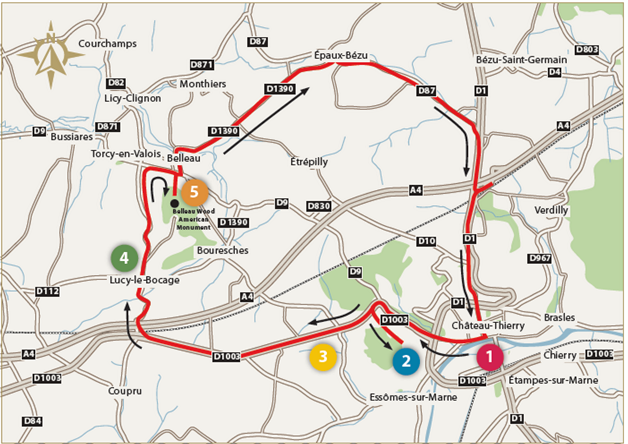
Stop 1 – Chateau-Thierry
The monument next to the parking lot is that of the American 3rd Division that stopped the German advance here on the banks of the Marne River. The original monument, destroyed during WWII, was just east of the tourist office in the traffic circle by the bridge. After passing the monument, go to the riverside at a crosswalk.
On June 1, 1918, when German troops reached the town, it was defended by a force of the French 10th Colonial Infantry Division and Company A, 7th Machine Gun Battalion, 3rd Division. Outnumbered, they were pushed back to the riverbank. One German patrol rushed the bridge. When they were repulsed at a barricade, French engineers blew half the bridge into the river. The 7th Machine Gun Battalion fired from the alleyways and gardens on the south bank, covering American and French troops who swam the Marne or crossed the rail bridge upstream. Other elements of the 3rd arrived with French reinforcements to reestablish the front line on the south bank.
Down river to the west you can see the Chateau-Thierry American Monument. The monument sits on Hill 204, which was the next objective of the German drive.
Stop 2 – Chateau-Thierry American Monument
The Chateau-Thierry American Monument commemorates the service of those Americans and French who fought in this region. It is a lasting symbol of the bonds of friendship and cooperation between French and American forces. This commanding height became the focus of action after the Marne River bridges were destroyed. From June 1 to July 9, 1918, the hill was contested for its excellent observation of the surrounding country. From the monument, you can see the Marne crossings. Trenches beyond the woods behind the monument looked down on sloping vineyards to the southwest. The height dominates Chateau-Thierry to the east and Vaux to the west. You will notice vineyards below its southern slopes. Belleau Wood is 7 km over the hills to the northwest. By holding Hill 204 and Chateau-Thierry, the German army cut the main route from Paris to Reims and beyond to Verdun. Parts of the hill exchanged hands many times until it was finally retaken by the French 39th Division in mid-July.
Stop 3 – Vaux
Look back across the valley to Hill 204. It dominates the local terrain. German artillery spotters could easily target an exposed area like this stop. Before the first American attack on Hill 204, they seized the village of Vaux – the closest the German offensive came to Paris on this road. Vaux is a classic wine-producing village of the region with strong stone structures and ample storage cellars. To the left of the town is the Bois de la Roche. The American 2nd Division attacked Vaux down the axis of this road on July 1, 1918.
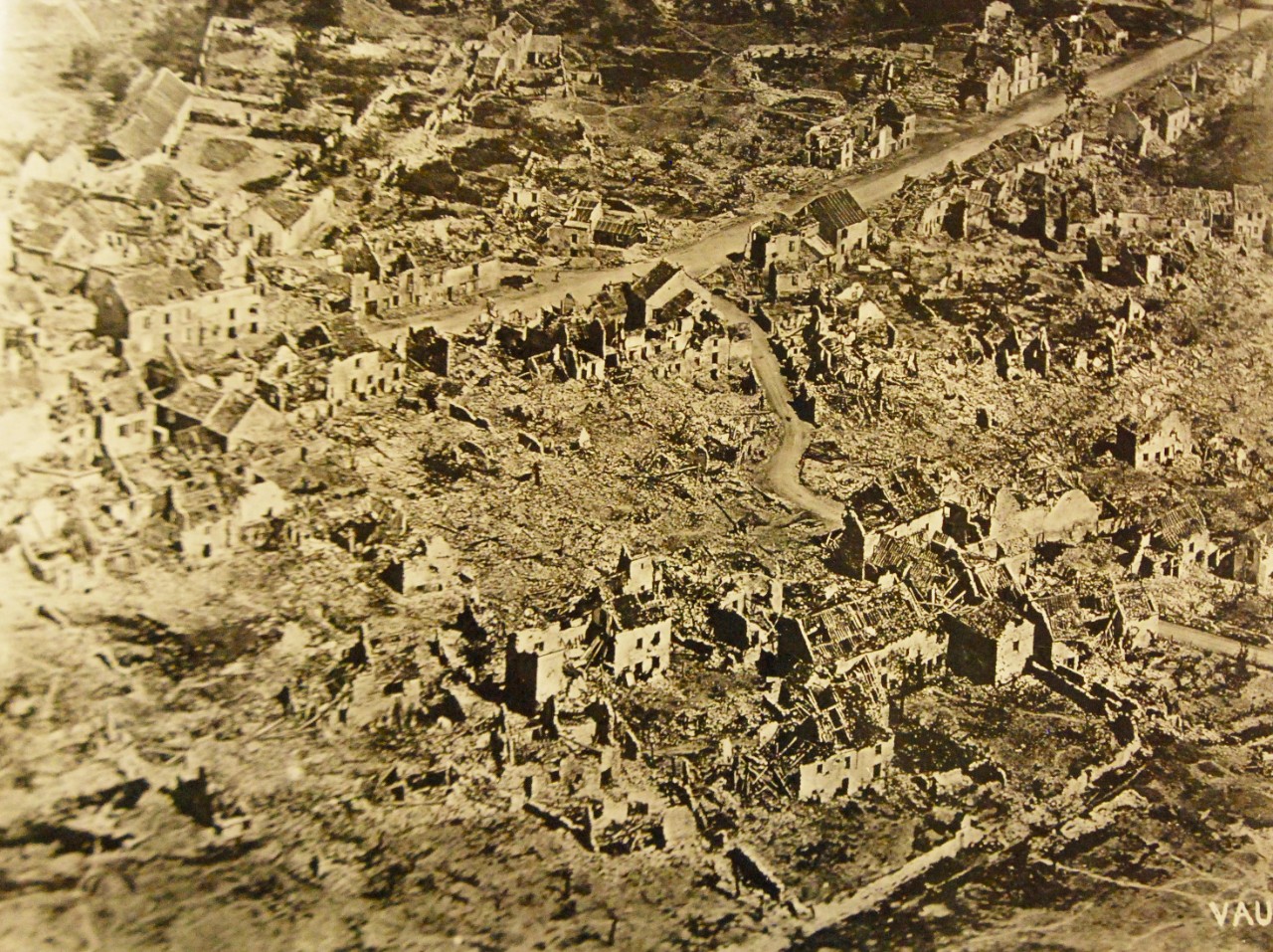
American Intelligence interviewed refugees of Vaux for details on every house and wine cellar. Famous American photographer Maj. Edward Steichen provided aerial images to map the town accurately. Twenty-one American and French artillery batteries bombarded the town methodically for a day before the attack at 6 p.m. on July 1. The artillery put down two barrages to suppress defenders and conceal the attack. A standing barrage fell behind Vaux and the Bois de la Roche to cut off German reinforcements. Immediately east of this stop a rolling barrage fell, moving about 90 meters eastward every two minutes. American infantry and engineers followed behind it closely. They attacked Vaux’s strongpoints and cellars with explosives before the Germans could react. The left flank attacked and occupied the Bois de la Roche. The shattered town was captured by Americans in an hour, along with many machine guns and dazed German soldiers. American reinforcements arrived promptly. They refortified the eastern edges of the ruins of Vaux and the Bois de la Roche immediately. The new defenses withstood a German counterattack on July 2.
Stop 4 – Belleau Wood and Lucy-le-Bocage
The forest to your east is the south end of Belleau Wood. On June 4, 1918, the Germans attacked Lucy-le-Bocage across these fields from the north and east. They were repulsed by the rifle fire of Marines of the American 2nd Division in Lucy and Les Mares Farm.
On June 6, Marines attacked Belleau Wood from Lucy-le-Bocage; some crossed these fields to the southern wood and others down this road toward the northern wood. Repulsed from the northern wood, they took positions west of the road in the Bois de Bruyeres. At the same time, other Marines advanced east from Lucy-le-Bocage to secure the south side of Belleau Wood by capturing the village of Bouresches.
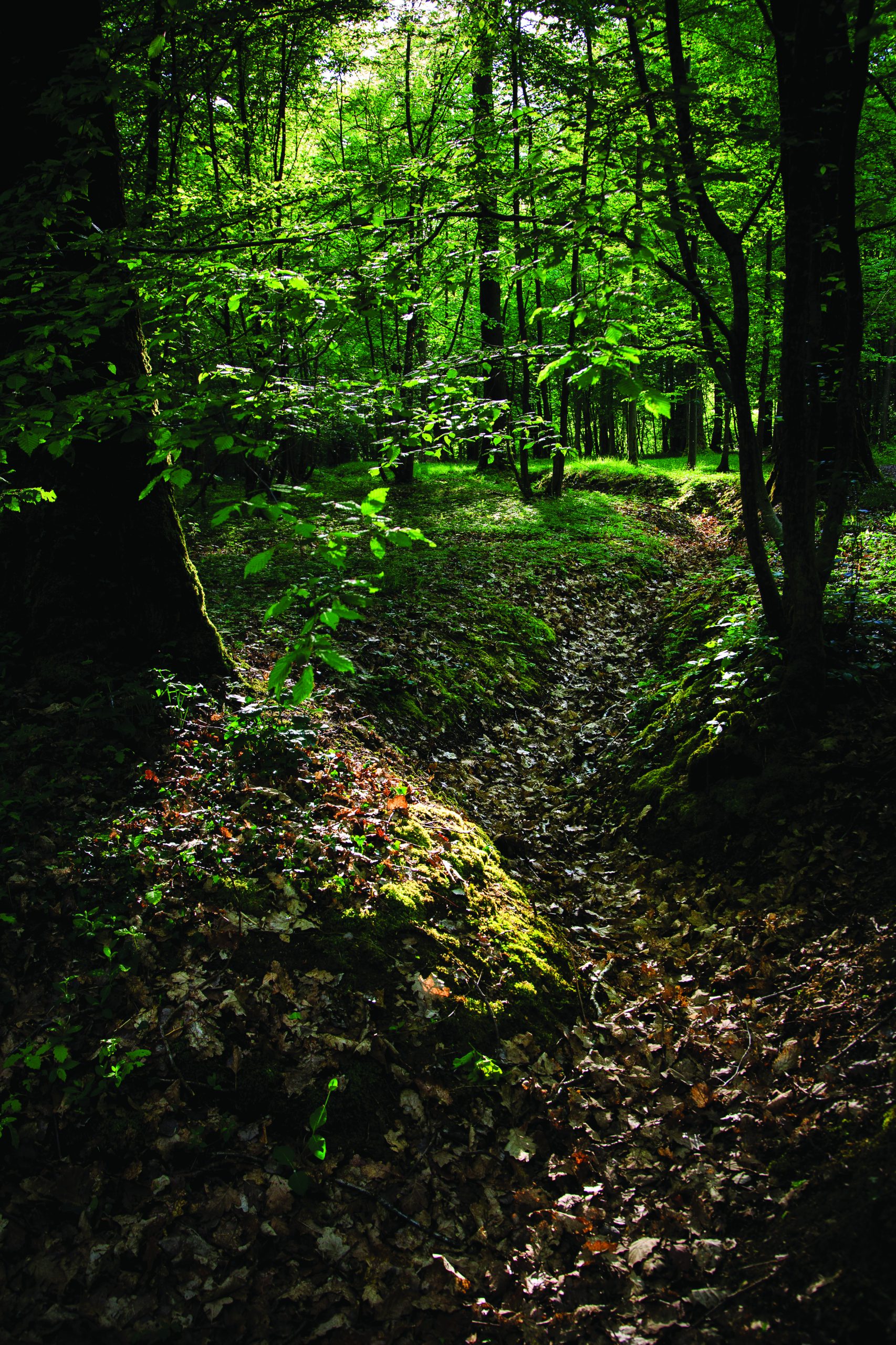
Stop 5 – Aisne-Marne American Cemetery and Belleau Wood
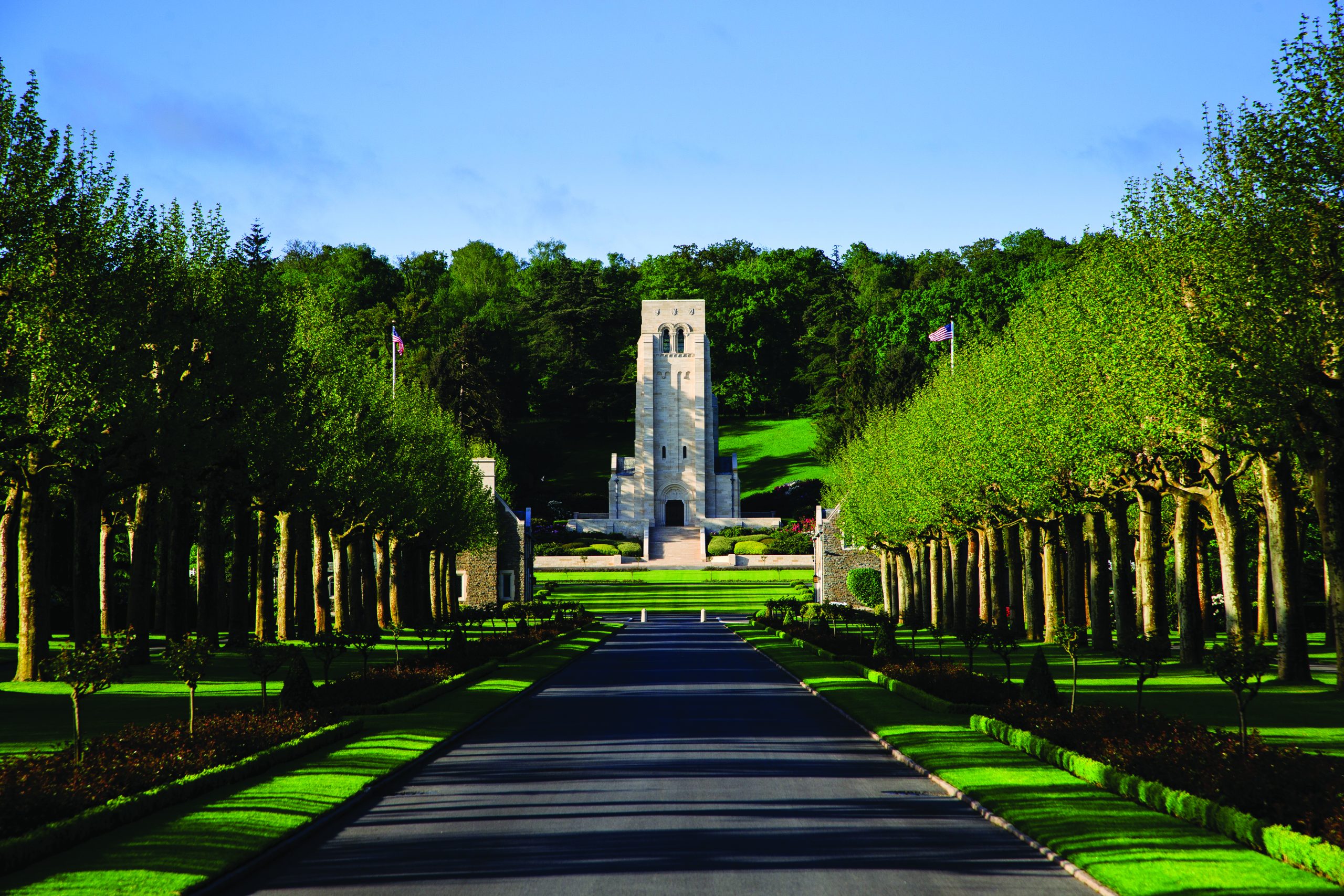
The Aisne-Marne American Cemetery rests at the foot of slopes that rise into Belleau Wood. Approaching the chapel, the two large plots of the cemetery come into view curving away left and right around the hill. There are nearly 2,300 Americans buried here, most of whom were casualties of the fighting in this region in the summer of 1918. Among those interred are more than 200 whose identity is unknown. On the Walls of the Missing in the chapel are the names of more than 1,000 missing. A rosette next to a name indicates the remains of the service member have been recovered and identified.
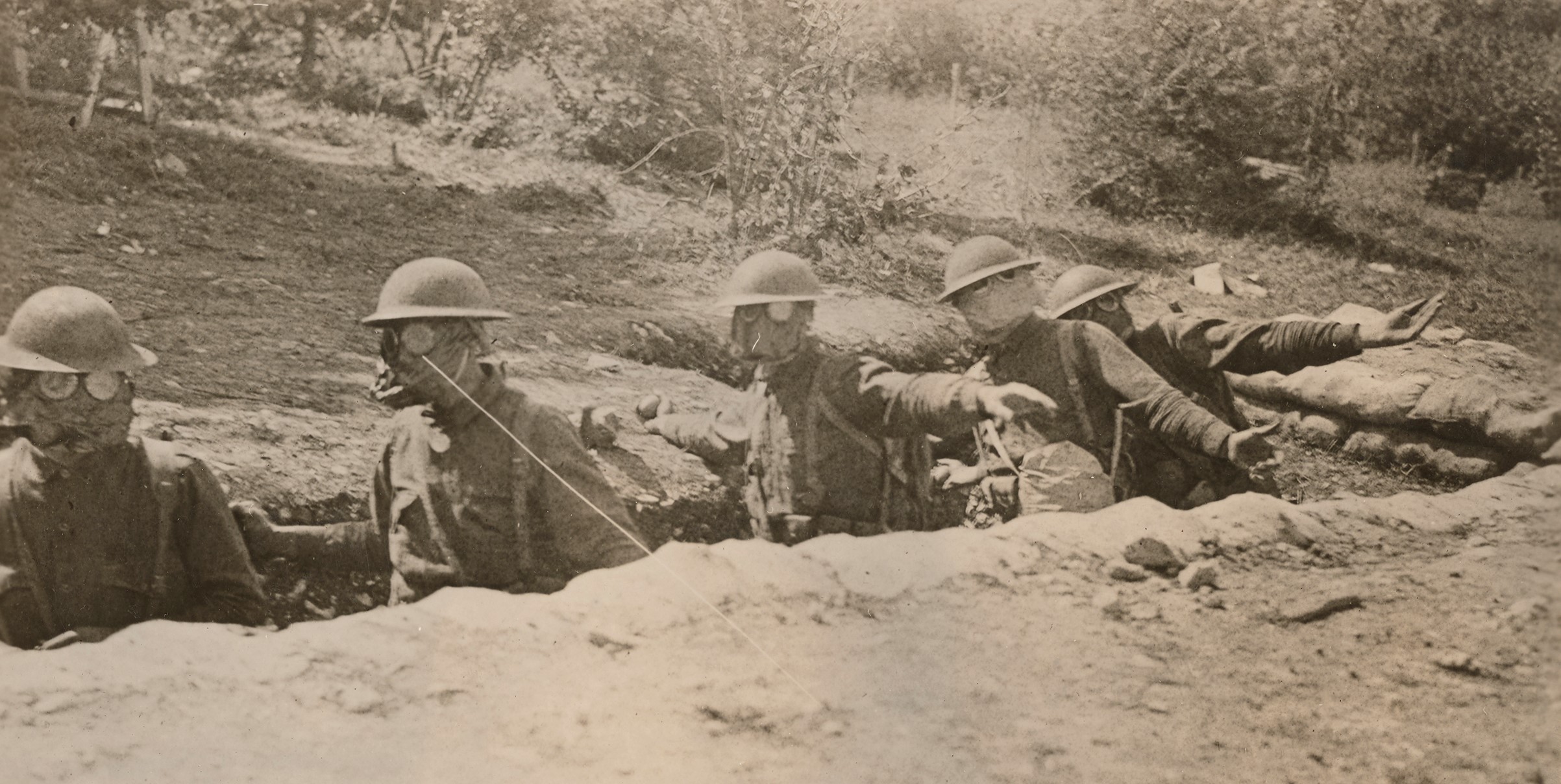
The Marine memorial is in the middle of Belleau Wood surrounded by the remains of German artillery of the era. Belleau Wood is perhaps the most famous battle in the history of the U.S. Marine Corps. The 5th and 6th Marine Regiments and the Marine’s 6th Machine Gun Battalion took a central part in the fighting as a brigade of the U.S. Army’s 2nd Division. Walking in Belleau Wood, it is best to reflect that this was a heavily wooded hunting reserve before World War I. The damaged stone tower was a lodge from which hunters shot passing game through second story windows. Heavy fighting in Belleau Wood lasted from June 6-26, 1918. In the forested area, maneuvering was difficult and vision was restricted at ground level after shelling shattered the trees. Both German and Allied artillery made frequent use of poison gas. American soldiers and Marines fought in the heat of summer in gas masks, buttoned up in uniform to avoid burns from mustard gas.
Map this route: https://maps.app.goo.gl/kyY1AURXMBu2iUqC8
Download a PDF of ABMC’s full World War I Battlefield Companion.